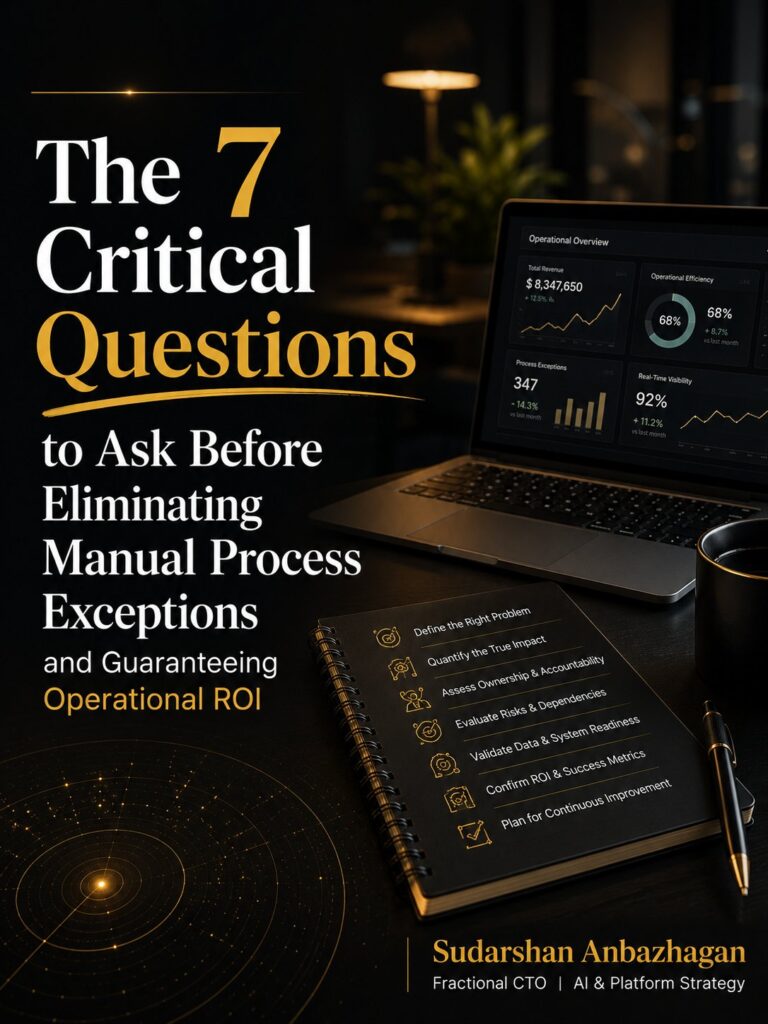

7 Critical Questions to Ask Before Eliminating Manual Process Exceptions and Guaranteeing Operational ROI
Every operations leader I have worked with across 14 countries over the past 15 years has faced the same moment: a manual process exception is on the table, someone in the room is eager to eliminate it, and the pressure to act quickly is real. The urgency is understandable. The cost of inaction looks obvious. The solution feels straightforward. But what happens in the next 90 days after that decision tells a very different story. Operations that guarantee ROI do not move fast on instinct. They move with precision, and precision begins with seven specific questions that most teams never formally ask before launching a process elimination initiative.
What separates operations that deliver measurable, sustained ROI from those that endlessly revisit the same problems is not technology, budget, or team size. It is the discipline to interrogate every manual exception before touching it. I have seen teams automate over flaws they did not understand, eliminate processes that were serving critical edge cases, and celebrate efficiency gains that quietly destroyed downstream reliability. The cost of those mistakes was never recorded as a process failure. It showed up as customer trust erosion, audit findings, and leaders losing confidence in future modernization investments. That is the real price of skipping the right questions.
This is not a framework designed for operations analysts or project managers. This is a decision filter for C-suite leaders who are accountable for the outcome. Whether you are a COO evaluating an automation roadmap, a CTO advising on system redesign, or a CEO asking whether the projected ROI is real, these seven questions will protect your investment, accelerate your timeline, and give you a clear foundation for proving value before and after the work is done.
Question 1: Why Does This Manual Process Exception Actually Exist?
Every manual workaround in your operation has an origin story, and that story contains the most important information you will ever find about whether elimination is the right answer. When a team member manually overrides a system entry, when a supervisor handles an exception that the workflow was supposed to catch, or when a parallel spreadsheet is quietly maintained alongside the official system, it almost never happened by accident. Someone, at some point, encountered a situation that the original system could not handle, and they created a workaround that worked. That workaround became a habit, the habit became a process, and the process became invisible infrastructure that nobody questions anymore.
The question is not simply “why does this exist today.” The question is “what was the original system gap, business rule, regulatory constraint, or customer requirement that made this workaround necessary in the first place.” Until you have a verified answer to that question, you are not ready to eliminate anything. I have led technology transitions where the exception that looked most redundant turned out to be compensating for a calculation error in the core system that had never been fixed. Eliminating the workaround would have silently introduced that error back into live operations. The cost of discovering that six months later, in production, would have been orders of magnitude higher than the time spent answering this one question upfront.
The operational leaders who guarantee ROI treat every exception like an archaeologist treats an artifact. They do not discard it because it looks old or inefficient. They study it, understand what conditions created it, and then determine whether those conditions still exist. If they do, the elimination plan must address them. If they no longer exist, the workaround can be confidently retired. Either way, the decision is grounded in verified knowledge rather than assumptions about the past.
How Frequency Data Defines Your Process Elimination Priority
Question 2 asks: how often does this exception actually happen? And the emphasis on “actually” is deliberate, because assumption-based frequency estimates are one of the most common sources of misallocated operations investment I have ever encountered. Teams routinely overestimate how frequently certain exceptions occur because the team members handling them experience them as disruptive and memorable, which creates a cognitive bias toward inflating their perceived frequency. Conversely, teams frequently underestimate exceptions that are so routine they have become invisible, handled automatically by experienced team members without any formal documentation or complaint.
Frequency determines priority in a way that nothing else can replicate. An exception that occurs 200 times per day consumes vastly different resources than one that occurs three times per quarter, and yet both might appear on the same elimination roadmap if the frequency data has not been measured. The ROI calculation for these two scenarios is not slightly different. It is fundamentally different. Eliminating the high-frequency exception delivers compounding returns from day one. Eliminating the low-frequency exception may deliver savings that do not justify the redesign cost for years, or ever.
Measuring actual frequency requires going to the source data rather than asking the people who handle the exceptions. System logs, ticket volumes, escalation records, and manual tally sheets kept by operations staff are all more reliable than verbal estimates from team members who are close to the work. I consistently advise operations leaders to spend one to two weeks collecting this data before any elimination decision is made. That investment almost always changes the priority order and frequently reveals that the exception most loudly advocated for elimination is not the one with the greatest ROI potential. The data leads you to the right answer. Assumption leads you to the convenient one.
Ownership Accountability and the Process That Is Already Broken
Question 3 is the one that generates the most discomfort in the room: who owns this exception right now? Discomfort is productive here. If the answer takes more than 30 seconds to establish with certainty, you have already discovered something critical. A manual process exception with no clear, named owner is not just an efficiency problem. It is a governance problem. And governance problems do not get solved by automation. They get embedded more deeply into systems that are harder to examine and correct.
Clear ownership means one person or role is accountable for the quality, accuracy, and outcome of every instance of this exception. That person knows when an instance occurs, knows the criteria for handling it correctly, and can be held accountable if it is handled incorrectly. When that clarity does not exist, the exception is being managed through collective informal knowledge, which means its handling quality varies based on who is available, how experienced they are, and what else is competing for their attention on a given day. That variability is the source of most downstream failures in operations, and eliminating the exception without first establishing ownership means you are solving for efficiency while leaving the governance gap intact.
I have seen operations teams launch automation initiatives on unowned processes and then spend twice the original budget diagnosing why the automated process produces inconsistent outputs. The answer, in almost every case, is that the rules for handling edge cases within the exception were never formally documented because no one person had the full picture. The automation faithfully reproduced the inconsistency that was already in the manual process, at higher speed and at larger scale. Establishing clear ownership before elimination is not a bureaucratic formality. It is the precondition for any automation producing reliable results.
Understanding Downstream Impact Before You Touch a Single Exception
Question 4 is where operations leaders earn or lose the trust of their broader organization: what breaks downstream if this process goes wrong after elimination? The answer to this question is almost never found in the same place where the exception lives. The real cost of a failed exception elimination is three, four, or five steps downstream from the original change, in a system or team that may not even be part of the initial conversation. This is the nature of interconnected operations: impact rarely stays where you put it.
Mapping downstream dependencies before any elimination begins is a discipline that separates high-maturity operations from those that are perpetually managing the fallout from well-intentioned changes. This mapping does not need to be exhaustive on day one, but it must answer three specific questions with confidence. First, which systems receive data or signals from this process, and how would they behave if the format, frequency, or content of those inputs changed? Second, which teams or roles make decisions based on outputs from this process, and what decisions would they be unable to make, or would make incorrectly, if the process were disrupted? Third, which compliance, audit, or regulatory requirements touch this process, and what documentation or evidence chain would be affected by its elimination?
The investment in answering these questions before acting pays for itself many times over in avoided remediation costs. In my experience leading operations modernization engagements, the teams that map downstream impact rigorously are the teams that hit their ROI targets on schedule. The teams that treat this as optional are the teams that discover, three months post-launch, that a reporting feed to finance or a data dependency in customer service has been silently broken since day one. Fixing those issues after the fact is expensive, damaging to organizational confidence, and entirely avoidable.
Recognizing When an Exception Is Hiding a Deeper System Gap
Question 5 is the most intellectually demanding of the seven, and the one that has the greatest long-term impact on whether your operations platform remains healthy over time: is this exception hiding a deeper system gap? The distinction matters enormously. An exception that exists because a specific edge case is genuinely rare and easily managed manually is a candidate for efficient elimination. An exception that exists because the underlying system has a structural gap in its data model, its business rules, or its integration architecture is a warning signal, not an efficiency opportunity. Automating over a structural gap does not fix it. It makes the gap permanent and increasingly expensive to address later.
Structural gaps reveal themselves through specific patterns. If the same type of exception recurs across different products, customers, or time periods despite previous attempts to reduce it, the exception is symptomatic rather than standalone. If the exception requires a team member to consult information from a system that the main workflow does not have access to, there is likely an integration gap that the manual step is bridging. If the exception involves applying a business rule that is not encoded anywhere in the system and exists only in the institutional knowledge of experienced staff, there is a business logic gap that will create reliability problems the moment any of those staff members leave the organization.
The right response to a structurally symptomatic exception is not faster elimination. It is a deliberate redesign that addresses the root gap first, then builds the automated process on a corrected foundation. This takes more time upfront. It consistently produces more durable results, and it eliminates the risk of discovering, well into an automation rollout, that the system you built cannot handle the very cases your team handles manually every day. The governance frameworks that protect against this risk are not complicated, but they require the discipline to ask this question before committing to an elimination path.
Evaluating Whether the System Can Handle Edge Cases Without Human Judgment
Question 6 challenges one of the most common assumptions in process automation: the assumption that every exception should be eliminated. Not every exception should be eliminated. Some exceptions exist precisely because they require the kind of contextual human judgment that no current system can replicate reliably, and attempting to automate them introduces risk that far outweighs the efficiency benefit. The goal of this question is to distinguish clearly between exceptions that are inefficient and exceptions that are necessary, because the path forward for each is completely different.
The test for whether a system can genuinely handle an edge case without human involvement has three components. First, can the exception be defined with a complete and stable set of rules that cover every scenario without requiring interpretation? If the rule set requires qualitative judgment, contextual awareness, or the ability to recognize patterns that are not explicitly enumerated, the system will either fail on edge cases or produce outputs that require human review anyway. Second, does the cost of an error in the automated handling of this exception justify the risk of removing human oversight? In regulated environments, customer-facing processes, and financial operations, the answer to this question will sometimes be no regardless of technical feasibility. Third, is the volume and frequency of this exception high enough that the efficiency gain from automation exceeds the cost of designing, testing, and maintaining the automated solution? For low-frequency, high-judgment exceptions, redesign rather than elimination is almost always the more economically sound choice.
Redesigning an exception means engineering a better process that still involves human judgment at the critical decision points while eliminating the unnecessary manual steps that surround that judgment. This approach is consistently undervalued in process improvement initiatives because it does not generate the headline efficiency numbers that full elimination does. But it produces more reliable operations, better risk management, and a system architecture that remains trustworthy when genuinely unusual situations arise. The operations teams I have worked with that maintain this discipline are the ones whose leaders sleep well when audit season arrives.
Defining Success Metrics Before You Start to Guarantee Operational ROI
Question 7 is the one that determines whether all of the previous work translates into provable, defensible value: what does success look like after this exception is gone, and how will you measure it before and after? If you cannot answer this question with specific, measurable metrics before you begin, you cannot prove ROI at the end. This is not a philosophical position about metrics. It is a practical reality about how investment decisions are evaluated and how organizational confidence in future modernization efforts is built or destroyed.
Defining success metrics before elimination requires establishing a clear baseline that captures the current state in quantifiable terms. That baseline must include the direct cost of handling the exception, measured in staff time, error rate, and processing volume. It must include the indirect cost, measured in the downstream decisions that are delayed or degraded by the exception. And it must include the quality dimension, measured in the accuracy and consistency of outputs from the current manual process. Without this baseline, any post-implementation measurement is measuring change from an unknown starting point, which makes it impossible to isolate the impact of the specific change you made from other variables that were also changing during the same period.
The success metrics themselves must be owned by a named individual who is committed to measuring and reporting them at defined intervals after implementation. Metrics without ownership produce one measurement at launch and then quietly disappear from reporting. Metrics with ownership become the foundation of a continuous improvement cycle that compounds value over time. This is the difference between an operations team that completes a project and an operations team that builds a track record of guaranteed ROI. The operational leaders who consistently deliver on their ROI commitments are the ones who treat measurement design as part of the project scope, not as an afterthought once the solution is live.
The Seven Questions as an Operations Investment Filter
Taken together, these seven questions form a decision filter that every process elimination initiative deserves to pass through before any resources are committed. They are not a bureaucratic checklist. They are a structured way of ensuring that the decision to eliminate a manual process exception is grounded in verified knowledge about why the exception exists, how often it occurs, who owns it, what it affects downstream, whether it is symptomatic of a deeper problem, whether the system is genuinely equipped to handle its edge cases, and whether success has been defined in terms that can be measured and defended.
In 15 years of leading technology transitions across 500+ projects and 14 countries, the pattern that separates high-performing operations from those that cycle through the same problems repeatedly is not intelligence, budget, or the sophistication of the technology platform. It is the discipline to ask the right questions before acting. Operations that move fast without this discipline tend to produce impressive launch announcements followed by quiet remediation efforts that consume the efficiency gains they were supposed to protect. Operations that invest in these questions before acting tend to launch less dramatically and deliver more consistently, because they are solving the actual problem rather than the most visible symptom of it.
The most common answer I hear when I ask operations leaders which of these seven questions their team has never formally answered is Question 5: whether the exception is hiding a deeper system gap. That answer deserves careful thought, because it is the gap that tends to compound most aggressively over time. Every automation built over an undiagnosed structural gap makes the eventual remediation more expensive and more disruptive. The operations teams that take this question seriously before any elimination initiative begins are the ones that build platforms they can trust, scale with confidence, and defend with data when the results are reviewed. That is what guaranteeing operational ROI actually looks like in practice.