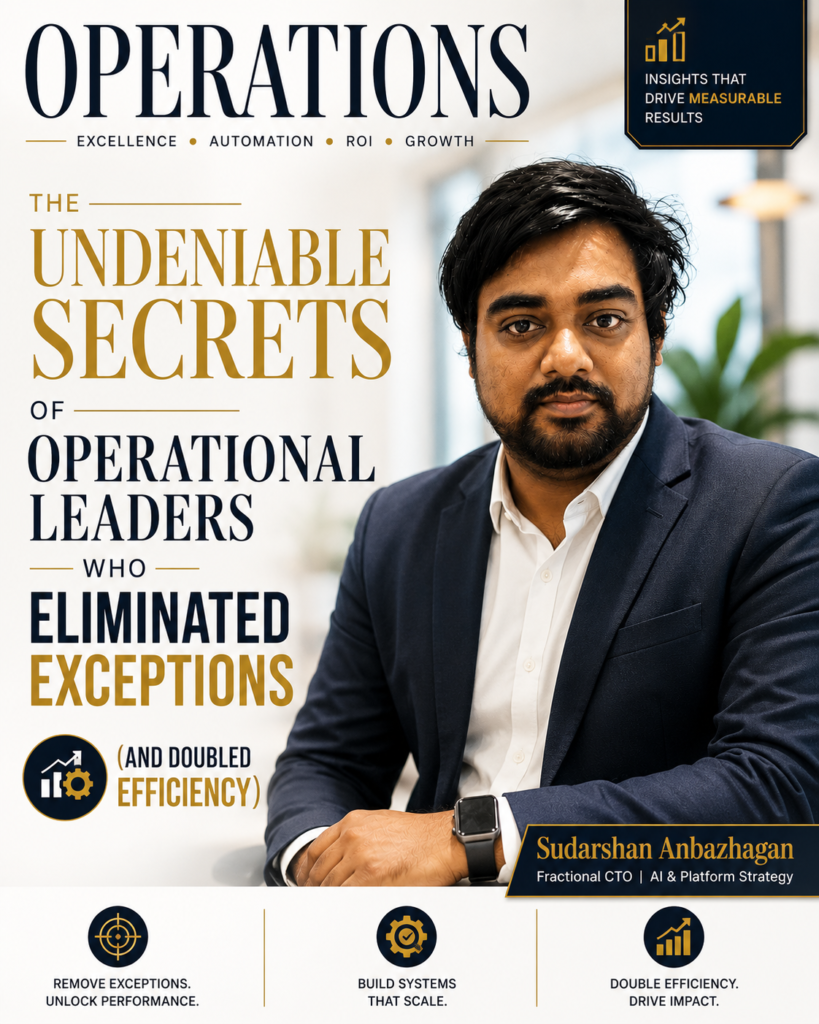

The Conversation That Shaped How I Think About Operational Leadership
One of the most meaningful conversations I have had in over fifteen years of working with operations and technology leaders across fourteen countries happened in Bangalore, with a director who reflected with genuine candour that she had not taken a full weekend off in eight months. What struck me most was not the volume of work she was carrying. It was the clarity with which she understood what was happening and the thoughtfulness she brought to articulating it. She told me that every Saturday, without fail, her team would encounter a situation that required her specific knowledge and her specific judgement to navigate successfully. She was exceptional at her role. She had accumulated years of institutional knowledge, deep process understanding, and the kind of operational intuition that only comes from sustained experience at the highest level. And she had reached the point where she was ready to build a system that could carry that knowledge forward without requiring her to be physically present every time it was needed.
That conversation has stayed with me because it captures something I have observed consistently across the most capable and forward-thinking leaders I have worked with globally. The leaders who achieve lasting and scalable operational efficiency are not the ones who simply work harder or respond faster. They are the ones who decide, at a particular moment in their leadership journey, to transfer what they know into the systems and structures around them, so that their excellence multiplies across the organisation rather than remaining concentrated in a single point of expertise. That is a sophisticated and genuinely difficult leadership ambition. And the leaders who pursue it deliberately are the ones whose organisations perform at a level that compounds over time rather than plateauing.
What I have seen in the leaders who genuinely eliminate exceptions and sustainably double operational efficiency is that they share one uncommon and deeply admirable trait. They build systems that no longer depend on them for every escalation, every critical judgement call, and every moment of operational clarity under pressure. Not by stepping away from leadership or withdrawing from the work they care about, but by creating operational structures so clear, so well-designed, and so deeply understood at every level of the team, that every person in the organisation knows exactly what to do when a complex situation arises. Without waiting. Without escalation to the senior level for questions that the team is fully capable of answering. Without unnecessary delay in delivering value to the business. That is the architecture of a genuinely world-class operation. And it begins with a leadership decision that must be made deliberately and sustained consistently, well before the results of that decision become visible in any metric or dashboard.
What the Highest-Performing Operations Teams Consistently Share
The most consistent insight I bring back from working with operations and technology leaders across the United States, the United Kingdom, Europe, France, and across India is that the highest-performing operations teams are not necessarily the ones with the lightest workload or the simplest operational environment. They are the ones where complexity, when it arises, triggers a design response rather than a purely reactive one. The moment a recurring exception or a repeated operational challenge is treated as a design opportunity rather than simply an urgent incident to be resolved, the entire character of the operation begins to shift in a direction that produces compounding value over time. The leader moves from being the central point of resolution to being the architect of a system that resolves intelligently on its own. That transition is exactly where lasting operational efficiency takes root and begins to grow.
The pattern holds consistently across sectors and geographies. In technology delivery organisations managing complex cross-geography programmes, in enterprise operations teams handling large-scale CRM and ERP implementations, in AI-driven service organisations building intelligent automation at scale, and in manufacturing environments managing multi-site delivery, the organisations that achieve and sustain efficiency gains at the highest level are the ones led by people who made a deliberate strategic choice about how they wanted to use their leadership energy. They chose to invest that energy in building systems that could perform reliably without constant senior intervention, rather than investing it primarily in resolving individual situations as they arose. That choice, made once and maintained consistently over time, produces a qualitatively different organisation at the twelve-month and three-year mark than the alternative approach.
What this looks like in practice is a leader who consistently asks a particular kind of question after a team successfully navigates a complex situation. Not simply “good work, what is next?” but “what did we learn from this situation that would make the next similar situation easier for the team to navigate independently?” That question, asked consistently and followed through with genuine structural change when the answer reveals a design opportunity, is one of the most powerful investments a senior operational leader can make in the long-term performance of the organisation they are building. It signals to the team that the standard of excellence they are being held to is not simply speed of resolution. It is the quality and durability of the systems they are building together.
The Leadership Discipline of Treating Every Exception as a Design Opportunity
There is a specific discipline that the best operational leaders I have worked with apply consistently, and it is one that distinguishes the organisations that achieve lasting efficiency from those that manage their operational complexity effectively but never quite move beyond it. The discipline begins with a question that gets asked with genuine curiosity after every significant operational challenge is successfully resolved: What does this situation reveal about where the process design has an opportunity to be strengthened? Not as a performance review. Not as an audit. But as a genuine architectural inquiry into what the system is communicating through the patterns that are emerging over time, and what structural improvements would make those patterns unnecessary.
In every sustained operational improvement I have been part of across more than five hundred projects and over one hundred and fifty enterprise launches, this question was the consistent inflection point between organisations that built genuine long-term efficiency and those that managed their operations excellently at the current level without achieving the step-change improvement that their senior leaders were working toward. An exception that appears once is a useful data point. An exception that appears three times is a clear pattern worth studying. An exception that appears consistently across multiple weeks or quarters is a system communicating precisely and helpfully about where the design has a meaningful opportunity to improve. The leaders who double their operational efficiency are the ones who receive that communication with curiosity and respond with thoughtful structural investment, rather than simply optimising the speed or quality of the existing response.
The practical implication of this discipline is a meaningful shift in how senior leadership time and attention gets allocated across a week and across a quarter. Rather than reserving the most senior cognitive capacity for exception resolution, the most effective operational leaders reserve it for exception analysis and process design. The two activities may appear similar in a calendar or a status report. The outcomes they produce over ninety days and over twelve months are in an entirely different category of value. One approach produces an operation that handles its current level of complexity with increasing excellence. The other produces an operation that is continuously raising the ceiling of what it considers normal, and building the structural capability to perform confidently at each new level of ambition.
This discipline also transforms what gets recognised and celebrated within the team culture over time. When a leader consistently returns to the question of what each complex situation reveals about where the design can be strengthened, the team develops a shared understanding that the standard of performance they are contributing to is not measured only in how quickly situations are resolved. It is measured in how permanently the design improves as a result of each challenge that the team successfully navigates. That shared standard changes what people bring their best thinking to. And in organisations where it is genuinely embedded in the culture, it produces measurable and compounding improvements in operational efficiency that build on themselves across every quarter.
The Three Practices That Define Leaders Who Build Efficient and Scalable Operations
Across every leader and organisation I have worked with that has achieved lasting and scalable operational efficiency, three practices appear consistently. They are not proprietary frameworks or complex methodologies. They are leadership disciplines that the most effective operational leaders apply with quiet consistency, regardless of the volume of work in front of them or the pressures of any given quarter. Each practice is straightforward to understand and genuinely valuable to sustain over time.
Practice One: They treat every exception as a design opportunity, not just a management priority.
Rather than simply ensuring that situations are resolved promptly and the team moves forward, these leaders ask what each recurring challenge reveals about where the process design has an opportunity to improve. They invest time in understanding the structural root of patterns that appear repeatedly, and they follow through with genuine design changes that reduce the likelihood of the same pattern appearing at the same frequency in the future. Over time, this practice produces an operation in which the team’s energy is increasingly directed toward meaningful and compounding work rather than toward managing the same categories of complexity quarter after quarter.
Practice Two: They separate volume from value in how they understand and communicate about team performance.
A team managing a large volume of operational complexity each week may be performing at a very high level of operational excellence. And the most sophisticated measure of that excellence is not the volume of situations managed, but the trajectory of how that volume evolves over time as the team learns and the system improves. The leaders who achieve lasting efficiency make this distinction visible in how they talk about performance with their boards, their peers, and their teams. They track not only how many situations were successfully resolved but how many categories of challenge the organisation is building the structural capability to prevent entirely. That distinction changes what the team optimises for at every level.
Practice Three: They protect and invest in team capacity for improvement, not only for delivery.
The organisations that achieve the most significant and durable gains in operational efficiency are the ones where senior leadership has made a deliberate and formal commitment to preserving space in the team’s week, sprint, and quarter for the work of improving the system alongside the work of operating it. This is not a matter of reducing delivery capacity. It is a matter of recognising that the team’s best contribution to the long-term performance of the organisation is not only excellent delivery of the current level of work, but continuous and structured improvement of the systems that make that delivery possible. The leaders who sustain this commitment produce compounding returns over time that consistently exceed what any other single investment in operational performance can deliver.
Separating Volume from Value: The Measurement Shift That Changes Everything
One of the most consistently valuable conversations I have in the first phase of any senior operational engagement is about the metrics that the organisation is using to understand and communicate about its own performance. The organisations that have already achieved significant efficiency gains typically share a specific characteristic in how they think about measurement. They have moved beyond volume as the primary indicator of operational health and developed a richer vocabulary for understanding whether the system is genuinely improving over time, or whether it is managing its current complexity with increasing excellence without yet achieving the structural improvements that would change the nature of what it considers normal work.
True operational efficiency, as I understand it from fifteen years of engagement with operations and technology leaders across fourteen countries, is not measured in how many situations are successfully resolved in a given period. It is measured in how the profile of those situations evolves over time as the team learns, the design improves, and the system matures. The organisations that double their operational efficiency consistently are the ones where the senior leadership team has the clarity and the confidence to hold this longer view alongside the immediate priorities of the week and the quarter. They track resolution volume as one indicator of operational health. And they invest with equal rigour in tracking the trajectory of structural improvement, because that trajectory is where the compounding value of their leadership investment becomes visible and measurable.
This shift in measurement also changes the nature of the leadership conversations that happen at the most senior levels of the organisation. When efficiency is measured only in terms of resolution volume and response time, the conversation between a COO and a CTO tends to focus on capacity, speed, and the management of current complexity. When efficiency is measured in terms of structural improvement trajectory alongside volume, the conversation shifts toward architecture, design quality, team capability development, and the long-term performance potential of the systems being built. That shift in the quality of the senior leadership conversation is itself a meaningful indicator of organisational maturity. And it produces a qualitatively different set of decisions, investments, and outcomes over any sustained period of time.
The practical change this measurement philosophy requires is not complicated, but it does require deliberate commitment from the most senior levels of the organisation. It means adding a small number of structural improvement metrics to the dashboards and review cycles that already exist. It means building those metrics into the quarterly conversations that happen between senior leaders and their teams. And it means celebrating progress on those metrics with the same genuine recognition that is given to excellent resolution performance, because both are genuinely valuable contributions to the long-term health and performance of the operation.
Protecting Team Capacity: The Investment That Produces the Highest Compounding Return
There is a dimension of operational performance that rarely appears in dashboards or quarterly business reviews, but that the most experienced and thoughtful senior leaders I have worked with understand intuitively as one of the most important levers available to them. It is the quality and availability of the team’s cognitive and creative capacity for improvement work alongside their delivery work. When teams are fully engaged in managing a high volume of operational complexity with no structured capacity reserved for the work of improving the systems they are operating, they perform at an excellent level within the current design of the operation. They develop extraordinary expertise in navigating the complexity they face consistently. And they reach a natural ceiling at the level of performance that the current design makes possible, because there is no capacity available to invest in raising that ceiling.
What our clients who maintain an average partnership tenure of 6.8 years consistently tell us is that the operational maturity they value most was built through intentional and sustained investment in team capacity for improvement alongside delivery. Not through heroic individual effort, though every high-performing team brings genuine commitment and energy to their work. But through a structural decision by the senior leader to protect and formalise time and capacity for the team to study the systems they operate, identify the design opportunities those systems reveal, and invest in building the structural improvements that compound over time. That decision requires leadership commitment to maintain across the competing priorities of any given quarter. And the organisations that sustain it consistently find that it produces returns that compound in ways that no other single leadership investment can replicate.
The best operational leaders I have had the privilege of working with across fourteen countries protect their teams’ capacity for improvement with the same rigour and commitment they bring to protecting delivery quality. They build it into sprint planning and quarterly capacity reviews as a formal and non-negotiable allocation. They create structured mechanisms for teams to surface design opportunities alongside operational status updates, so that the intelligence the team develops through their daily work is consistently channelled into system improvement rather than simply accumulated as institutional knowledge in individual people. They celebrate improvement work with genuine recognition at every level of the organisation, signalling clearly that the team’s contribution to the long-term performance of the operation is valued with the same seriousness as their contribution to the immediate delivery of results. And they hold that commitment consistently, even when the pressure of the current quarter makes it temporarily feel like a luxury rather than a strategic necessity. That consistency is precisely what produces the compounding returns that distinguish the organisations that achieve lasting efficiency from those that manage their current complexity excellently without ever achieving the step change their senior leaders are working toward.
The Architecture of Operational Clarity That Performs and Scales Independently
What makes an operation genuinely scalable at a world-class level is not headcount, tooling, or the volume of process documentation in the shared drive. It is the quality of the operational clarity that exists at every level of the team, the kind of clarity that enables a team member to encounter a genuinely novel situation and know, with confidence and without unnecessary delay, what the right response is. That clarity does not emerge from a policy document, however well-written. It emerges from a leadership approach that consistently models the thinking behind decisions, creates enough visibility into the reasoning framework that teams can begin to internalise and apply it independently, and invests in building the structural knowledge architecture that allows that clarity to scale across people, geographies, and time zones without diminishing.
In the Managed Teams and cross-geography technology operations I have been part of building at SuperBotics over more than fifteen years and across five hundred or more engagements, the teams that perform most reliably and most independently at scale are the ones where the decision logic is visible, well-understood, and genuinely shared across every level of the team. Where team leads have encountered enough real examples of how their senior leader reasons through complexity that they can apply the same quality of thinking when that leader is not present. Where process documentation functions as a genuine operational guide rather than a historical archive. Where the team’s collective understanding of how to navigate the full range of situations they face is deep enough that the organisation performs at its designed level regardless of which specific individuals are present on any given day. That is the architecture of an operation that is genuinely ready to scale. And building it is one of the highest-value investments a senior operational leader can make in the long-term performance and resilience of the organisation they are responsible for.
The framework that produces this quality of operational clarity consistently includes five structural elements that I have seen work across a wide range of sectors, geographies, and organisation sizes:
- Explicit decision authority at every level of the team. Every team member has a clear and documented understanding of what they can decide independently, what benefits from consultation with a peer or team lead, and what warrants senior leader involvement. This boundary is explicit, regularly reviewed as the team’s capability grows, and designed to expand over time as the team demonstrates its readiness to operate with greater autonomy at each level.
- Structured resolution pathways for the most common and recurring operational categories. Rather than approaching every situation as entirely unique, the team has a well-designed response framework for the categories of complexity that arise most frequently, with clear ownership, defined steps, and the team-level authority to navigate them successfully without requiring senior leader involvement in every instance.
- A formal improvement cadence that connects operational learning to structural design. A structured process by which the patterns revealed through operational experience are escalated for design review with genuine ownership, clear timelines, and formal accountability for the resulting improvements. This transforms the team’s operational experience into a continuous and compounding source of design intelligence.
- Metrics that track structural improvement trajectory alongside resolution performance. A measurement framework that makes the organisation’s progress on building lasting efficiency visible and celebrated at every level, creating a shared organisational commitment to the kind of improvement that compounds over time rather than simply maintaining excellent performance at the current level of complexity.
- Formally protected capacity for improvement work within every planning cycle. A structured and non-negotiable allocation within every sprint, week, and quarter that is reserved for the work of improving the systems the team operates, and that is treated with the same seriousness and commitment as the delivery work it is designed to make progressively better over time.
When these five elements are in place and maintained with genuine senior leader commitment, the operation develops a self-improving quality that compounds measurably over time. Each structural improvement creates additional capacity for the next level of improvement. Each increase in team autonomy creates space for the senior leader to invest in the strategic work that produces the next phase of growth. Over twelve to eighteen months, organisations that commit to this architecture consistently achieve measurable and sustained improvements in operational efficiency, meaningful strengthening of team capability and engagement, and a significant increase in the organisational capacity available for strategic work and growth investment.
What Genuinely Doubled Operational Efficiency Looks and Feels Like
When operational efficiency genuinely doubles in a world-class organisation, the change is visible and felt in ways that extend well beyond any individual metric or dashboard. Senior leaders notice it first in the quality and character of their own working week. The time they are spending in reactive conversations diminishes meaningfully, and the time available for strategic thinking, relationship building, and forward-looking leadership increases in direct proportion. The volume of situations that require senior leader involvement is significantly lower, not because the team is managing less complexity, but because the system has been designed to provide the team with the clarity, the authority, and the structural support to navigate a much greater range of situations independently and excellently. The leader’s calendar reflects their most valuable contribution rather than their most urgent obligation.
Teams experience the change in the quality and meaning of their daily work. The shift from an environment in which the majority of team energy is invested in managing the current level of operational complexity, to one in which a meaningful and growing portion of the week is spent on work that improves the system and builds lasting capability, is significant and is felt genuinely by every person doing the work. Team engagement strengthens not because the conditions of employment have changed, but because people are spending more of their time on work that builds something lasting, work that they can see compounding over time, work that connects their daily contribution to the long-term performance of the organisation they are proud to be part of. The quality of team conversations changes. The ambition of what the team believes is possible changes. The level of genuine professional development that each team member experiences across a year changes in ways that matter deeply to the people involved and to the organisation that depends on their continued growth.
At the organisational level, the capacity that becomes available when an operation no longer needs to invest its full resource base in managing its current level of complexity is one of the most powerful competitive assets available to any senior leader. That capacity can be directed toward strategic initiatives that were previously postponed, capability investments that were identified but never prioritised, market expansion that was desirable but resource-constrained, or product and service improvements that have been in the pipeline waiting for the right moment. The efficiency gain is not simply a cost optimisation or a process improvement metric. It is a fundamental reallocation of organisational energy from managing the present to building the future. And that reallocation, sustained consistently over time, is one of the most significant sources of competitive strength and long-term value creation available to any organisation with the leadership commitment to pursue it seriously.
The Leadership Decision That Precedes Every Lasting Operational Outcome
Doubling operational efficiency is always a leadership decision before it becomes a measurable result. The decision to invest in building a system that performs with clarity and confidence without depending on constant senior intervention. The decision to treat recurring operational patterns as design opportunities that merit structural investment rather than purely management challenges that require faster or better individual responses. The decision to protect and formalise team capacity for improvement work alongside delivery, and to hold that commitment consistently through the competing priorities of every quarter. The decision to measure performance by the trajectory of structural improvement alongside the quality of current delivery, and to celebrate both with genuine recognition at every level of the organisation. These are not minor operational adjustments that can be delegated to a process improvement function or addressed in a single planning workshop. They are strategic postures that determine what an organisation is capable of building over time, and they must be chosen and embodied by the senior leader before they can take root anywhere else in the organisation.
What I have learned working alongside operations and technology leaders across fourteen countries and more than five hundred engagements is that the most durable and significant efficiency gains are never the primary product of a technology implementation, a process redesign, or a structural reorganisation, though all of these can play a valuable supporting role at the right moment. They are the product of a leader making a clear and committed decision that the system they are building should be capable of performing at its best without requiring their constant presence, their constant judgement, and their constant energy to sustain it. That decision, made with genuine conviction and maintained consistently through the natural pressures of any demanding quarter, changes everything that follows. It changes what the team believes is possible. It changes what they invest their best thinking in. It changes the kind of organisation that exists at the other side of twelve months of deliberate and compounding leadership investment.
The operational leaders I have had the greatest privilege of working with are respected and admired not only for the standards they have maintained throughout their careers, but for the structural legacies they have built. The systems that perform at a high level long after any individual contribution has moved forward. The teams that carry forward a shared understanding of how to navigate complexity, make excellent decisions, and continuously improve the organisations they are part of. The cultures in which excellence in design is valued alongside excellence in delivery, and in which every person understands that their most meaningful contribution is building something that lasts. That is the kind of operational leadership that compounds across years and across the careers of every person fortunate enough to be part of it. And it begins with one clear, considered, and genuinely courageous leadership decision.
Let Us Continue This Conversation
If the ideas in this piece connect with how you are thinking about building operational efficiency, developing team capability, and creating organisations that perform at a world-class level without depending on constant senior intervention, I would be genuinely glad to continue the conversation with you.
I am Sudarshan Anbazhagan, Founder and CEO of SuperBotics MultiTech Private Limited, Fractional CTO, AI Architect, and a practitioner who has spent fifteen years working alongside operations and technology leaders across fourteen countries to build organisations, systems, and teams that perform at a level that endures and compounds over time. With more than five hundred successful projects, one hundred and fifty-plus enterprise launches, a 98 percent on-time release rate, and an average client partnership tenure of 6.8 years, the work I do is built on a foundation of genuine field experience, sustained relationships, and a deep commitment to the long-term success of every organisation I have the privilege of working with.
I welcome connections with senior leaders, C-suite executives, and practitioners who are serious about building operational excellence that scales. Connect with me directly on LinkedIn and let us explore what is possible together.
Connect with Sudarshan Anbazhagan on LinkedIn: linkedin.com/in/sudarshananbazhagan