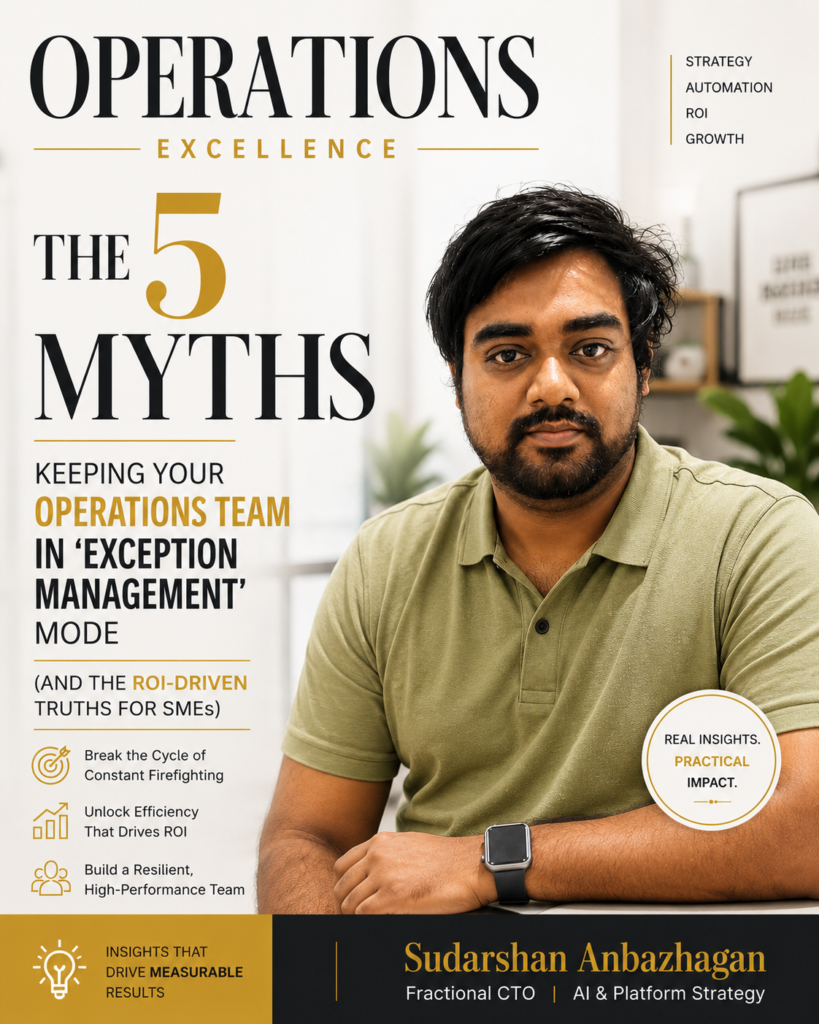

The Day I Understood What Operational Control Really Looks Like
I once stood in a room where an operations lead had pinned a full A3 exception log to the wall. It was colour-coded by priority. Each row carried an assigned owner. Every open item had a revised closure date written in careful, deliberate handwriting. The system was thorough, the effort was unmistakable, and the operations lead was visibly proud of what his team had constructed together. I understood that pride completely. The log represented real discipline. It represented genuine accountability. It represented a team committed enough to their craft that they tracked every deviation, assigned every resolution, and drove every item to closure with consistency and care. That kind of dedication is rare, and it deserves to be recognised for what it is.
And yet, beneath the structure and the colour-coding, I could see something equally significant. I could see a team that had quietly, completely, and without ever making a conscious decision about it, accepted firefighting as their permanent professional identity. Not because they had abandoned their ambition. Not because they lacked the capability or the drive for something better. But because the belief system that surrounded them had gradually and invisibly redefined what operational success looked like. The definition had shifted from “building a system where exceptions rarely occur” to “managing exceptions as efficiently as possible once they do.” That shift, invisible in the language of daily stand-ups and invisible in the colour-coded log, was costing the business far more than anyone in that room had ever been asked to calculate.
That moment changed permanently how I think about operations leadership. Across more than 12 years of working alongside growing businesses in manufacturing, services, and technology, I have come to understand with complete clarity that exception management does not become the norm because teams are weak, underfunded, or lacking ambition. It becomes the norm because of beliefs. Five specific beliefs, each entirely reasonable on the surface, each quietly and steadily constraining what the business is able to achieve. The genuinely exciting truth, and the reason this perspective holds real value for every senior leader reading it, is that beliefs are not fixed. They are changeable. And when the right beliefs take hold inside an operations function, the performance outcomes that follow are not marginal. They are transformational.
Why Beliefs Drive Operational Performance More Powerfully Than Processes Ever Could
Most operational improvement programmes open with process. A current state is mapped. Gaps are identified. New workflows are designed with care and expertise. A rollout plan is built and communicated. The investment is real, the effort is considerable, and the results are often measurable in the short term. But the businesses that achieve lasting operational transformation, the ones whose performance continues to compound year over year rather than reverting to the previous baseline after a few months, are the ones where the underlying belief system shifted alongside the process work. Process change without belief change is a renovation. Belief change is a structural rebuild. The renovation looks compelling for a season, but the foundational conditions that produced the original problem remain active beneath the new surface.
What gives beliefs such extraordinary power in an operational environment is precisely the fact that they are invisible. They do not appear on process maps or show up in capability assessments. They live in the language a team reaches for instinctively when an exception arrives. “This kind of thing happens all the time.” “That is just the nature of our business.” “We have tried to address this before.” “Some variables are simply outside our control.” Every one of those phrases is a belief that has successfully disguised itself as a fact. And every time a belief like that is accepted as settled truth rather than examined as a working assumption, the operational latitude available to that team quietly contracts. The businesses that build genuinely outstanding operations are the ones where leadership has had the confidence to question those phrases consistently, constructively, and without blame, until the team discovers that what once felt like an immovable constraint was actually a solvable problem waiting for the right question.
The five beliefs examined in this blog are not theoretical constructs or unusual edge cases. They appear, in some combination, in virtually every SME operations environment I have encountered across more than a decade of direct engagement. Each one carries a logic that makes it feel sound. Each one has produced generations of capable, hard-working operations professionals who accepted it as foundational. And each one, when replaced with a more precise and more empowering perspective, consistently produces measurable improvement in operational predictability, team energy, and business performance. The goal here is not to evaluate any organisation that holds these beliefs. The goal is to give every senior leader reading this the clarity to examine them with fresh eyes and the strategic perspective to move decisively beyond them.
Belief One: Exceptions Are Inevitable in a Complex Business
This is the most widely held of the five beliefs, and it carries the heaviest operational cost. Its logic is genuinely straightforward: as a business grows in scale and sophistication, the number of interdependencies multiplies, the variables in any given process increase, and the probability that something deviates from plan at some point rises accordingly. Complexity and exceptions, the reasoning goes, travel together as permanent companions. And because the business is genuinely complex, and exceptions are genuinely occurring every week, the belief receives fresh validation with every entry added to the exception log. The team resolves the week’s exceptions, the log fills up again the following Monday, and the cycle feels like evidence confirming the belief rather than evidence that the belief itself is generating the cycle.
The businesses that build genuinely predictable, high-performance operations hold a fundamentally different and far more productive relationship with exceptions. They do not accept them as the inevitable price of operating in a complex environment. They treat every exception, without exception, as a diagnostic signal about a specific part of their operating system. A recurring exception in supplier delivery is not the unavoidable cost of managing a complex supply relationship. It is a precise signal that somewhere in the upstream process, a handoff expectation has never been formally shared, or a decision right has never been clearly assigned. A recurring exception in customer fulfilment is not the natural friction of managing high transaction volumes. It is an invitation to ask which step in the delivery process lacks an owner who is accountable for its consistent quality. When exceptions are read as signals rather than managed as events, the operational agenda transforms completely. The team stops being reactive managers of what arrives and becomes proactive architects of what the system should be producing instead.
Across more than 500 projects and client engagements, the single most consistent practice I have observed in businesses that successfully reduce exception frequency is this: they treat the root cause of every recurring exception as a leadership responsibility, not an operations department task. When a pattern appears in the exception data, the question leadership asks is not “who is handling this?” It is “what in our operating system is producing this, and what do we need to change so that it stops?” That question, asked with genuine curiosity and pursued with genuine commitment, creates a culture where exceptions reduce progressively over time rather than accumulate at a steady accepted rate. The complexity of the business does not shrink. The operating system’s capacity to absorb that complexity without generating exceptions grows. That distinction is the strategic foundation of every operationally excellent business I have had the privilege of working alongside.
Belief Two: Adding Headcount Is the Fastest Path to Operational Relief
When exceptions are running at high frequency and the operations team is visibly stretched, the most natural and compassionate leadership response is to reinforce the team with additional capacity. More people means more hands available, faster resolution times, and meaningful relief for a group that is working extremely hard under real pressure. The reasoning is both commercially logical and humanly considerate, and in many operational contexts it is exactly the right investment to make. Adding talented, motivated people to a well-structured operations team accelerates performance in ways that deliver genuine and lasting value to the business.
The challenge arises when headcount is added to a process that lacks the underlying clarity to put that capacity to its best use. In that context, the additional people distribute themselves across the existing gaps in the system rather than filling them. A process with an unclear handoff between two departments continues to generate exceptions regardless of how many skilled people are assigned to manage the consequences. An approval workflow with ambiguous decision rights continues to create delays and escalations whether the team responsible for it has five members or twenty. The exceptions continue at a similar frequency, the resolution speed improves modestly, and six months later the business finds itself with a larger team, a similar exception rate, and a leadership conversation that is increasingly focused on why scale is not translating into the operational improvement the investment was intended to deliver.
The businesses that resolve high exception rates in ways that endure invest in clarity before they invest in capacity. They define precisely who owns each step of every critical process. They establish what a successful output looks like at every stage in language specific enough that any team member can apply the standard without needing to check. They build decision rights that are clear enough for the person closest to the work to act with confidence in every routine scenario, without requiring escalation to a more senior level. Once that clarity is present and operating consistently, every additional person who joins the team steps into a system that knows exactly what it needs them to do. Capacity investments at that stage deliver their full intended value, because the structure is ready to channel the capability they bring. After working with growing businesses across 14 countries, one observation holds true across every context: operational performance scales most reliably and most sustainably with clarity, and clarity is always the investment that delivers the strongest return on every subsequent hire.
Belief Three: The Right Technology Platform Will Resolve the Core Problem
Technology has expanded what is operationally possible for SMEs in ways that would have seemed extraordinary a decade ago. Workflow automation tools, real-time operational visibility platforms, AI-assisted decision support systems, integrated ERP infrastructure, and cloud-based collaboration environments have placed capabilities in the hands of growing businesses that were previously available only to the largest enterprises. The opportunity this creates is genuine and significant. The businesses that invest in technology thoughtfully and with clear strategic intent build competitive advantages in speed, accuracy, and scalability that compound meaningfully over time. This context makes the belief that the right software investment will resolve an organisation’s core operational challenges entirely understandable. The platforms are genuinely impressive. The vendor demonstrations are compelling. The case studies from businesses that have seen transformational results are real and encouraging.
The consistent insight I have carried out of technology implementations across every scale and sector is that software amplifies whatever it finds in the underlying process. When the process is clearly defined, consistently owned, and reliably followed, technology amplifies its quality and accelerates its speed in ways that create real and durable operational value. When the process is ambiguous, informally owned, or followed in different ways by different team members depending on individual interpretation, technology amplifies the inconsistency with equal reliability and speed. The same handoff that generated exceptions in a manual process generates them more quickly and more visibly in an automated one. The same decision point that caused delays in a spreadsheet-based workflow causes delays in a purpose-built platform. Technology does not introduce these structural conditions, and it does not resolve them. What it does, with great consistency and great value, is reveal them with a clarity that makes them impossible to continue treating as acceptable background noise.
The operational transformations I have seen deliver the strongest and most sustained returns from technology investment share a single consistent starting condition. Before the platform was selected, before the implementation scope was defined, before a single configuration decision was made, the organisation invested the time and attention required to define its processes clearly enough that the technology had something precise to automate and something meaningful to support. They understood what they were building in the platform because they had already built it in their operational thinking. The technology then delivered exactly what it was designed to deliver, because the design reflected a clear and shared understanding of what good operational performance looked like. The businesses that achieved this starting point did not need to be large or technically sophisticated. They needed to value process clarity enough to treat it as an investment worth making before the technology investment, not as an obstacle standing between them and the implementation they were excited to begin.
Belief Four: Exceptions Are Random Events and Therefore Resistant to Prevention
One of the most energising and practically powerful discoveries available to any operations leader is the consistent finding that exceptions in most growing businesses are not random. They feel random because they arrive without warning, involve different products or customers or team members in each instance, and require individual judgment and bespoke resolution effort every time they appear. The lived experience of managing exceptions has an inherently varied and unpredictable quality that creates a powerful and deeply convincing impression of randomness. But when exception data is examined over time with honest analytical intent, a pattern that is almost universal in SME environments emerges with striking consistency. A small number of root causes, typically somewhere between three and five, is responsible for driving the large majority of operational exceptions across the entire business.
This concentration finding changes the strategic problem completely and opens an operational opportunity of significant scope. A genuinely random problem is a permanent condition that must be absorbed into the operating model as a cost of doing business. A concentrated problem is a defined project with a clear boundary, a finite set of causes, and a realistic path to permanent resolution. When an operations team discovers that the majority of their weekly exceptions trace back to four identifiable root causes, the strategic question shifts from “how do we manage exceptions more efficiently and at lower cost?” to “what specific investments would resolve these four root causes permanently, and what would that change in our operations look like a year from now?” Those two questions lead to entirely different investments of time, leadership attention, and operational energy. The resolution of a concentrated root cause creates sustained reduction in exception frequency across the entire business and frees the operations team to direct its talent and energy toward work that builds the business rather than work that maintains it.
What makes root cause analysis particularly powerful in an SME context is the structural speed advantage that smaller organisations hold in moving from insight to resolution. When an SME operations team identifies that a specific supplier relationship, a particular internal handoff, or a defined approval stage is generating a disproportionate share of exceptions, the people with the authority to address those root causes are typically close enough to the work to understand the problem with full contextual clarity and act on it with meaningful speed. The organisational distance between the analytical insight and the strategic decision is short. The number of stakeholders who need to reach alignment before action is manageable. The speed at which a root cause resolution can travel from identification through design to implementation to sustained operational improvement is genuinely and structurally faster than in a large enterprise. This is one of the most significant and consistently underutilised operational advantages that SMEs possess, and the businesses that actively and deliberately use it build operational performance that compounds with a speed and durability that becomes a genuine differentiator in their market.
Belief Five: Predictable, High-Performance Operations Are Built for Large Enterprises
The belief that genuine operational excellence at scale is a capability reserved for large enterprises with dedicated operational functions, specialised methodologies, and substantial infrastructure investment is understandable given the way operational success is most commonly documented and discussed. The most prominent case studies in operations management feature large businesses. The most frequently cited operational frameworks were developed in large manufacturing or logistics environments. And the operational realities that SMEs navigate every day, the resource constraints, the competing strategic priorities, the limited bandwidth available for structured improvement work, can make the aspiration of genuine operational excellence feel distant and theoretical rather than immediate and achievable for a business of their size and complexity.
The reality I have observed directly, working with businesses of every size across more than 12 years of operational engagement, is that SMEs with fewer than 50 people are frequently more operationally effective, measured relative to their complexity, than enterprises with hundreds of dedicated operations staff. The structural reasons for this are consistent and worth understanding clearly. Ownership is unambiguous because the organisation is compact enough that accountability cannot be distributed invisibly across layers of management without everyone noticing. Decisions are fast because the person with the clearest contextual understanding of the situation is frequently the same person with the authority to act on it. Leadership stays genuinely and consistently close to execution because the organisation has not yet developed the structural and informational distance that large enterprises invest enormous resources trying to bridge. And the cultural environment of a smaller business, where individual performance is personally visible, where contribution is directly felt, and where the connection between effort and outcome is clear, creates a natural and powerful alignment between individual motivation and operational outcomes that large organisations spend years and significant investment attempting to replicate.
The SMEs I have seen build the strongest operational performance are not the ones that attempted to reproduce enterprise frameworks at a smaller scale. They are the ones that recognised their inherent structural advantages with clarity and built deliberately on them as the business grew. They kept ownership unambiguous as headcount increased, resisting the natural and often well-intentioned tendency to diffuse accountability through the creation of additional management layers. They maintained fast decision-making by preserving decision rights at the level closest to the relevant information, even as the organisation became more complex. And they protected the cultural proximity between leadership and execution as an explicit strategic asset, not as an informal characteristic of smallness that would naturally fade with growth. The result, consistently and without exception in my experience, was operational performance that improved with scale rather than degrading under it which is precisely the operational outcome every growing SME has both the ambition and the structural foundation to achieve.
The Leadership Shift That Makes Outcome-Driven Operations the New Standard
The transition from exception-driven to outcome-driven operations is, at its core, a leadership transition. It does not begin with the deployment of a new process framework or a technology investment or an organisational restructure, though each of those may follow from it in time. It begins with a deliberate and sustained change in what leadership measures, what leadership notices, and what leadership treats as a meaningful signal about the health of the operating system. In an exception-driven environment, the primary performance signals are all oriented toward response: how quickly exceptions are being resolved, how many remain open at any given moment, and how efficiently the operations team is managing the current volume of incoming issues. These metrics have real value for understanding operational capacity. But they measure the quality of the firefighting, not the quality of the conditions the business is creating. They reward resolution speed rather than prevention investment. And in doing so, they create an incentive structure that keeps the team’s best energy focused on the wrong problem.
In an outcome-driven operations environment, the primary performance signals are oriented toward prevention and system health. Leadership tracks not just how quickly the team resolves exceptions but how frequently the same exception recurs over time. A recurring exception is treated as an unambiguous signal that a root cause has not been addressed, and in a well-led operations environment, that signal carries as much strategic urgency as a high-volume week of exception management. Leadership also tracks the ratio of proactive improvement work to reactive resolution work within the operations function, because that ratio tells a precise and honest story about where the team’s collective energy is being invested. A team spending 80 percent of its time on resolution and 20 percent on prevention is a team operating in sustained firefighting mode. A team that has shifted that balance to 60-40 is a team actively and visibly building a better system. Tracking that shift, celebrating it publicly, and treating it as a meaningful indicator of operational leadership quality creates the cultural permission for operations teams to invest their most creative and capable energy in the work that changes the system rather than the work that maintains it.
After 12 years of this work across hundreds of operational engagements, one truth holds with absolute consistency: the operations teams that build the most durable and the most admired performance are the ones where leadership created the conditions for prevention to be valued as visibly and as generously as resolution. That does not diminish the importance of resolving exceptions well and quickly. What it does is build an operating system where the same problem stops requiring resolution repeatedly, because the root cause has been permanently addressed, the process has been clarified with enough precision that the exception cannot recur in its previous form, and the conditions that produced the original gap have been redesigned. That kind of compounding operational improvement is available to every SME, regardless of sector, current scale, or where the business sits today on its operational development journey. It starts with a leadership decision to treat the exception log not as the measure of operational performance, but as the most valuable source of strategic insight the business generates every single week.
Building the Operations Function That Grows Stronger as the Business Scales
One of the most consequential and most consistently underestimated inflection points in the journey of a growing SME is the moment at which operational performance begins to soften under the pressure of scale. In the earlier stages of growth, the business operates primarily on the strength of individual knowledge, established personal relationships, and the informal coordination that flows naturally when the team is small enough for everyone to know everyone and communication is fast and instinctively accurate. Growth then adds new people, new geographies, new service or product lines, and new layers of complexity, and the informal coordination that held the system together at smaller scale begins to develop gaps. Handoffs that were managed through a direct conversation become unclear because the two people who had that conversation no longer share a daily workspace. Ownership that was obvious because there were only three people on the team becomes ambiguous when there are fifteen. Decisions that were fast because the person with the context was the person with the authority become slow because growth has separated those two conditions. And exception frequency, which had been low when the business was compact and culturally aligned, begins to rise as the informal system that had been quietly preventing exceptions is replaced by a formal system that has not yet been fully designed or clearly communicated.
The businesses that navigate this transition with their operational performance intact are the ones that build their formal operational infrastructure with deliberate intent and with genuine respect for the structural conditions that will be required at larger scale. They formalise ownership and accountability structures while the team is still compact enough to move through that work quickly and with full participation. They define process standards while the volume is still manageable enough that the team has the mental space to think carefully about what consistent quality looks like and how it should be measured. They invest in building the operational clarity that will hold the entire system together at larger scale while the cost of that investment is still low and the ROI is still easy to calculate. Growth-focused leadership teams find it genuinely difficult to prioritise this kind of structural investment, and that difficulty is understandable. The attention and energy of a growing SME is properly and powerfully oriented toward customers, markets, and products. The operational infrastructure that will determine whether the business can deliver on those growth ambitions with consistency and profitability tends to feel like a lower-urgency investment right up until the moment it becomes the primary constraint on the growth the business is working so hard to achieve.
The businesses that invest in operational infrastructure early and intentionally carry that investment forward as a compounding advantage at every subsequent stage of their growth. The process clarity they establish early makes every technology investment more precise and more effective. The ownership structures they define early make every headcount investment more productive from day one. The decision rights they establish early make leadership attention scalable in ways that create genuine leverage, because the team can act with confidence at the level closest to the work rather than routing every non-standard situation upward for resolution. The operations function they build to scale without losing performance quality becomes one of the most durable and most distinctive competitive advantages the business carries, enabling faster growth, stronger customer relationships, more resilient delivery, and the kind of talent attraction and retention that follows naturally when skilled operations professionals can see that the business is building something genuinely worth being part of.
The One Question That Transforms How an Operations Team Sees Its Own Potential
There is a question I have returned to consistently across operations reviews with businesses of every size, sector, and stage of development, and it reliably reorients the conversation toward what is most strategically significant. The question is this: is your team investing the majority of its collective energy in solving the same problems, or in building the conditions where those problems stop appearing altogether? It is asked in genuine curiosity, not as a rhetorical device. It is a precise diagnostic question. And the answer, given honestly, tells a senior leader more about the true operational health and the genuine future trajectory of the business than any exception log metric, resolution rate figure, or capacity utilisation calculation can provide on its own.
When the honest answer is that the team is predominantly occupied with solving the same problems repeatedly, the most constructive and most productive response is not urgency or concern. It is curiosity of a very specific kind. Which beliefs are making that pattern feel like a normal and acceptable operational condition? Which root causes are responsible for the concentration of recurring exceptions? Which investments in process clarity would shift the team’s daily agenda meaningfully from resolution toward prevention? Which leadership practices and recognition behaviours would signal clearly that prevention work is as valued, as visible, and as celebrated as the resolution speed that currently dominates the operational scorecard? These are the questions that, when asked with genuine commitment and pursued with real analytical rigour, create the conditions for operational improvement that does not plateau after one improvement cycle but continues compounding across multiple years and multiple growth phases. They are the defining questions of outcome-driven operations leadership. And they are available to every SME leader, in every sector, at every stage of their operational development journey, beginning today.
The operations lead with the colour-coded A3 exception log had built something that reflected genuine discipline, genuine accountability, and a genuine commitment to operational performance. What his team’s development required next was not more sophistication in the practice of exception management. It was the clarity to recognise that the carefully collected and meticulously maintained data in that log was not primarily a management tool. It was a rich, precise, and profoundly valuable body of evidence about exactly where the operating system was ready to be strengthened. Every colour on that log was a signal with a story worth following. Every revised closure date was an invitation to ask what structural condition had made the revision necessary. Every assigned owner was the beginning of a productive conversation about whether the right process clarity and the right decision rights existed for that person to prevent the exception the next time rather than simply resolve it. That is the shift from exception management to operational excellence. It does not require a larger budget or a more sophisticated platform or an enterprise-scale operations function. It requires a different and far more rewarding relationship with the information the team is already generating every single day, and the leadership conviction to follow that information all the way to its root.
Let Us Continue This Conversation
The shift from exception-driven operations to outcome-driven performance is one of the most consequential and most accessible strategic moves available to a growing SME. If this perspective has opened a line of thinking that feels relevant to where your business is right now, I would genuinely welcome the opportunity to explore it further with you.
I regularly share field-tested insights on operations leadership, business strategy, and building organisations that scale without losing the performance quality that made them successful in the first place. I invite you to connect with me directly on LinkedIn, where these conversations continue every week.
Connect with Sudarshan Anbazhagan on LinkedIn: linkedin.com/in/sudarshananbazhagan