
A founder I worked with once asked me a question that has stayed with me across every engagement since. His company had invested seriously in automation, brought in experienced operations leaders, and restructured workflows across multiple departments. Revenue was growing quarter on quarter. But margins stayed flat, and the team felt operationally stretched regardless of how much capacity was added or how many process improvements were announced. He leaned forward and said: “If we are doing everything right, why does it still feel like we are always catching up?” That question is not unique to him. It surfaces in boardrooms across industries and geographies, and it almost always points to the same underlying source. Operational efficiency is not a matter of effort or investment volume. It is a matter of how well a business has designed its systems to handle the work that falls outside the defined path.
What makes that question so important is not the frustration behind it. It is the fact that it reveals a gap between operational activity and operational design. The effort is real. The investment is genuine. The leadership intention is clear. And yet the gap persists, because no amount of talented people working hard inside a poorly designed system will produce the margin improvement or the ROI consistency that the business is expecting. After 15 years of building and leading cross-geography operations across 14 countries, with 500 plus projects and 150 plus enterprise launches behind me, I have come to understand that the single most underestimated factor in sustainable operational ROI is how an organisation chooses to identify, manage, and ultimately eliminate its process exceptions. Not how quickly it resolves them. Not how many it tracks. How systematically it designs them out of existence over time. That is the distinction that separates organisations that compound their operational value from those that plateau despite consistent effort.
This blog is written for operational and technology leaders who are serious about that distinction. Not as a framework to implement from a slide deck, but as a set of grounded principles that I have seen move organisations from operationally reactive to operationally capable across industries, geographies, and scales of complexity. Every section that follows reflects what the work has taught me, and every insight is offered in the spirit of giving senior leaders something they cannot get from a vendor presentation or a management methodology. A real perspective on how the most durable operational improvements actually happen.
How Operational Efficiency Gains Stall Even When Everything Looks Right
The most common reason operational ROI improvement stalls is one that rarely appears on a leadership dashboard, and that is precisely why it persists. Organisations that invest in process improvement tend to focus their energy on the defined path, the standard flow that covers the majority of transactions or work units. They optimise that path, measure it carefully, and celebrate the efficiency gains it produces. What they tend to underinvest in is understanding the ecosystem of exceptions that runs alongside it, the work that does not fit the standard flow, the cases that require a human decision, a manual workaround, or an escalation that sits outside the designed process. These exceptions absorb a disproportionate share of operational capacity, introduce the most variability into output quality, and create the sustained margin pressure that leaders feel even when core metrics appear healthy.
What I have observed consistently across engagements in the US, UK, Europe, and Asia is that exceptions are not random. They cluster. In most organisations, the large majority of operational exceptions can be traced to a small number of recurring root causes, and those root causes are almost always structural rather than behavioural. A handoff point between two departments that has never been formally defined. An approval workflow designed for a previous organisational scale that has never been updated. A data entry stage that tolerates variability in input format, creating inconsistency in everything downstream. A policy that was written for one context being applied in a different one without adjustment. The exceptions look different on the surface, but when you trace them back far enough, they share an origin. Finding that origin before reaching for a solution is the single most important thing an operations leader can do to improve ROI sustainably, and it is the step that is most consistently skipped in favour of faster, more visible action.
The leaders who build compounding operational advantage are the ones who create the conditions for that root cause work to happen with the same rigour and urgency that is typically reserved for resolving the exceptions themselves. They build disciplines around pattern recognition before solution design. They ask their teams not just what went wrong, but what structure allowed it to go wrong repeatedly. They treat the recurrence of an exception not as a sign of poor execution, but as a signal that the system has not yet been designed to prevent it. That reorientation, from resolution speed to recurrence reduction, is the foundational shift that everything else in operational efficiency improvement depends on. Organisations that make it early tend to see improvements that compound. Organisations that skip it tend to cycle through improvement initiatives without achieving the durable margin gains they are seeking.
The Accountability Structure That Makes Operational ROI Measurable
One of the most consistent governance patterns I see in organisations that struggle to translate operational investment into visible ROI is the confusion between process ownership and outcome accountability. These are two different things, and treating them as equivalent creates a structural gap that no amount of performance management can close. Process ownership describes who manages the execution of a workflow. It answers the question of who ensures the steps are followed, the tools are used, and the exceptions are escalated appropriately. Outcome accountability answers a more strategically important question: who is responsible for ensuring this process requires fewer exceptions next quarter than it did this quarter? That question does not have an obvious home in most organisational structures, and its absence is one of the clearest predictors of operational ROI stagnation.
When accountability is structured only around process ownership, teams become very good at executing within a system but have no structural incentive to improve the system itself. The operational review focuses on whether the process ran, not on whether it is getting better. Exceptions are documented, escalated, and resolved, and the conversation ends there. The insight embedded in that exception, what it reveals about a structural gap, a design assumption that no longer holds, or a handoff that has never been formally agreed, never gets converted into an improvement action because no one owns that conversion. Over time, the organisation builds an increasingly sophisticated apparatus for managing exceptions that should no longer exist, and the cost of that apparatus is what keeps margins flat even when revenue grows.
What our clients who stay for an average of 6.8 years all have in common is that they build accountability structures around outcomes, not activities. The person responsible for a process is also the person measured on whether that process requires less intervention over time. That measurement is tracked explicitly, reviewed in operational forums with the same seriousness as throughput and capacity metrics, and used to set improvement targets for the following quarter. When that structure is in place, the conversation in every operational review changes fundamentally. Instead of discussing how many exceptions were resolved and how quickly, the team discusses why the same exceptions keep appearing, what the structural source is, and what a permanent design improvement would look like. That conversation is where operational ROI is built. The organisations that have it consistently are the ones whose margins improve alongside their revenue, and whose teams feel progressively more capable rather than progressively more stretched.
Why Simplification Must Come Before Automation for Guaranteed ROI
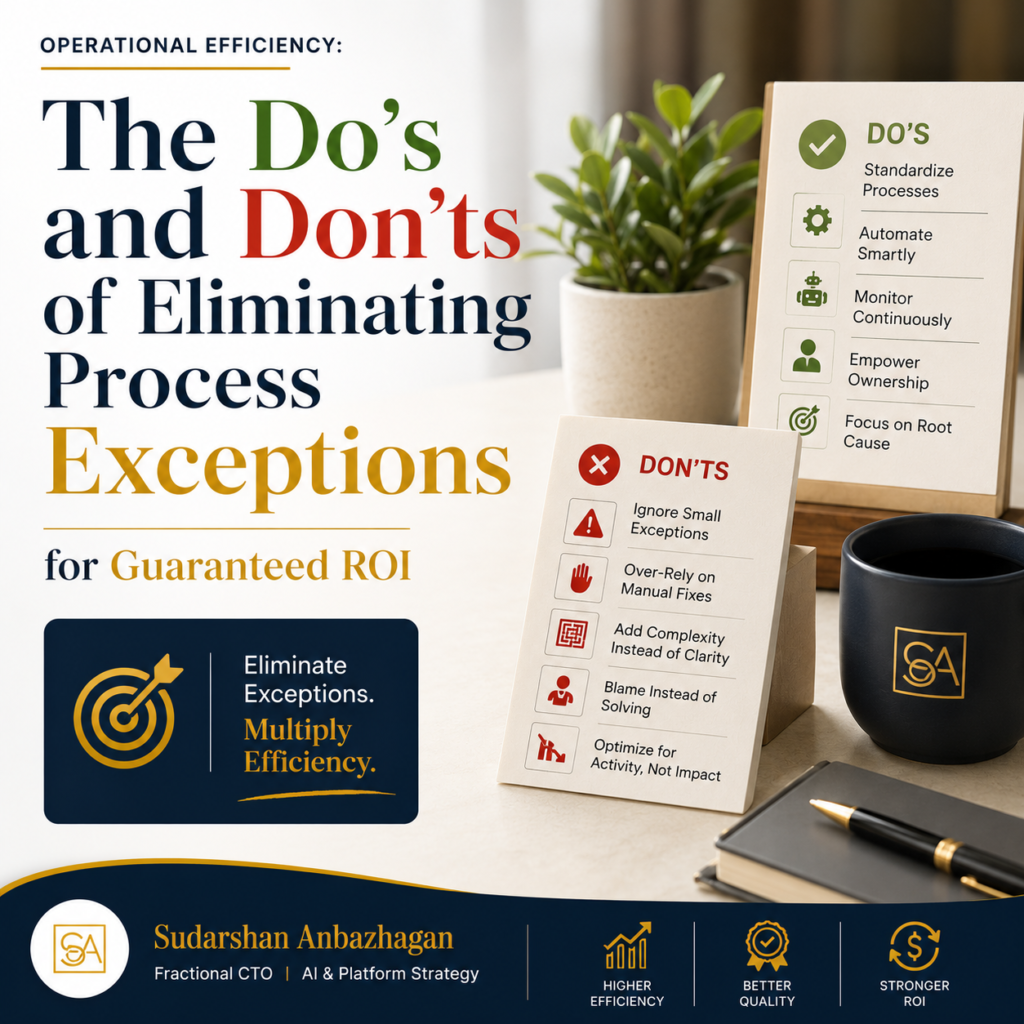
Automation is one of the most powerful tools available to operations and technology leaders, and the instinct to apply it is almost always correct. The question is not whether to automate. The question is what to automate, and in what order. The organisations that achieve the strongest long-term ROI from automation investments are the ones that treat simplification as a mandatory prerequisite rather than an optional preparation step. The ones that automate first and simplify later tend to find that their automation investments create speed without creating improvement, and that the cost of errors produced by an automated process is significantly higher than the cost of errors produced by a manual one, because the volume and velocity are both greater and the point of failure is further downstream and harder to detect.
As a Fractional CTO, the first question I ask when an organisation wants to automate a process is not about the technology. It is about whether the process, as currently designed, has been walked end to end by someone with the authority and the mandate to remove every step that does not directly contribute to the intended outcome. In most cases, the answer is no. The process has been documented, mapped, and discussed, but it has not been genuinely simplified. It still carries the weight of workarounds that were added years ago to accommodate a system limitation that no longer exists. It still includes approval steps that made sense at a previous organisational scale. It still tolerates input variability that creates downstream inconsistency. When that process is automated in its current form, all of those structural inefficiencies are encoded into the automation itself, and they become dramatically harder to remove because they are now embedded in a technical system rather than a human workflow.
The sequencing discipline that produces the best automation ROI is consistent across every industry and geography I have worked in. The first step is to define the intended outcome of the process with precision, not the activities it contains, but the result it is designed to produce. The second step is to eliminate every activity in the current process that does not directly contribute to that outcome, which almost always includes more than leaders expect. The third step is to standardise the inputs to the process so that the system receives consistent, complete, and correctly formatted information at every entry point. The fourth step is to run the simplified process manually for a defined period, long enough to confirm that it performs reliably and that the exception rate has measurably decreased. Only at that point does automation become the right investment, because at that point it is a force multiplier on a system that already works rather than a faster version of a system that does not. Organisations that follow that sequencing consistently find that their automation investments produce compounding returns rather than diminishing ones, and that the ongoing cost of managing the automated process is a fraction of what they anticipated.
The Leadership Culture That Builds Compounding Operational Advantage
There is a leadership pattern in high-performing operational organisations that is worth examining closely, because it looks different from what most management frameworks celebrate, and it produces results that those frameworks rarely explain adequately. In most organisations, speed of response is the most visible and most rewarded operational competency. The team that mobilises quickly when something goes wrong is praised. The leader who resolves a crisis efficiently is promoted. The operational review celebrates resolution time as a proxy for operational excellence. That culture produces teams that are genuinely skilled at managing exceptions, and there is real value in that skill. The ceiling it creates, however, is one of the most persistent constraints on operational ROI in organisations at every scale.
The leadership culture that builds compounding operational advantage rewards a different kind of capability entirely. It celebrates the team that identified why a particular exception kept recurring and designed the system change that eliminated it permanently. It promotes the leader who, instead of resolving the same crisis more quickly each time it appeared, invested in understanding its structural source and built the process discipline that made it stop appearing. It measures operational progress not by resolution speed but by recurrence rate, and it creates explicit recognition for the patient, rigorous, less visible work of system improvement that most organisations underinvest in because it is harder to see and slower to validate than the heroics of crisis management. When that culture is established at the senior leadership level, it cascades through every layer of the organisation and creates a self-reinforcing improvement dynamic that is extremely difficult for competitors to replicate, because it is not a tool or a methodology. It is a set of deeply embedded practices and beliefs about what operational excellence actually means.
What I have seen in the teams that perform most durably across the 14 countries I have worked in is that this culture shift happens through deliberate leadership choices about what gets time in the operational review, what gets visibility in the performance conversation, and what gets investment in the planning cycle. When the operational review consistently includes a standing agenda item on recurrence reduction alongside throughput and capacity, the message about what matters is communicated without a single word about culture. When the performance conversation recognises a team for eliminating a class of exceptions permanently alongside recognising a team for resolving a high volume of exceptions efficiently, the incentive structure begins to shift. When the planning cycle includes a dedicated budget for process improvement projects that do not produce immediate output but do produce structural operational gains, the organisation demonstrates that it values compounding improvement as much as short-term performance. Those three choices, consistently made over time, are what build the operational culture that translates investment into durable ROI.
The Operational Metrics That Reveal True Improvement Velocity
The measurement frameworks that most organisations use to assess operational efficiency are well designed for tracking activity and less well designed for tracking improvement. Throughput, cycle time, resolution speed, volume per team member, and escalation rate are all useful metrics. They describe how the operation is performing right now against its current design. What they do not describe is whether the operation is getting better in the ways that actually compound into ROI improvement. For that, a different set of metrics is needed, and building the discipline to track and act on those metrics is one of the highest-leverage investments a senior operations leader can make.
The metric I return to most consistently across engagements is recurrence rate by exception category. It tracks, for each defined category of process exception, how many times that exception appeared in a given period compared to the same period in the prior quarter. When recurrence rate is declining across the major exception categories, the operation is improving in the way that matters most. When it is stable or increasing despite consistent resolution effort, the organisation is investing in management without investing in design, and the ROI of that investment has a natural ceiling. The power of this metric is not just in what it measures. It is in the conversation it forces. When a team is asked not just how many exceptions they resolved but how many of the same exceptions they resolved for the third or fourth consecutive quarter, it immediately surfaces the question of why the structural source has not been addressed. That question is where operational improvement actually begins.
A second metric that produces significant value for senior leaders is the ratio of manual intervention to total transaction volume across key processes. This metric tracks what percentage of the work flowing through a process requires a human decision, a manual workaround, or an exception handling step that was not part of the designed flow. When this ratio is declining over time, the process is improving in the direction of genuine efficiency. When it is stable, the process is functioning but not advancing. When it is increasing, the process design is falling behind the demands being placed on it. Tracking this ratio across the organisation’s highest-volume processes and reviewing it quarterly alongside financial performance creates a direct line of sight between operational design quality and margin performance that most measurement frameworks do not currently provide. The organisations that build that line of sight early are the ones that can identify where operational ROI is being created and where it is being consumed, and that visibility is what enables genuinely strategic operational investment decisions.
The 90-day operational improvement cycle, structured around these metrics, is the practical vehicle through which the principles described in this blog translate into measurable business outcomes. At the beginning of each 90-day cycle, the leadership team identifies the three to five exception categories with the highest recurrence rate and assigns each to a named owner with outcome accountability for reducing that recurrence rate by a defined percentage within the cycle. At the midpoint, the team reviews progress, assesses whether root cause identification is complete, and determines whether the proposed design improvement is on track for implementation. At the end of the cycle, results are reviewed not just against the recurrence rate target but against the process design changes that were implemented, so that the improvement is structural and not dependent on sustained manual effort to maintain. This cycle, repeated consistently, creates an operational improvement rhythm that compounds over time and produces the kind of margin gains that remain visible in the financial results long after the improvement project itself has concluded.
What Process Exception Elimination Looks Like at Organisational Scale
Understanding how to manage individual process exceptions is valuable. Understanding how to build an organisational capability for eliminating them at scale is what separates organisations that achieve step-change operational ROI from those that achieve incremental gains. The difference is not a matter of resources or technology. It is a matter of how the organisation has designed its improvement infrastructure, the processes, roles, governance structures, and feedback loops that exist specifically to convert operational experience into structural improvement on a continuous basis.
In every engagement where I have seen this capability built successfully, it has three consistent elements. The first is a clear process for capturing exception intelligence at the point where exceptions occur. The teams that handle exceptions every day have an extraordinary amount of information about why those exceptions happen, what conditions produce them, and what a systemic solution might look like. Organisations that capture that intelligence systematically, through structured exception logging that records not just the exception type and resolution but the apparent root cause and the structural factor that enabled it, build a knowledge base that makes root cause analysis faster, more accurate, and more actionable over time. The teams that resolve exceptions without capturing this intelligence lose it immediately, and the improvement potential embedded in that experience is never realised.
The second element is a governance structure that reviews exception intelligence regularly at a level of the organisation with the authority to commission design changes. Exception data that is reviewed only within the team that manages it tends to produce local workarounds rather than structural improvements, because the team does not have the mandate or the resources to redesign the upstream process that is generating the exceptions. When exception intelligence is reviewed regularly at the operational leadership level, with explicit agenda time dedicated to identifying structural improvement opportunities, the gap between insight and action closes significantly. The organisations that build this governance structure consistently find that the volume and cost of manual intervention in their highest-priority processes decreases meaningfully over a 12 to 18-month horizon, and that the improvement accelerates over time as the exception intelligence base deepens and the improvement capability matures.
The third element is a set of clear design principles for process improvement that the organisation applies consistently when a structural change is warranted. These principles do not need to be complex. The most effective ones I have seen are straightforward: define the outcome before redesigning the process; eliminate before automating; standardise inputs before standardising outputs; test at small scale before full deployment; and measure recurrence rate in the first 90 days after implementation to confirm the design change has achieved its intended effect. Organisations that apply these principles consistently build a track record of successful structural improvements that reinforces the cultural shift described earlier in this blog, and that track record creates its own momentum. Teams become more willing to invest in improvement work when they have seen improvement work produce durable results. Leaders become more willing to protect the time and budget for it. And the operational environment becomes progressively more capable, more resilient, and more efficient in the ways that produce sustained financial performance.
Building the Operational Foundation That Compounds Business Value Over Time
The organisations that achieve the most consistent and most durable operational ROI are not necessarily the ones with the most advanced technology or the most experienced operations teams. They are the ones that have built the clearest connection between their operational design choices and their financial outcomes, and that have established the leadership practices, measurement frameworks, and governance structures needed to improve that connection on a continuous basis. That is a different kind of capability from operational excellence in the traditional sense. It is not about executing a defined process with maximum efficiency. It is about building a system that improves itself over time, that surfaces its own weaknesses through the exception intelligence it generates, and that gives the leaders inside it the information and the mandate to act on what they find.
What makes this capability so valuable at the C-suite level is that it produces results that are visible in the financial statements and that persist beyond any single improvement initiative. When recurrence rates are declining across the major exception categories, the cost of manual intervention is decreasing in a way that directly improves margin. When automation is applied after simplification rather than before it, the return on that investment compounds over every cycle rather than requiring constant management attention to sustain. When accountability is structured around outcome reduction rather than process execution, the organisation develops an internal improvement velocity that does not depend on external consultants, new technology purchases, or periodic restructuring to maintain. The business becomes genuinely more capable over time, and that compounding capability is what the most respected operational leaders I have worked with across 14 countries have consistently identified as the foundation of long-term competitive strength.
The question I started with, the founder who asked why it still felt like the organisation was always catching up despite doing everything right, has a clear answer when you understand this framework. The feeling of catching up is the experience of a system that is well managed but not well designed for improvement. It resolves when the organisation shifts its primary operational attention from resolving the exceptions the system produces to designing the system to produce fewer of them. That shift is not dramatic. It does not require a transformation programme or a technology overhaul. It requires a set of clear decisions about what gets measured, what gets rewarded, and what gets invested in, made consistently over time by leaders who understand that the most powerful source of operational ROI is not faster execution within the current system. It is a better system, built deliberately, improved continuously, and designed from the ground up to compound its own value. The organisations that build that system do not feel like they are catching up. They feel, and perform, like they are pulling ahead.