
Across the technology and operations engagements I have led over 15 years, one pattern shows up with quiet consistency. Teams that appear slow, overly cautious, or reluctant to move without approval are rarely that way because of a capability gap. When I step into an organisation and watch a senior engineer pause before making a straightforward architectural call, or see a delivery manager escalate a decision that their role clearly empowers them to make, I am not looking at a performance problem. I am looking at a governance problem.
The hesitation is not about competence. It is about clarity. The moment a team is unsure where their authority begins and ends, every decision carries an invisible risk premium. Actions that should take hours stretch into days. Work that should move forward stalls in a loop of validation, re-confirmation, and cautious over-communication. The cost of that ambiguity is real, and it compounds across every sprint, every delivery cycle, every quarter.
Most governance frameworks I have seen across the organisations I have worked with are built to protect the organisation. That is a legitimate goal. But the best governance models I have worked within go one step further. They protect the team as well. And the distinction between those two approaches is where the real performance difference lives.
What Ambiguity Actually Costs a High-Performing Team
The instinct to over-escalate is a rational response to unclear boundaries. When a team does not know precisely what falls within their authority, the safest path is always to ask before acting. This is not timidity. This is intelligent self-preservation in an environment where the cost of exceeding authority is higher than the cost of slowing down.
What I have seen, particularly in cross-geography technology teams managing deliveries across multiple time zones, is that this ambiguity spreads. One engineer asks before acting. Another observes and adopts the same behaviour. Within weeks, an entire team is operating in a mode of collective caution, because the unwritten rule has become clear: confirm before you commit. The team is still capable. But it is no longer confident, and the difference in output is significant.
The hidden cost is not just in speed. It is in ownership. Teams that are constantly seeking validation do not build a genuine sense of accountability over their work. They complete tasks. They do not own outcomes. That distinction matters enormously when the work involves real complexity, cross-functional coordination, or decisions that require judgment under pressure.
The Framework That Frees
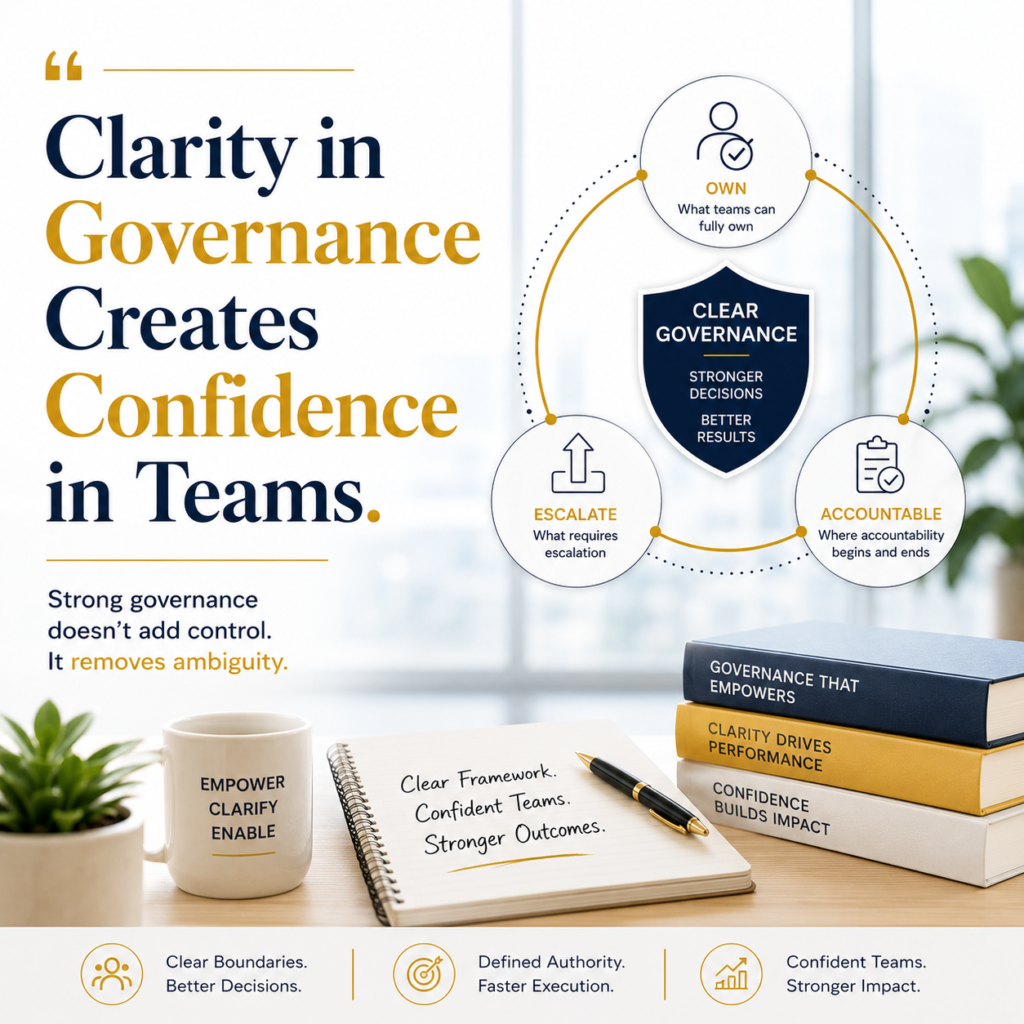
Strong governance does not restrict a team’s capacity to act. It defines the field within which they can act fully. When a team knows precisely what they own, what requires escalation, and where their accountability begins and ends, three things happen simultaneously. Decision velocity increases because the second-guessing stops. Collaboration improves because boundaries between roles become clear rather than contested. And ownership deepens because people are empowered to stand behind the decisions they make.
In every GCC engagement I have led, one of the earliest conversations I initiate is about decision rights. Not because I am building bureaucracy. Because I have seen what happens when cross-functional teams spread across geographies operate without that foundation. A team in Bangalore is not sure whether a particular infrastructure decision needs sign-off from the London architecture council or sits within their own mandate. A product operations lead in Chennai is uncertain whether a client-facing process change requires escalation to the engagement director or can be resolved locally. In both cases, the right answer is often one they are already capable of executing. But without the framework to confirm it, they wait.
Governance, designed well, eliminates that wait. It does not remove the need for judgment. It gives people the confidence to use it.
Where Governance Becomes a Leadership Asset
The organisations that build governance as a leadership asset rather than a compliance mechanism share a common characteristic. Their governance frameworks are designed to be understood by the people who work within them, not just by the people who designed them. The decision boundaries are written at the level of the teams who need to apply them, not at the level of the board that approved them.
After 15 years of stepping into technology organisations at critical junctures, I have come to believe that how a governance framework is communicated tells you more about its effectiveness than the framework itself. A well-designed model that sits in a policy document no one reads is not governance. It is documentation. Real governance lives in the daily behaviour of teams who understand what they are empowered to do, act on that empowerment with confidence, and escalate selectively when the situation genuinely warrants it.
The senior leaders I have worked with who build the highest-performing teams tend to treat governance as a tool for liberating their people, not managing them. They invest time early in making decision rights explicit. They revisit those rights as the team scales and the operating environment changes. And they create a culture where escalation is a considered choice, not a reflex.
What the Highest-Performing Teams I Have Worked With Share
Some of the most capable technology and operations teams I have had the privilege of working alongside were not the teams with the fewest rules. They were the teams with the clearest ones. Not the most complex governance structures. The most comprehensible ones. Teams that could answer the question “do I own this?” quickly and without ambiguity moved faster, made better decisions, and held themselves to a higher standard of accountability than teams who were technically talented but operationally unclear.
This is particularly true in managed team and GCC environments, where the layers between a team’s daily work and the client’s strategic objectives can create significant room for misalignment. In our delivery model at SuperBotics, clarity of ownership is one of the first things we establish in any cross-functional pod. The 40-plus specialists who make up a delivery team work better not because they are told more, but because they are clear about where their authority lives. That clarity is not accidental. It is architected.
The teams I have seen sustain the highest performance over the longest engagements are also the ones where governance is treated as a living document, not a founding artefact. Decision rights are revisited when the scope changes. Accountability boundaries are recalibrated when new roles are introduced. The framework evolves with the team, which means the team continues to move with confidence rather than operating on assumptions that no longer reflect the current engagement reality.
The Human Dimension of Governance
There is a human dimension to this that is easy to undervalue. When a team member makes a strong decision, acts on it with confidence, and delivers a good outcome, two things are true simultaneously. The outcome is visible. The framework that enabled it often is not. Leaders who recognise only the individual and not the conditions that supported them are missing an important signal about what is actually driving performance.
I have sat in enough post-delivery reviews to know that high-performing decisions are not always the product of individual courage. Often, they are the product of an individual who understood exactly where their authority sat and was confident enough in that understanding to act on it without hesitation. That confidence comes from governance. The person did not take a risk. They operated within a framework that made the path clear.
This matters when building teams for the long term. When people consistently feel supported by the structure around them, they develop genuine ownership over their domain. They invest more. They raise their own standards. They become the kind of practitioners who other team members look to when clarity is needed. The governance model does not just protect the organisation from poor decisions. It creates the conditions for people to grow into their best professional selves.
The Standard Worth Building Toward
The question worth sitting with is not whether your governance model protects your organisation. Most do. The more important question is whether it protects and empowers your teams as well.
A governance model that only controls the boundaries of what people can do is a compliance mechanism. A governance model that also defines the space within which people can move freely, decide confidently, and own outcomes fully is something more valuable. It is a performance infrastructure. The organisations that understand that distinction build teams that do not just execute well. They lead well, from within.
Clarity is not a constraint. For a capable team, clarity is the most empowering thing a leader can give.
If governance, team performance, or technology leadership is something you are thinking through in your organisation, I share field-based perspectives on these topics regularly. Connect with me on LinkedIn: