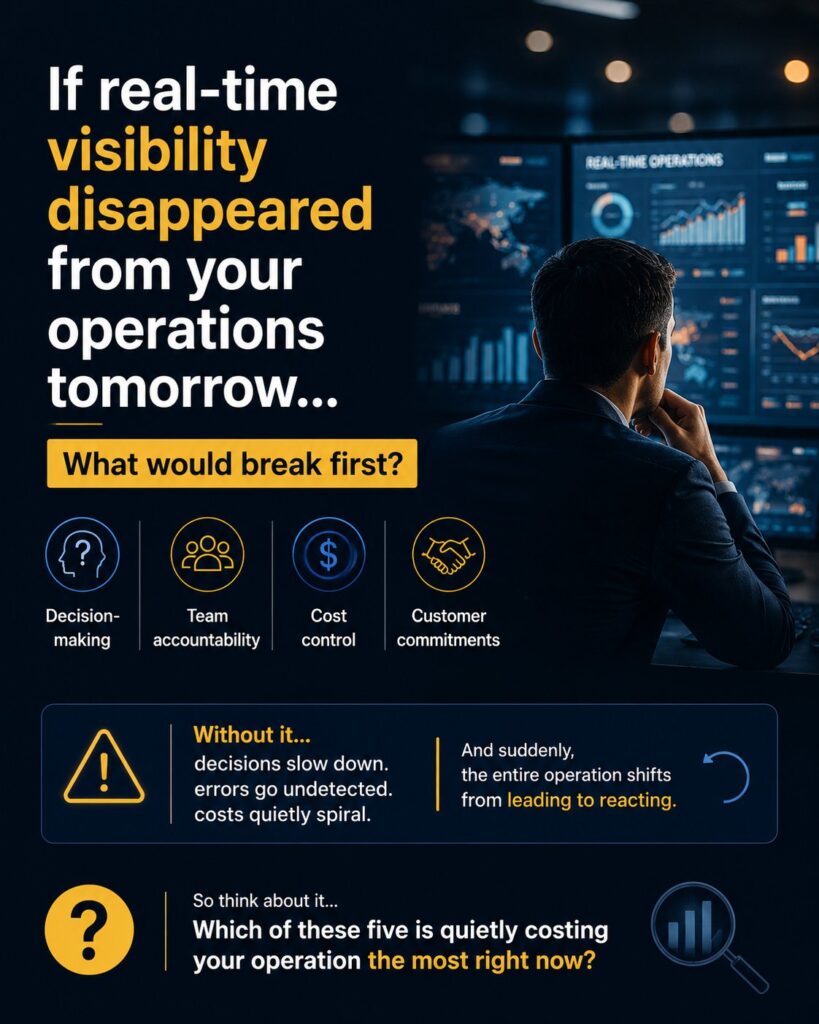

There is a question I ask at the beginning of every operational assessment that tends to produce a long pause before anyone answers. The question is this: if real-time visibility into your operations disappeared entirely tomorrow morning, what would break first? Not what would be inconvenient, not what would require some manual workarounds, but what would actually break, in a way that would become visible to your customers, your board, or your regulators before you had the chance to address it. The pause that follows is not because the question is difficult to answer. It is because the answer is immediately obvious to everyone in the room, and the obvious answer reveals something important about how deeply operational visibility is embedded in the organisation’s ability to function at its current level of performance.
For most operations leaders, the honest answer involves one or more of four things: decision-making slows to a pace that is incompatible with the speed the business requires, team accountability becomes impossible to enforce because nobody can verify what is actually happening at the point of execution, cost control degrades because the signals that would trigger corrective action arrive too late to prevent the overage, or customer commitments are missed because the early warning indicators that would have enabled a proactive response were not available when they were needed. Any one of these consequences is significant. In combination, they represent an operational state that most organisations would describe as a crisis, and the fact that they would only materialise if visibility disappeared entirely is precisely the point. Visibility, in a modern operational context, is not a reporting amenity. It is a foundational operational infrastructure, and the organisations that treat it as such are the ones that scale with confidence rather than accumulating the reactive patterns that eventually constrain growth.
What I want to examine in this piece are the five most costly mistakes that operations leaders make in their approach to real-time visibility. These are not mistakes in the technology they select or the platforms they implement. They are mistakes in how visibility is conceptualised, designed, and managed as an operational capability. I have observed each of these patterns repeatedly across engagements in multiple industries and geographies, and in every case the cost of the pattern was significantly higher than the cost of correcting it would have been if it had been identified earlier. Understanding these mistakes clearly is the first step toward building a visibility architecture that produces the kind of operational ROI that justifies the investment and compounds over time.
Mistake One: Chasing Data Volume Instead of Decision Clarity
The first and most pervasive mistake in operational visibility is the conflation of data volume with decision quality. This mistake has become more common as data infrastructure has become less expensive and more accessible, because the technical barriers to collecting and storing large volumes of operational data have largely disappeared. Organisations that previously made decisions based on weekly reports now have access to real-time data streams across every operational domain, and the natural instinct is to collect as much of it as possible and surface it in dashboards that are comprehensive enough to answer any question a leader might ask. The result is a visibility architecture that is technically impressive and operationally paralyzing.
The problem with comprehensive dashboards is not that they contain too much information. It is that they require the person reading them to perform the analytical work of determining which information is signal and which is noise, which movement represents a problem requiring action and which represents normal operational variation, which metric is telling them something they need to respond to today and which is contextual background that will become relevant in a different conversation. When this analytical work falls on the decision-maker, the time they spend on it is time they are not spending on the decisions that actually require their judgment. And when the dashboard is sufficiently complex, the cognitive load of navigating it produces a form of decision fatigue that consistently degrades the quality of the decisions that emerge from it.
The correct framing for a real-time visibility architecture is to start with the decisions that leadership needs to make and work backward to the data required to make them confidently. This means identifying the ten to fifteen decisions that drive the most significant operational outcomes, defining the specific information each of those decisions requires, and building the visibility layer around those requirements rather than around the full universe of available data. The result is a visibility architecture that is narrower in scope than a comprehensive dashboard but substantially more effective as a decision-support tool, because every element it contains is directly connected to a decision that someone needs to make, and the absence of every element it excludes has been explicitly evaluated and accepted.
Mistake Two: Building Visibility After the Process Instead of Into It
The second mistake is one of sequencing, and it produces one of the most frustrating patterns in operational improvement: the organisation invests in real-time visibility infrastructure, implements it against its existing operational processes, and discovers that the real-time data it is now receiving is telling it, with great precision and speed, that its processes are unreliable. The inventory data is inaccurate because the process for recording inventory movements is inconsistent. The financial performance data is misleading because the process for allocating costs to the correct cost centres is not followed uniformly. The customer service data is incomplete because the process for recording customer interactions has gaps that vary by region and channel. Real-time visibility has simply accelerated the discovery of problems that were always present in the underlying processes but were previously obscured by the latency of the reporting cycle.
The insight that resolves this pattern is one that counterintuitively reduces the urgency of the visibility investment: real-time visibility into an unreliable process does not produce real-time insight. It produces real-time noise. The speed at which inaccurate data arrives makes it no more useful than inaccurate data that arrives slowly, and in some cases it makes it less useful, because the velocity of the data creates an impression of precision that the underlying quality does not support. The correct investment sequence is to standardise and validate the operational processes that generate data before investing in the infrastructure to accelerate its availability. A well-designed process that produces reliable data on a daily basis is a more valuable foundation for a real-time visibility investment than a poorly designed process that produces real-time data of uncertain quality.
The practical implication for operations leaders considering a real-time visibility investment is to conduct a data quality audit before the infrastructure design begins. The audit should identify every operational process that generates data the visibility architecture will depend on, assess the consistency and accuracy of each one, and produce a clear view of which processes need to be standardised before the visibility layer is built on top of them. This step is frequently skipped because it delays the timeline for the visibility investment and requires operational work that is less visible to leadership than the technology implementation. The cost of skipping it, in accuracy problems and remediation projects after go-live, almost always exceeds the cost of conducting it before the investment is made.
Mistake Three: Ignoring the Human Layer Between Data and Action
The third mistake is the assumption that visibility produces action automatically, that if the right data is available to the right people at the right time, the appropriate response will follow without further organisational investment. This assumption is attractive because it implies that the visibility investment is self-completing: once the technology is in place and the data is flowing, the operational improvement will materialise. In practice, the relationship between visibility and action is mediated by a human layer that needs to be explicitly designed, and organisations that neglect this design consistently find that their visibility investments produce information without producing the behavioural change that information is intended to enable.
The human layer between data and action consists of three components that each require deliberate investment. The first is interpretation capability: the people who receive operational data need the analytical skills and the operational context to understand what the data is telling them and what the appropriate response looks like. Without this capability, data becomes a source of anxiety rather than a source of direction, because the recipients know something is being communicated but are not equipped to understand what or to act on it. The second component is decision authority: the people who see the data need to have the authority to act on what it tells them, or the visibility serves only to inform people of problems they cannot address. The third component is accountability structure: there needs to be a clear expectation that when the data indicates a problem, specific people will take specific actions within a specific timeframe, and a mechanism for verifying that this expectation is being met.
Building the human layer requires operations leaders to invest in capability development alongside technology development, to review the decision rights structure to ensure that the people closest to the data have the authority to act on it, and to design the accountability mechanisms that connect visibility to action. This investment is unglamorous compared to the technology implementation, and it is frequently deprioritised as a result. The organisations that get the highest return from their visibility investments are the ones that treat the human layer as equally important to the technology layer and allocate their investment accordingly.
Mistake Four: Measuring Activity When Outcomes Are What Matter
The fourth mistake is the most subtle and in some ways the most consequential: building a visibility architecture that tells operations leaders what is happening without telling them what it means. Activity metrics are the natural output of operational systems because activity is what those systems are designed to track. The number of orders processed, the volume of tickets resolved, the percentage of shipments dispatched on schedule, the number of system incidents logged and closed: all of these are legitimate operational measurements, and all of them are incomplete as decision-support information without the context that connects them to the outcomes the organisation is trying to produce.
The distinction between activity measurement and outcome measurement is one that experienced operations leaders understand conceptually but frequently fail to operationalise consistently in their visibility architecture. An activity metric tells you what happened. An outcome metric tells you what it means. The order processing volume tells you how busy the fulfilment team is. The on-time delivery rate against customer commitment tells you whether the fulfilment operation is producing the customer experience the business depends on. The ticket resolution volume tells you how active the customer service team is. The first-contact resolution rate and the net promoter contribution from service interactions tell you whether the service operation is producing the customer loyalty that drives retention. The difference in decision value between these pairs of metrics is not incremental. It is categorical, and organisations that measure activity rather than outcomes build visibility architectures that keep them busy without keeping them informed.
Redesigning a visibility architecture around outcomes rather than activities requires operations leaders to make explicit decisions about what outcomes matter most in their specific context and to invest in the measurement infrastructure that makes those outcomes visible in real time. This is frequently more difficult than measuring activity, because outcomes often require data from multiple systems to be combined and interpreted, and because the connection between operational activity and business outcome is not always direct or immediate. But the investment in outcome measurement produces a visibility architecture that actually supports strategic decision-making rather than simply reporting on operational busyness, and the quality of decisions that emerge from it reflects that difference.
Mistake Five: Treating Visibility as a One-Time Project Rather Than an Evolving Capability
The fifth mistake is the one that erodes the value of visibility investments over the longest time horizon, and it is the belief that a visibility architecture, once designed and implemented, is complete. This belief produces organisations that made a significant investment in real-time visibility several years ago and are now operating with visibility infrastructure that was designed for a business that no longer exists in its original form. The operations have scaled. New product lines have been added. The customer mix has shifted. The supply chain structure has changed. And the visibility architecture has not kept pace with any of these changes, because the original investment was treated as a project with a completion date rather than as a capability with an ongoing development roadmap.
The operational cost of static visibility infrastructure compounds over time in a way that is difficult to perceive from inside the organisation because the degradation is gradual. Each change to the operational environment creates a small gap between what the visibility architecture was designed to show and what the current operation actually needs to be seen. Individually, these gaps are manageable. Collectively, after several years of accumulated change without corresponding visibility updates, they produce an organisation that is making decisions based on a picture of its operations that is systematically incomplete in ways that its leaders may not fully recognise because the gaps have become normalised over time.
The governance model that prevents this degradation is straightforward in principle and requires discipline in practice. Visibility architecture should be reviewed on a defined cadence, at minimum annually and preferably quarterly, against the current state of the operational environment. Each review should assess whether the metrics the architecture surfaces are still the right ones, whether the data sources it depends on are still reliable, whether the human layer that connects data to action is still appropriately designed, and whether the outcomes the architecture measures are still the outcomes the business most needs to track. Changes identified in this review should be treated as operational priorities rather than deferred to future project cycles, because the cost of operating with outdated visibility infrastructure accumulates continuously and compounds in ways that are difficult to recover from without a more substantial remediation investment later.
What Separates Operations That Scale from Operations That Stay Reactive
The five mistakes described in this piece share a common root: they all reflect the treatment of real-time visibility as a technology problem rather than an operational leadership problem. When visibility is treated as a technology problem, the investment is made in platforms and dashboards, and the organisation waits for the improvement in decision quality that the technology was supposed to produce. When visibility is treated as an operational leadership problem, the investment is made in the full system that connects data to decision to action: the process reliability that makes the data trustworthy, the decision architecture that makes it actionable, the human capability that makes it understood, the outcome orientation that makes it strategically relevant, and the governance discipline that keeps it current as the organisation evolves.
The operations leaders who build visibility as a leadership capability rather than as a technology installation are the ones who find that their organisations become progressively more confident and more decisive over time. Their teams develop the analytical skills and the decision authority to act on what they see without waiting for leadership direction. Their processes produce data that is reliable enough to trust. Their metrics tell them what their operations mean for business outcomes rather than simply what their teams are doing. And their visibility architecture evolves alongside their business rather than falling behind it and becoming a constraint rather than an enabler. That is the difference between an operations function that scales confidently and one that stays reactive, and it begins with the decision to treat visibility as the foundational operational capability it actually is.
If the patterns described in this piece resonate with challenges you are navigating in your own operations and you would like to explore what a more effective visibility architecture might look like in your specific context, I welcome the conversation at linkedin.com/in/sudarshananbazhagan. The most productive operational improvement conversations I have had began with an honest answer to the question at the start of this piece, and I am always glad to start there.