
Your Engineering Team Is Not Slow, Your Decisions Are
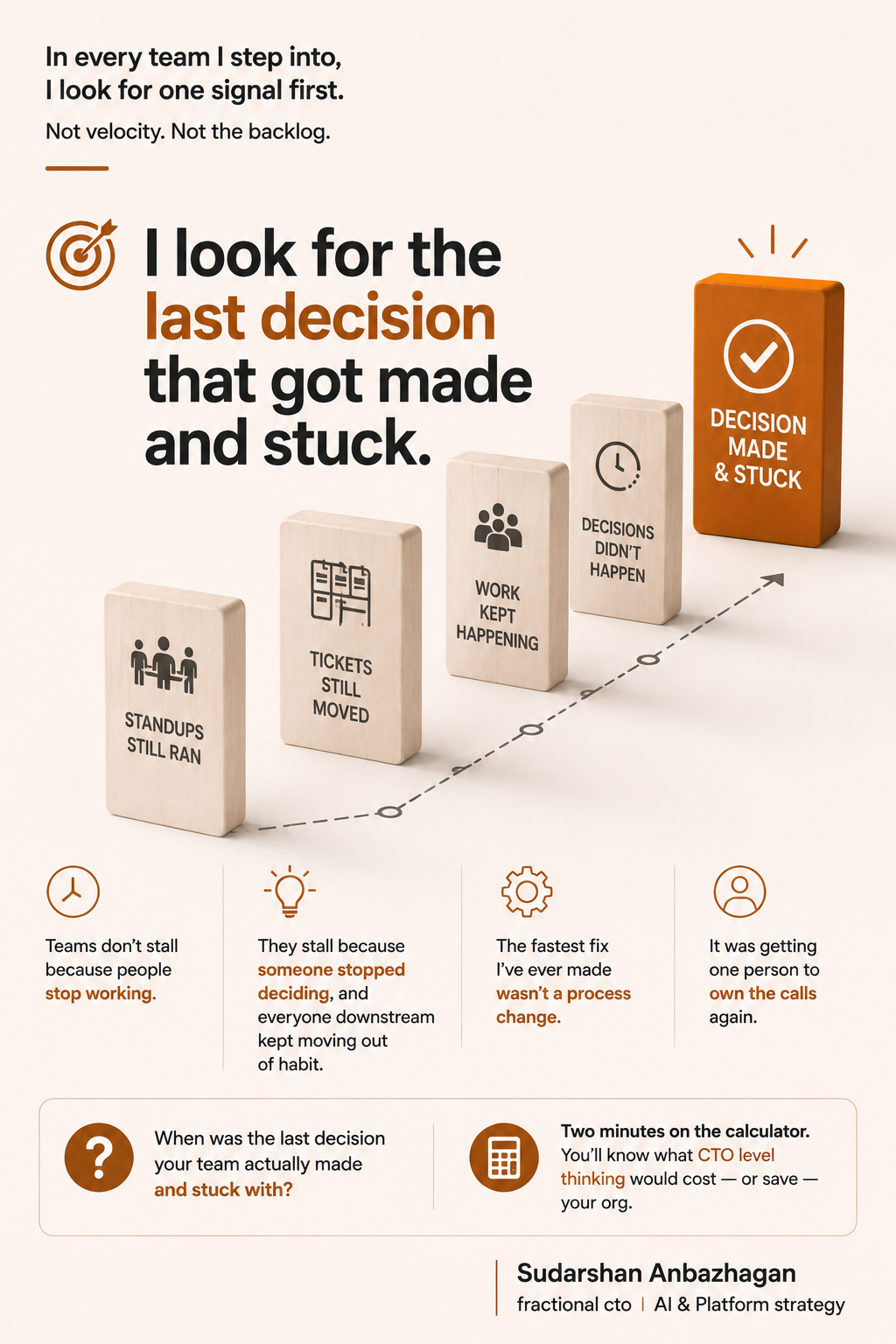
Leadership blames the engineering team for missed deadlines far more often than the evidence actually supports. Sprint after sprint gets reviewed, velocity charts get pulled up in the quarterly business review, and the conversation almost always lands on the same conclusion. The team needs to move faster. In our engineering reviews across SuperBotics’ 500+ successful deployments, we consistently observe that the real bottleneck sits one level above the team, not inside it.
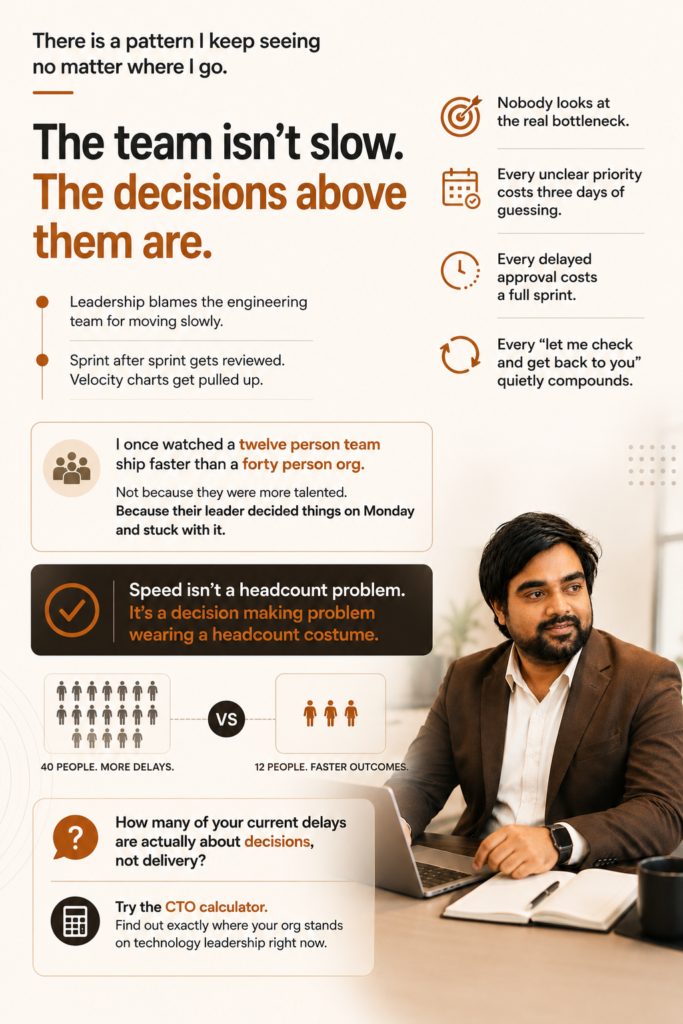
The pattern shows up the same way in company after company. Every unclear priority costs a team roughly three days of guessing about which task actually matters this week. Every delayed approval costs a full sprint, because a team cannot commit engineering hours to a feature that has not been formally greenlit. Every version of “let me check and get back to you” quietly compounds into weeks of stalled work that never shows up on anyone’s dashboard as a delay, because nothing was ever marked blocked.
The Twelve Person Team That Outran a Forty Person Org
I once watched a twelve person engineering team consistently ship faster than a forty person organisation working on a comparable problem. The difference was never talent density or tooling sophistication. The smaller team had a leader who decided things on Monday morning and stuck with the decision through the week, even when new information arrived that could have justified reopening the conversation. The larger org treated every Monday decision as provisional, subject to revision the moment a stakeholder raised a concern on Wednesday.
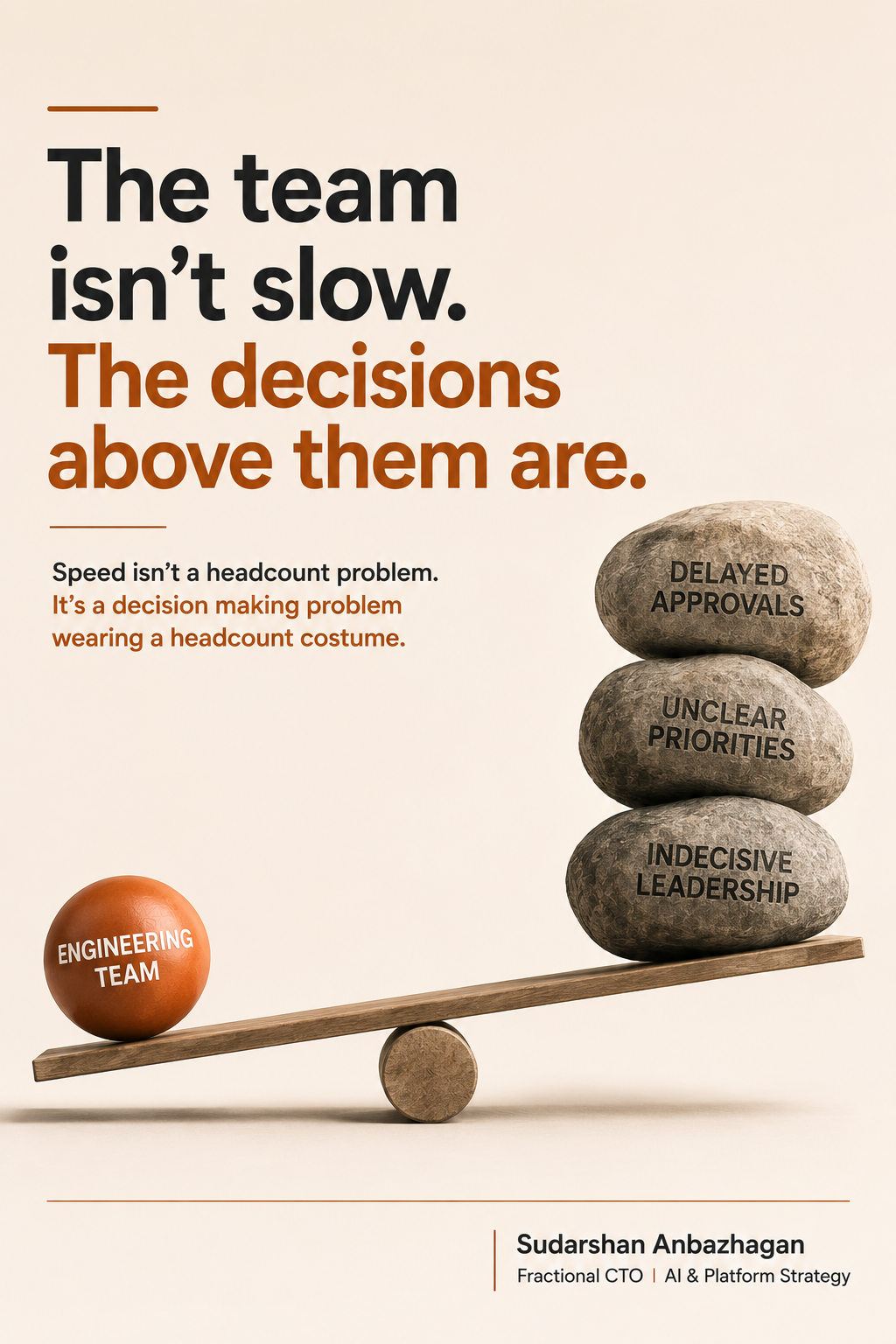
That single behavioural difference, deciding once and holding the line, created a compounding speed advantage that headcount alone could never close. Speed is rarely a function of how many engineers a company employs. It is far more often a function of how quickly and how durably decisions get made above the engineering layer.
Speed is not a headcount problem. It is a decision making problem wearing a headcount costume, and most leadership teams keep buying more costume instead of fixing the decision.
How to Tell the Difference Between a Delivery Problem and a Decision Problem
The diagnostic is simpler than most leadership teams expect. Pull the last five items that missed a deadline and ask, for each one, whether the delay traces back to a technical blocker the team could not solve, or to a decision that sat unresolved above the team for longer than it should have. In the majority of organisations I have reviewed, the second category dominates, often by a wide margin.
- A feature that shipped two weeks late because nobody confirmed the scope until the sprint was already half finished
- A technical debt cleanup that never started because three different stakeholders each thought someone else had approved it
- A customer request that stayed in limbo for a month because leadership could not agree on whether to decline it or accommodate it
None of these examples involve an engineer writing slow code or a team lacking the skill to solve the problem. Each one involves a decision that never got made, or got made and then quietly reopened, forcing the team to wait rather than build.
Most leaders who have run this calculation are surprised by where the real cost sits.
→ Calculate Your Fractional CTO ROI
→ Read the Fractional CTO Guide
What Changes When Someone Owns the Decision Layer
A Fractional CTO does not fix this by adding another layer of meetings or another approval step. The fix works in the opposite direction. Someone with the technical judgement to evaluate trade offs quickly takes ownership of the decisions that previously bounced between three stakeholders, none of whom had the full technical context to close the loop on their own.
| Signal | Delivery Problem | Decision Problem |
|---|---|---|
| Root cause | Technical blocker or skill gap | Unresolved priority or unclear ownership |
| Fix | More engineering capacity | A clear owner for the call |
| Typical cost | Hours of rework | Days to weeks of stalled sprints |
Once that ownership exists, the pattern reverses quickly. Priorities get set once and held. Approvals happen inside days rather than weeks. Engineers spend their time building rather than waiting to find out whether the work they already started is still the right work. None of this requires a larger team. It requires someone accountable for making the call and living with it.
Where to Look Before Your Next Hiring Round
Before adding another engineer to a team that already feels behind schedule, it is worth running an honest audit of how many of the last quarter’s delays trace back to a technical constraint versus a decision that sat too long without an owner. If the second category dominates, more engineering headcount will not close the gap. It will simply give the organisation more people waiting on the same unresolved decisions, at a higher monthly cost.
The teams that fix this problem are rarely the ones who hired the most talented engineers. They are the ones who identified, early and honestly, that their speed problem lived above the engineering layer rather than inside it. That distinction changes where the investment should go, and it changes it before the next round of hiring rather than after.
The gap between a full-time CTO and a Fractional one is rarely what organisations expect before they see the numbers.
→ Calculate Your Fractional CTO ROI
→ Read the Fractional CTO Guide