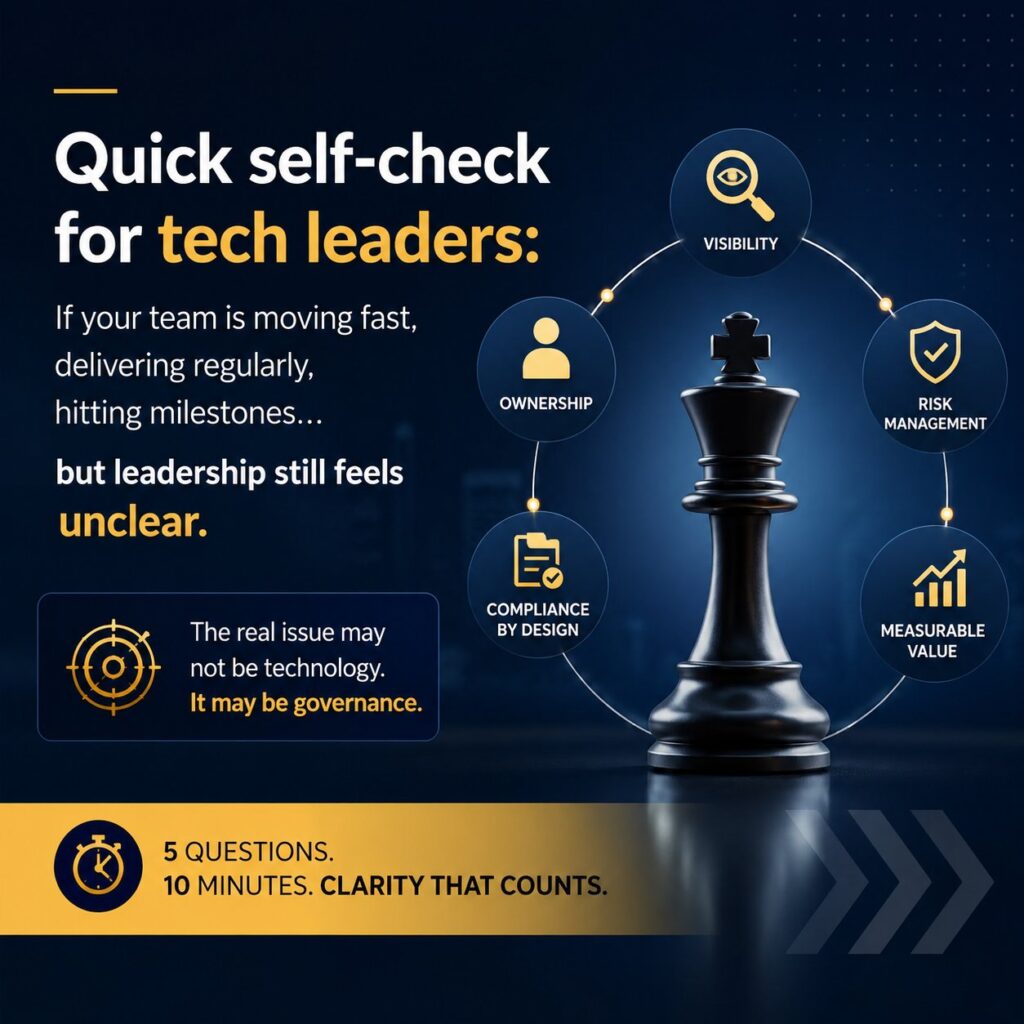

There is a particular kind of organisational discomfort that is difficult to name because it does not announce itself through visible failure. The team is delivering. Milestones are being met. The engineering velocity looks strong on any dashboard you care to consult. And yet, somewhere in the leadership layer, there is a persistent sense that something is not quite right. Decisions that should be straightforward take longer than they should. When something goes wrong, the conversation about who is responsible is more complicated than it ought to be. Compliance is assumed to be in order until someone asks a specific question and the answer takes several days to assemble. The technology portfolio is expanding, but the leadership team would struggle to articulate exactly what value each investment is producing and for whom. This set of symptoms is consistent and recognisable to anyone who has spent significant time in technology leadership, and it has a name. It is a governance problem, and it is one of the most consequential and least-discussed challenges in enterprise technology management today.
What makes technology governance problems particularly difficult to address is that they are invisible during normal operations. When the team is executing well against a clear set of priorities, the absence of a robust governance framework does not create immediate friction. The workarounds that substitute for defined accountability feel like agility. The assumption that compliance is being handled feels like trust. The difficulty of measuring technology value feels like a philosophical limitation rather than a structural one. It is only when something unexpected happens, when a critical decision needs to be made quickly, when a compliance question arrives from an external auditor, when a significant investment needs to be justified to a board that has grown impatient, that the absence of governance infrastructure becomes sharply apparent. By that point, the cost of addressing it has increased significantly, because you are now doing it under pressure rather than with the luxury of deliberate design.
This piece is built around five questions that I use as a governance health diagnostic in technology leadership engagements. They are not complex questions. They do not require a lengthy assessment process or external validation to answer. They require honesty, and they require a willingness to sit with the answers long enough to understand what they are actually telling you about the state of your organisation’s technology governance. In my experience working with technology and operations leaders across fourteen countries, the leaders who make this a regular practice build organisations that are substantially more resilient, more decisive, and more capable of sustaining performance through the kind of unexpected disruptions that reveal governance gaps in organisations that have not invested in this discipline.
What Technology Governance Actually Means for Executives
Before working through the five questions, it is worth being precise about what technology governance means in an executive context, because the term is frequently misused in ways that make it seem either more technical or more bureaucratic than it actually is. Technology governance is not an IT framework. It is not a compliance checklist. It is not the set of policies that your technology team maintains and reviews annually. Technology governance is the system by which your organisation ensures that technology decisions are made by the right people, with the right information, in a way that produces accountable and measurable outcomes. When that system is working well, leadership has clear visibility into what the technology portfolio is doing and why. Ownership of both performance and problems is unambiguous. Risk is actively managed rather than passively acknowledged. Compliance is built into how systems are designed rather than verified after the fact. And every significant technology investment can be connected to a specific business outcome that justifies it. When any one of these elements is absent or unclear, governance is not functioning at the level the organisation needs, regardless of how well the technology itself is performing.
The reason this distinction matters for C-suite leaders is that technology governance problems tend to be diagnosed as technology problems. When visibility is poor, the response is to buy a better analytics platform. When ownership is unclear, the response is to hire a stronger technology leader. When compliance is assumed rather than designed, the response is to bring in an external auditor after a gap has been identified. When value is hard to measure, the response is to commission a strategic review. All of these responses address the symptom without addressing the structural condition that produced it, which is why organisations that take this approach frequently find themselves repeating the same cycle of investment, diagnosis, and correction without ever arriving at a stable and functional governance state.
Question One: Can You See What Truly Matters?
The first question in any governance health assessment is about visibility, and it is important to define visibility precisely because it is a word that gets used to mean many different things in technology conversations. Visibility in this context does not mean the presence of dashboards, reports, or monitoring tools. Organisations that have significant governance problems frequently have abundant dashboards. What they lack is visibility that connects technology performance to business outcomes in a way that enables confident leadership decisions. The question is not whether data exists. It is whether the right people can see the right information at the right time to act on it with confidence.
The practical test for visibility is straightforward. Think about the most consequential decision your leadership team made in the last quarter that involved technology, whether that was a platform investment, an architectural direction, a build-versus-buy choice, or a response to an operational incident. Ask yourself honestly: did the decision-makers have access to all of the information they needed when they needed it, or did the decision proceed with significant uncertainty because certain information was unavailable, unreliable, or too late to be actionable? If the answer is the latter, your governance framework has a visibility gap, and that gap has a cost that is being paid every time a significant decision is made under conditions of preventable uncertainty.
Addressing a visibility gap requires more than adding reporting capability. It requires working backward from the decisions that leadership needs to make and designing the information architecture that supports those decisions. This is a governance design activity, not a technology implementation activity, and it requires active participation from business leaders, not just technology teams. The organisations that get this right do so because their business and technology leaders sat down together and agreed explicitly on what visibility means for their specific context, what decisions it needs to support, and what the organisation will invest to ensure that visibility is available when it is needed.
Question Two: Is Ownership Clearly Defined When It Matters Most?
The second question addresses ownership, and it is deliberately framed in a way that tests whether ownership is real or merely nominal. There is a significant difference between an organisation where ownership is assigned on paper and one where ownership is genuinely understood and accepted by the people who hold it. The test I use is simple: if something goes wrong at eleven o’clock tonight, does every relevant person in your organisation know without any ambiguity who is responsible, what authority that person has to respond, and what the escalation path looks like if the initial response is insufficient? If that question produces any uncertainty, your ownership structure has a governance gap that will be felt most acutely at the moments when it is most consequential.
Ownership gaps in technology governance typically manifest in one of three ways. The first is diffuse ownership, where responsibility is shared across multiple people or teams in a way that makes it unclear who has the authority to make a final decision. The second is misaligned ownership, where the person who is accountable for an outcome does not have the authority or the resources to influence it. The third is absent ownership, where a critical area of technology performance has no assigned accountability at all, either because it falls in the gap between organisational structures or because it was never explicitly considered during the design of the governance framework. All three of these patterns produce the same outcome: slower, more complicated responses to problems that should be addressed quickly and decisively.
The governance investment required to address ownership gaps is not primarily a structural one. Reorganising reporting lines does not produce clear ownership by itself. What produces clear ownership is a deliberate conversation in which leaders at every level of the organisation agree on who is responsible for what, what that responsibility includes and excludes, and what accountability looks like in practice. That conversation needs to happen before a crisis creates the urgency to have it, because the conversation that happens under pressure is rarely as thorough or as honest as the one that happens by design.
Question Three: Are Risks Actively Managed or Just Acknowledged?
The third question addresses risk management, and the distinction it draws is one of the most important in the entire governance framework. There is a pervasive practice in enterprise technology management of documenting risks thoroughly while managing them inadequately. Risk registers are maintained. Risk reviews are scheduled. Risk ratings are assigned and colour-coded. And at the end of this process, the organisation has an accurate and well-organised record of the risks it is exposed to, without having materially reduced its exposure to any of them. This is risk acknowledgment, and it is not the same as risk management.
Active risk management in a technology governance context means that identified risks have owners who are accountable for reducing them, that risk reduction is a measurable activity with defined milestones and visible progress, and that the risk profile of the technology portfolio is a standing agenda item in executive conversations rather than an annual exercise conducted by the technology team in isolation. It means that when a risk materialises into an incident, the post-incident review produces changes to the governance framework that reduce the probability of the same risk materialising again, rather than simply documenting what happened and moving on. And it means that risk appetite is defined at the leadership level and communicated clearly enough that technology teams can make decisions consistent with it without requiring executive escalation for every significant choice.
The organisations that manage technology risk most effectively are the ones where business and technology leaders share a common understanding of what the organisation’s risk exposure looks like and what it would take to change it. That shared understanding does not emerge automatically from the existence of a risk framework. It emerges from regular, honest conversations in which the people who own risks report on them with the same rigour and transparency they would apply to a financial performance review. When risk management is treated as a governance discipline rather than a compliance exercise, it changes the quality of decision-making throughout the organisation.
Question Four: Is Compliance Built In or Bolted On?
The fourth question addresses compliance, and the framing of built in versus bolted on captures a distinction that has significant implications for both operational efficiency and risk exposure. Compliance that is bolted on is compliance that is verified after systems have been designed and processes have been established. It is the audit that identifies gaps, the remediation project that addresses them, and the monitoring process that checks periodically whether the gaps have reappeared. This approach to compliance is expensive, reactive, and structurally limited, because it can only catch problems that have already occurred rather than preventing them from occurring in the first place.
Compliance that is built in means that the systems, workflows, and decision-making processes your organisation operates have been designed with compliance requirements as a foundational consideration rather than an afterthought. It means that the controls that ensure regulatory adherence, data protection, and internal policy compliance are embedded in how work gets done rather than applied as a check on work that has already been done. It means that your compliance posture strengthens as your technology portfolio scales rather than deteriorating under the weight of accumulated technical debt and policy drift. And it means that when a compliance question arrives, from a regulator, from a board audit committee, from a potential partner conducting due diligence, the answer can be provided with confidence and speed rather than with the anxiety that comes from uncertainty about what an investigation might reveal.
Transitioning from bolt-on to built-in compliance is a governance investment that pays returns across the entire organisation. It reduces the cost of compliance activity, because prevention is less expensive than remediation. It reduces risk exposure, because built-in controls catch issues at the point of origin rather than after they have propagated. And it builds the kind of institutional confidence in compliance posture that allows leadership to pursue opportunities aggressively without the concern that growth will create compliance exposure that the organisation is not equipped to manage.
Question Five: Can Every Technology Investment Be Tied to a Measurable Outcome?
The fifth question is the one that most directly connects technology governance to business performance, and it is the one that most organisations find most difficult to answer with confidence. The ability to connect every significant technology investment to a specific, measurable business outcome is the clearest indicator of a mature governance framework, because it requires everything else in the governance system to be functioning. You cannot measure technology value without visibility. You cannot assign value to investments without clear ownership. You cannot sustain value creation without managing the risks that threaten it. You cannot scale value without building compliance into the systems that produce it. Value measurement is not the end of the governance conversation. It is the outcome that all other governance investments are designed to enable.
The practical challenge of technology value measurement is that the connection between a technology investment and a business outcome is rarely direct and is sometimes separated in time by months or years. A platform modernisation investment that enables faster data access does not immediately produce a revenue improvement, but it does produce a decision quality improvement that will eventually manifest in better resource allocation, faster responses to market changes, and reduced cost of operational errors. Making this connection explicit requires a discipline of investment thesis documentation and outcome tracking that most organisations have not yet built into their governance framework. It also requires a shared vocabulary between technology and business leaders about what value means in the context of specific investments, and that vocabulary can only be developed through sustained, deliberate conversation.
The organisations that do this well are the ones where technology investment decisions are made with the same rigour as capital allocation decisions in any other part of the business. The investment thesis is documented. The expected outcomes are defined in measurable terms. The timeline for realising those outcomes is agreed. And the governance framework includes a process for reviewing actual outcomes against the thesis and drawing explicit lessons from the comparison, whether the investment performed as expected or not.
Making Governance Health a Leadership Habit
The five questions in this checklist take minutes to answer. What they surface can take months to address, and that is exactly the point. The value of a regular governance health self-assessment is not that it resolves governance gaps in the moment of reflection. It is that it keeps leadership aware of the gaps before they create the kind of acute pressure that forces a response at a cost far higher than proactive investment would have required. The strongest technology leadership teams treat governance health as a standing agenda item, not a crisis response. They ask these questions regularly, they track their answers over time, and they treat improvement in governance health as a leadership objective with the same standing as any other strategic priority.
Good governance does not slow organisations down. This is the misconception that most consistently prevents investment in governance infrastructure, and it is worth addressing directly. The organisations with the clearest visibility, the most unambiguous ownership, the most active risk management, the most embedded compliance, and the strongest value measurement capability are not the ones that move slowly and cautiously. They are the ones that move quickly and confidently, because their leaders have the information they need to make decisions without hesitation, the accountability structures to execute without confusion, and the risk awareness to pursue opportunities without being blindsided by exposures they did not see coming.
If any of the five questions in this checklist gave you pause, that pause is useful information. It is telling you where your governance investment will produce the greatest return. The question worth asking now is not whether the gaps exist. The question is whether you will address them by design or by crisis. The leaders who build governance health into their regular practice have already made that choice, and the organisations they lead are measurably stronger for it.
If you are working through a technology governance challenge or building a governance framework for a scaling organisation and would like to continue this conversation, I invite you to connect directly at linkedin.com/in/sudarshananbazhagan. The most useful governance conversations I have had started with one of these five questions and went somewhere neither party expected.