Interim CTO Engagement: Why You Need Three Decisions, Not a Full-Time Hire
There is a pattern that repeats across founder conversations regardless of industry or geography. Founders arrive ready to hire a CTO before they are actually ready to use one productively. The instinct is understandable. Technical uncertainty feels urgent, and hiring a senior leader feels like the responsible response to that urgency. But in our engineering reviews across SuperBotics’ 500+ successful deployments, the more accurate diagnosis is almost always narrower and far less expensive to solve than a full-time hire suggests.
A full-time CTO is a significant, multi-dimensional commitment. Equity, salary, and typically six to twelve months before the hire produces meaningful strategic output, simply because ramp-up in a new organization takes real time regardless of how experienced the person is. Most of the time, what the business actually needs right now is not a permanent addition to the leadership team. It is three specific, nameable decisions currently blocking the next quarter of progress.
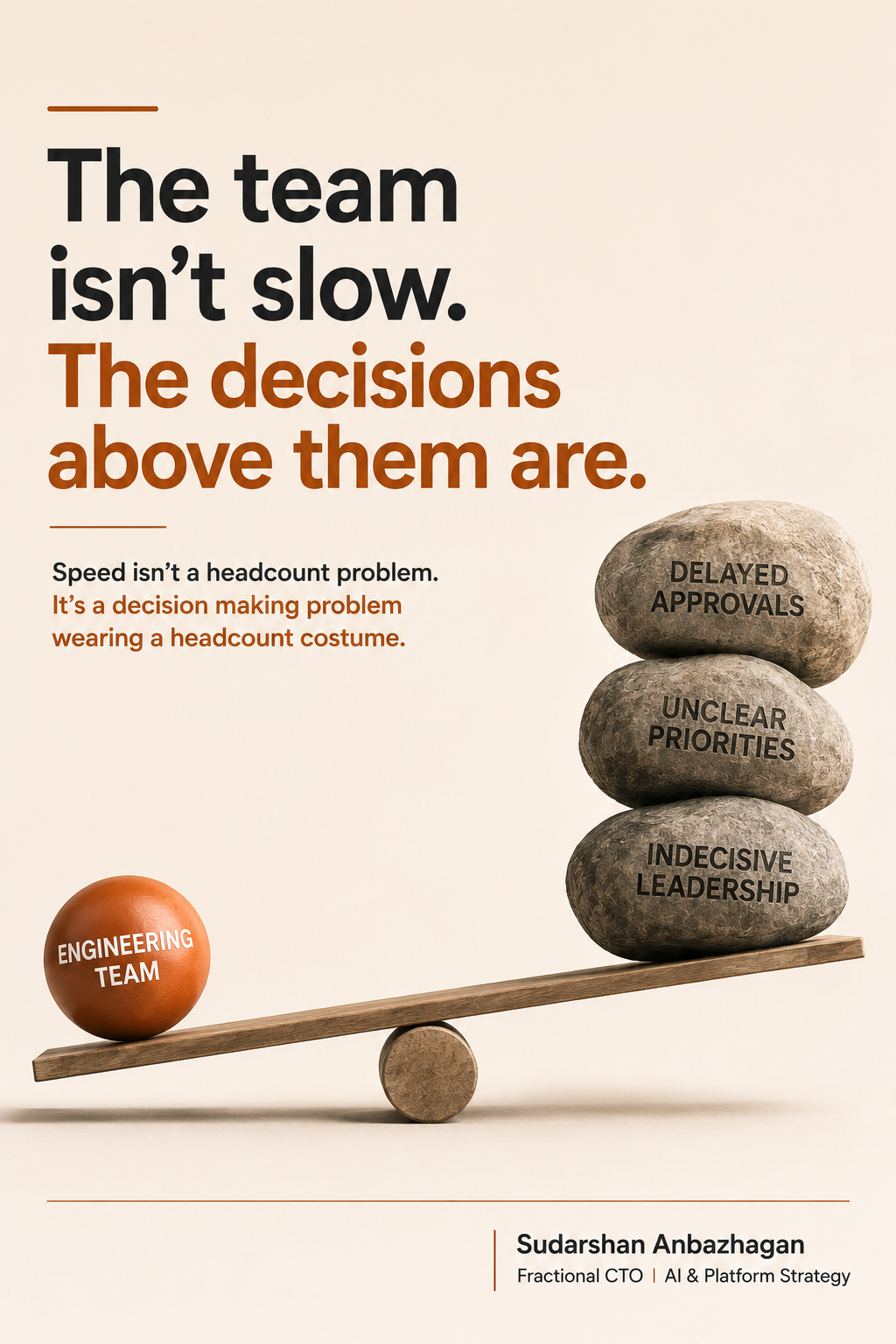
Which architecture to commit to. Which vendor to select. Which team model to build around. These three categories of decisions account for the overwhelming majority of what actually stalls a growing technology organization, and none of them require a permanent job description to resolve. They require an interim CTO engagement structured specifically around unblocking those decisions with speed and accountability.
Why an Interim CTO Engagement Resolves What a Job Description Cannot
Those three decisions do not need someone hired into a role. They need someone who has already witnessed the consequences of getting each type of decision wrong, and who can therefore resolve them quickly rather than researching them from a standing start. That distinction matters enormously in practice. A newly hired full-time CTO, however talented, spends their first several months learning the organization before they can respond to a live decision with genuine, tested confidence. An interim CTO engagement, structured around a fractional CTO technology governance framework, arrives with that pattern recognition already built from prior engagements and applies it immediately.
Most leaders who have run this calculation are surprised by where the real cost sits.
→ Calculate Your Fractional CTO ROI
→ Read the Fractional CTO Guide
An interim CTO engagement does exactly this, and importantly, leaves the organization in a stronger position for a permanent hire once that hire is genuinely warranted. The engagement is not designed to postpone the eventual full-time role indefinitely. It is designed to ensure that when the full-time hire happens, they inherit an organization with its architecture, vendor relationships, and team structure already resolved, rather than inheriting the same three unresolved decisions that were blocking progress before the interim engagement began.
Are You Hiring a CTO, or Trying to Resolve Three Specific Decisions
| Signal | You Need a Full-Time CTO | You Need an Interim CTO Engagement |
|---|---|---|
| Nature of the gap | Ongoing leadership presence across many domains | A small set of specific, high-stakes decisions |
| Time horizon | Multi-year strategic ownership | Weeks to a few months of focused resolution |
| Organizational stage | Scale requires daily technical leadership presence | Growth stage still defining its core architecture |
Before the hire, run the math. Most founders do not, which is exactly why they are surprised later, either by the cost of a full-time hire that sits underutilized during a slower quarter, or by the six-month search timeline that leaves the three blocking decisions unresolved for longer than the actual decision-making would have taken.
Cross-Geography Engineering Teams and the Architecture Decision Backlog
Founders running cross-geography engineering teams face a particular version of this problem. Managing delivery inconsistency in cross-geography engineering teams frequently traces back to exactly one of these three decision categories left unresolved, most often the architecture question, because architecture decisions made without full-time technical leadership tend to get made piecemeal by whichever engineer is available in a given time zone, rather than deliberately by someone accountable for the whole system.
An interim CTO engagement addresses this directly by resolving the architecture question once, with full context across every time zone the team operates in, rather than allowing it to accumulate as a patchwork of local decisions made independently across US-Europe market targets and India-based delivery centres. That single resolved decision often does more to stabilize delivery than months of incremental process improvements applied to a codebase whose foundational architecture question was never actually settled.
Vendor Selection: The Decision Most Founders Underestimate
Vendor decisions, whether choosing a cloud data infrastructure provider, an MLOps pipeline platform, or a testing framework like Appium or Playwright, are frequently treated as procurement exercises rather than strategic technology decisions. That framing consistently understates their real impact. A vendor decision made without senior technical judgment locks an organization into months, sometimes years, of downstream constraints that a founder without deep technical background cannot easily evaluate at the time of selection.
The gap between a full-time CTO and an interim CTO engagement is rarely what organizations expect before they actually see the numbers.
An interim CTO engagement resolves the vendor decision with the benefit of having seen similar vendor evaluations play out across other engagements, spotting the contractual and technical constraints that a first-time evaluator would likely miss entirely. This single decision, made well once, frequently saves more organizational cost than the entire engagement itself.
Team Model: The Third Decision That Determines Everything Downstream
The third decision, which team model to build around, whether that means in-house hiring, a managed delivery pod, or some hybrid structure, shapes nearly every other operational decision that follows it. Getting this decision wrong does not fail immediately. It fails slowly, over quarters, as the mismatch between the team model and the actual work compounds into delivery inconsistency that gets misdiagnosed as a talent problem rather than a structural one.
This connects directly to the broader question of what builds durable trust in technology leadership at the founder level. Founders who bring in focused, decisive technical judgment at exactly the moments those three decisions arise build organizations that scale predictably. Founders who default to a full-time hire as the answer to every technical uncertainty often end up with a senior leader whose actual daily work is dominated by decisions that could have been resolved in weeks, not carried as an ongoing full-time responsibility.
What an Interim CTO Engagement Actually Looks Like Week to Week
Founders considering this path often ask what the engagement structure actually looks like in practice, since “interim CTO” can sound abstract without a concrete cadence attached to it. In a well-structured engagement, the first two weeks are spent entirely on diagnosis, not decision-making. This period exists specifically to avoid the trap of resolving a decision quickly but incorrectly, because speed without proper context produces the same downstream problem a rushed full-time hire would create.
Following diagnosis, each of the three core decisions, architecture, vendor, and team model, gets its own structured resolution sprint, typically running one to three weeks depending on complexity. Each sprint ends with a documented decision, the reasoning behind it, and a named internal owner who will carry that decision forward once the engagement concludes. This documentation step is frequently the most valuable deliverable of the entire engagement, because it prevents the same ambiguity that created the original blocking decisions from re-forming six months later once the interim CTO’s direct involvement has ended.
The engagement typically closes with a structured handoff, not unlike the Three-Phase Pod Calibration Window used in engineering pod formation, where the internal team demonstrates ownership of each resolved decision before the interim CTO’s involvement formally winds down. That handoff discipline is what separates an interim engagement that leaves lasting clarity from one that simply defers the same ambiguity a few more months into the future.
The Cost Comparison Most Founders Never Actually Run
Do the math on what a six-month CTO search actually costs, not just in recruiting fees, but in the compounding cost of three unresolved decisions sitting blocked for that entire search period. Architecture decisions left unresolved accumulate technical debt every sprint they remain open. Vendor decisions left unresolved often mean paying month to month for suboptimal tooling while the search continues. Team model decisions left unresolved mean continued reliance on whatever staffing pattern already exists, even when that pattern is visibly not working.
When founders actually run this comparison line by line, rather than treating the full-time hire as the default, obviously correct choice, the numbers frequently favor an interim CTO engagement quite clearly, not because full-time technical leadership lacks value, but because the timing of when that leadership actually gets applied matters as much as whether it exists at all. Fractional CTO services exist specifically to close this timing gap without asking a growing organization to make a premature multi-year commitment before it has clarity on what that commitment should actually look like.
When You’ve Outgrown the Decisions, That’s When You Need the CTO
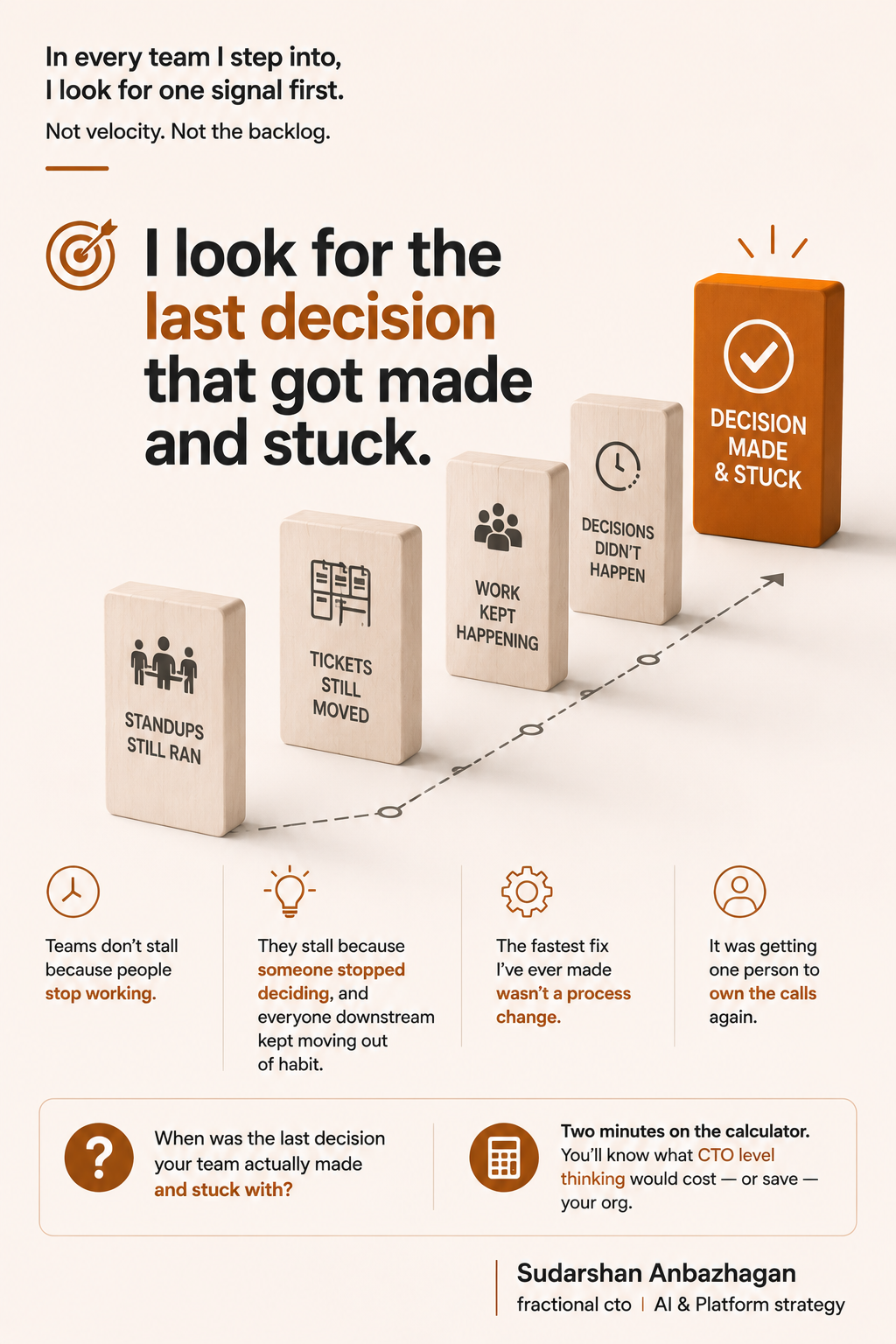
There is a clear signal for when an interim CTO engagement should transition toward a full-time hire. It is not a revenue milestone or a headcount threshold. It is the moment when the volume and frequency of technical decisions requiring senior judgment exceeds what a focused, time-boxed engagement can reasonably absorb. At that point, the organization has genuinely outgrown the three-decision framing, and a permanent technical leader becomes the right structural answer.
Before the hire, run the math. Most people don’t. That’s why they’re surprised later.
→ Calculate Your Fractional CTO ROI
→ Read the Fractional CTO Guide
Are you hiring a CTO, or trying to get three specific decisions resolved. That question, asked honestly before opening a search, saves most growing organizations months of unnecessary search time and delivers the actual unblocking they need far faster than a traditional hiring process ever could.