
Why Technology Rebuilds Repeat the Same Mistake Eighteen Months Later
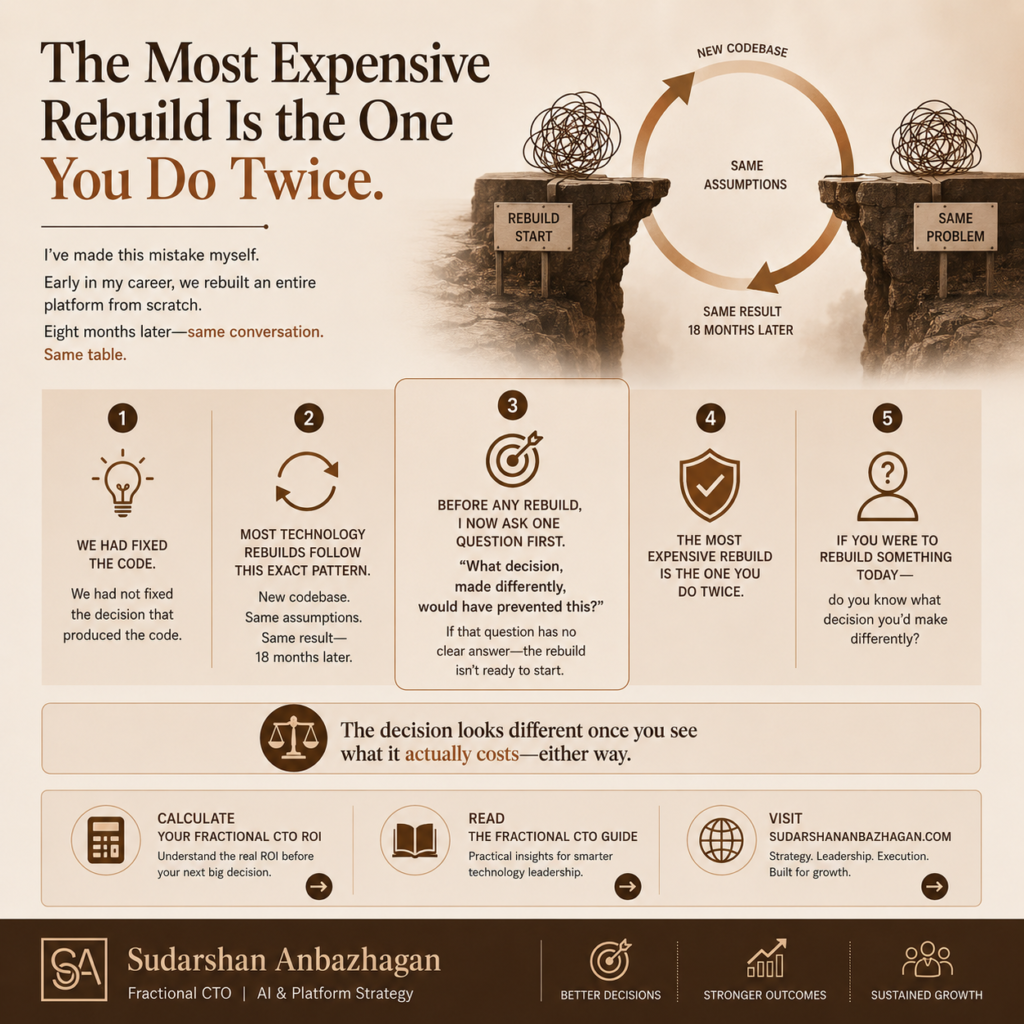
Early in my career, a team I was part of rebuilt an entire platform from scratch. New codebase, fresh architecture, a genuine sense that the old problems were finally behind us. Eight months later, the same conversation happened, at the same table, with the same frustration. We had fixed the code. We had not fixed the decision that produced the code, and that distinction is the center of nearly every failed technology rebuild I have seen since.
Managing delivery inconsistency in cross-geography engineering teams almost always traces back to this same root cause when a rebuild is on the table. A team spread across time zones inherits not just the previous system’s technical debt, but the previous decision-making pattern that created it. Rewriting the code without examining that pattern guarantees the pattern survives the rewrite completely intact.
Most technology rebuilds follow an identical structure. New codebase. Same assumptions carried over unexamined. Same result surfacing again roughly eighteen months later, dressed in a different technology stack but recognizable to anyone who lived through the first version. The rebuild feels productive because visible, measurable work is happening. Commits are landing. Tickets are closing. But the underlying decision that shaped the failure the first time was never actually revisited.
The Question That Determines Whether a Fractional CTO Technology Governance Framework Rebuild Will Succeed
Before any rebuild begins, there is one question worth asking with real discipline. What decision, made differently, would have prevented this. If that question produces no clear, specific answer, the rebuild is not actually ready to start, regardless of how urgent the pressure to begin feels.
Most leaders who have run this calculation are surprised by where the real cost sits.
→ Calculate Your Fractional CTO ROI
→ Read the Fractional CTO Guide
This is precisely the discipline a fractional CTO technology governance framework rebuild is designed to enforce before a single line of new code is written. The framework does not begin with architecture diagrams. It begins with a structured post-mortem on the decision history behind the system being replaced, because skipping that step is the single most reliable predictor of a rebuild repeating its predecessor’s outcome.
Common Decisions That Survive a Rebuild Unexamined
- Who has authority to approve a scope change mid-project, often never formally clarified
- Which quality bar actually gates a release, frequently assumed rather than documented
- How disagreements between product and engineering get resolved, usually resolved by whoever is loudest
None of these are technical questions. All three are decision-ownership questions, and all three transfer directly from an old system into its replacement unless someone deliberately interrupts that transfer.
Managing Delivery Inconsistency in Cross-Geography Engineering Teams During a Rebuild
Rebuilds involving cross-geography engineering teams face an additional layer of risk. Managing delivery inconsistency in cross-geography engineering teams becomes significantly harder during a rebuild because the team assembled for the new build often includes people who were not present for the original decisions that shaped the system now being replaced. They inherit the codebase’s problems without inheriting the context of why those problems exist, which means they are structurally unable to avoid repeating the same choices, because nobody explained what those choices actually were.
I have watched teams spanning US-Europe market targets and India-based delivery centres approach a rebuild with genuine technical excellence and still land in the same place eighteen months later, because the decision history was never transferred as deliberately as the technical requirements were. Compliance and governance entities like SOC 2 and GDPR get documented meticulously during a rebuild. The decision-making pattern that caused the original system’s failure almost never gets the same documentation discipline, and that asymmetry is exactly where repeat failures come from.
The most expensive rebuild is the one you do twice, and the second one is rarely more expensive because of the code. It is more expensive because the decision debt compounded for another eighteen months before anyone addressed it.
MLOps Pipelines, RAG Frameworks, and Rebuilds That Inherit the Wrong Assumptions
Modern rebuilds frequently involve introducing MLOps pipelines or RAG framework capabilities that did not exist in the original system. This creates a specific trap. Teams assume that because the technology is genuinely new, the underlying decision patterns must also be new. In practice, the same unresolved questions about ownership, quality gates, and escalation authority get imported directly into the new AI-enabled architecture, simply wearing more modern terminology.
A RAG framework implementation still requires someone to decide what “good enough” retrieval accuracy looks like for the business case at hand. An MLOps pipeline still requires someone to decide how model drift gets escalated and to whom. These are the same category of decision that went unaddressed in the legacy system, now embedded inside newer infrastructure, Odoo views, or React Native mobile builds that make the rebuild feel fundamentally different when the actual decision-making skeleton underneath has not changed at all.
The Three-Phase Diagnostic Before Committing to Any Rebuild
- Document every major decision that shaped the system now being replaced, with the name of who owned each one
- Identify which of those decisions were never formally revisited, only inherited by default
- Assign explicit new ownership for each unresolved decision before writing a single line of new architecture
This diagnostic is deliberately uncomfortable, because it forces a team to admit that the previous failure was rarely a pure technology problem. This mirrors the deeper discipline behind what builds lasting trust in technology leadership, a willingness to examine decisions honestly rather than simply replacing the artifact those decisions produced.
Why Leadership Underestimates How Much a Rebuild Actually Costs
Rebuilds are almost always budgeted as a technical exercise, with cost estimates built around engineering hours, infrastructure spend, and migration timelines. That budgeting approach consistently underestimates the true cost of a rebuild, because it leaves out the cost of the decisions that will need to be made along the way and the cost of getting those decisions wrong a second time.
Fewer assumptions and more clarity is not a slogan borrowed from a leadership workshop. It describes a measurable difference in how rebuild budgets actually play out. Teams that treat decision-making capacity as a line item, allocating real time for structured decision reviews rather than assuming they will happen informally, consistently land closer to their original timeline. Teams that treat the rebuild as purely a coding exercise consistently discover, around month six, that the timeline has slipped because unresolved decisions kept resurfacing mid-sprint, each one requiring a pause that was never budgeted for.
This is one of the clearest places where CTO-level thinking earns its cost. The value is not in writing better code personally. It is in forcing the decision-cost conversation into the budget before the rebuild starts, rather than discovering it as an unplanned delay once the rebuild is already underway and the pressure to ship has made careful decision-making feel like an unaffordable luxury.
Technology Governance Health as a Leading Indicator Before You Rebuild
Organizations considering a rebuild often skip a step that would meaningfully change how the rebuild gets structured, an honest assessment of the technology governance health that existed around the system now being replaced. A system rarely fails purely because of accumulated code complexity. It fails because the governance structure around it, who approves what, who owns quality, who resolves disputes, degraded quietly over time until the code complexity became the visible symptom of an invisible governance failure.
Rebuilding without first assessing that governance health means rebuilding on the same foundation that allowed the original failure to develop undetected. A structured governance health checklist, walked through honestly before committing engineering resources to a rebuild, frequently surfaces the actual root cause faster and at a fraction of the cost of discovering it eighteen months into a new codebase that has begun exhibiting the same warning signs its predecessor did.
Enterprise modernization efforts that skip this step tend to modernize the technology while leaving the governance gap completely untouched, which is exactly the condition that produces a second rebuild down the line. The organizations that break this cycle treat governance health as a prerequisite check, not an afterthought, before committing to any significant rebuild.
What Rebuild Success Actually Looks Like Eighteen Months Later
Organizations that break this cycle share a specific pattern. Eighteen months after a rebuild, the codebase looks different, which is expected. What is more telling is that the decision log looks different too, with clear ownership assigned to categories of choices that used to drift by default. The rebuild succeeded not because the new architecture was better engineered, though it usually was, but because the decision debt that produced the original failure was actually paid down rather than simply carried forward into new infrastructure.
The decision looks different once you see what it actually costs, either way.
→ Calculate Your Fractional CTO ROI
→ Read the Fractional CTO Guide
If you were to rebuild something today, do you know what decision you would make differently, specifically and by name, rather than in general terms about “better process.” The most expensive rebuild is the one you do twice, and the only reliable way to avoid a second rebuild is to fix the decision before you fix the code, not after.
A Short Test Before You Approve the Next Rebuild Proposal
Before signing off on a rebuild, it is worth running one final test with the team proposing it. Ask them to name, out loud and specifically, the single decision that they believe caused the current system’s most persistent failure. Not a technology choice, a decision. If the room answers quickly and specifically, the rebuild proposal is likely grounded in real diagnosis. If the room reaches instead for a technology explanation, a framework that is outdated, a database that does not scale, that answer is often a symptom being mistaken for a cause.
Enterprise modernization initiatives that pass this test consistently outperform the ones that skip it, not because the resulting architecture is more advanced, but because the team building it has already done the harder work of separating what actually went wrong from what merely looked wrong. That separation, more than any framework choice, determines whether the next rebuild becomes the last one this system ever needs.