
How to Structure GCC Governance Without Slowing Down Decisions
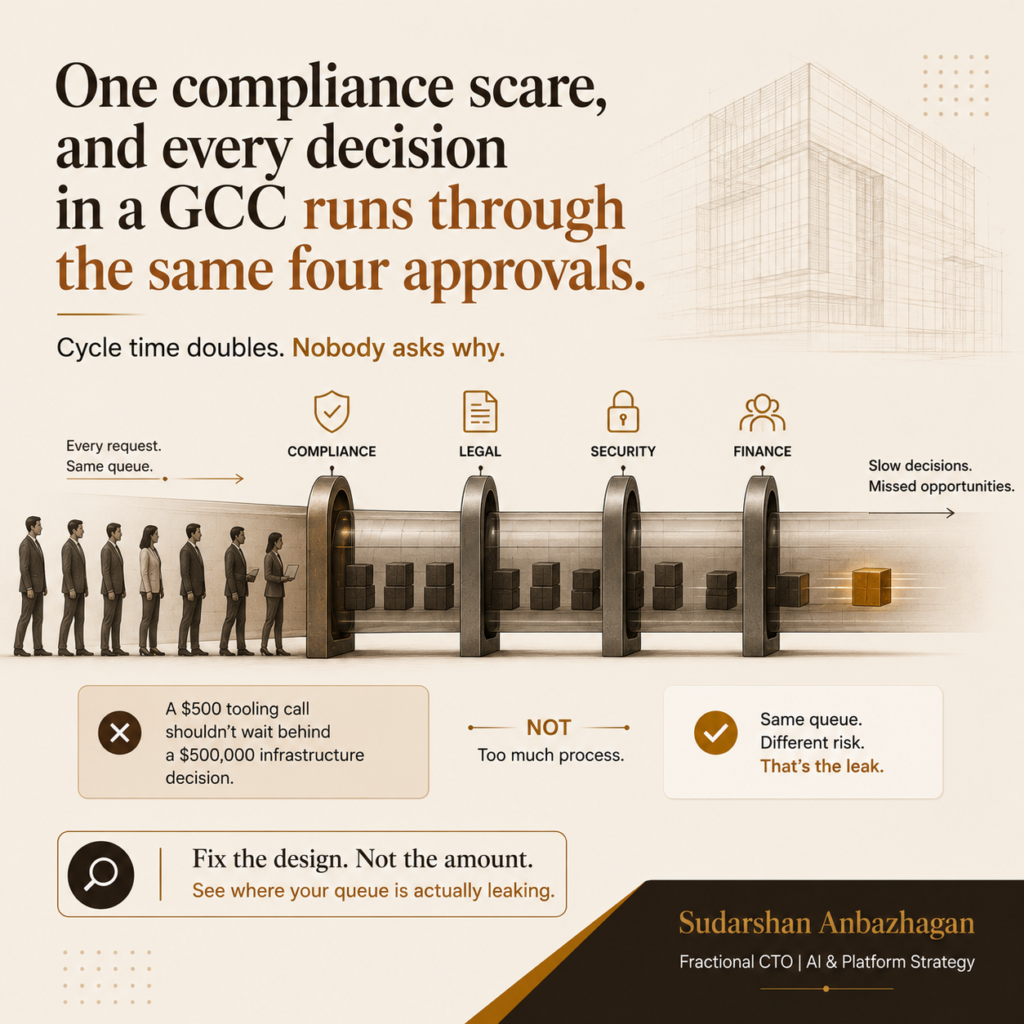
One compliance scare is usually all it takes. A near miss, an audit finding, an uncomfortable question from a board member, and suddenly every decision inside a Global Capability Centre, big or small, starts routing through the same four layers of approval. Cycle time doubles within a quarter. Almost nobody stops to ask why.
In our engineering reviews across SuperBotics’ work with GCCs across 14+ countries, this is one of the most consistent structural mistakes we see, and it rarely gets diagnosed correctly. Leadership assumes the problem is too much process, and responds by trying to strip process out. That usually reintroduces the exact risk the process existed to prevent. The real problem was never the amount of governance. It was the design.
The Queue Design Problem Hiding Inside Most GCCs
A five hundred dollar tooling subscription and a five hundred thousand dollar infrastructure commitment should not wait behind the same approval queue. They carry entirely different risk profiles, yet in most GCCs that have grown organically, they travel through an identical chain of sign offs, because nobody designed separate lanes for separate risk levels.
This is the leak that governance conversations usually miss. Everyone focuses on the number of approval steps. The actual issue is that every decision, regardless of size or risk, enters the same single queue, so a low-stakes call gets stuck behind a high-stakes one purely because of arrival order, not because it deserves the same scrutiny.
The risk hiding inside this is not just slower delivery. It is a governance model people quietly start working around, because a control that treats every decision as equally risky eventually gets treated as equally unimportant.
The Tiered Governance Model That Actually Scales
We consistently observe that GCCs which maintain both speed and control do so through one specific design choice: they tier decisions by risk and dollar impact, and route each tier through a different approval path, rather than routing everything through leadership.
| Decision Tier | Example | Approval Path |
|---|---|---|
| Tier 1: Low risk, low cost | Tooling subscriptions, minor process tweaks | Team lead sign off, logged not escalated |
| Tier 2: Moderate risk or cost | Vendor contracts, staffing changes within budget | Functional head approval, reviewed weekly |
| Tier 3: High risk or strategic | Infrastructure commitments, compliance-adjacent decisions | Leadership review, full documentation required |
The mechanics of this model are not complicated. What makes it hard is the discipline to actually let Tier 1 decisions move without escalation, because the instinct after a compliance scare is to tighten everything uniformly. Tiering only works if leadership resists that instinct and trusts the lower tiers to function as designed.
The First 90 Days Are When This Gets Decided, Whether Anyone Notices or Not
We have written before about how the first ninety days of a GCC define the next three years, and governance design is one of the clearest examples of why that window matters so much. A tiered approval structure is straightforward to build before the center is operating. It is considerably harder to retrofit once every team has already learned to route everything through the same single queue out of habit.
Centers that get this right in year one rarely think of it as a governance project. They think of it as answering one question clearly, before the first hire joins: who is trusted to decide what, without asking permission first. Everything else in the tiering model follows from that single answer.
The GCC cost model looks very different once you replace assumptions with real numbers.
→ Calculate Your GCC Cost Model
→ Read the GCC Strategy Guide
What Happens When Tiering Is Missing
Without a tiered structure, a GCC’s governance model tends to drift toward one of two failure modes, and both are expensive in different ways.
The first is the queue congestion already described, where everything waits behind everything else, and cycle time creeps up until leadership eventually notices delivery has slowed without an obvious single cause. The second, less discussed failure mode is the opposite: teams start quietly bypassing the process altogether for small decisions, because waiting weeks for a tooling approval is not tenable, and once bypassing becomes normal for small decisions, it becomes harder to enforce discipline for the large ones that genuinely need it.
Neither failure mode looks like a governance problem from the inside. Both usually get diagnosed as a hiring problem, a communication problem, or a tooling problem, because the actual root cause, an undifferentiated approval queue, is not the first place leadership tends to look.
A Practical Sequence for Introducing Tiering to an Existing GCC
- Pull the last quarter of approval requests and sort them by actual dollar impact and risk, not by which team submitted them.
- Draw the tier boundaries based on that real distribution, not on a theoretical framework borrowed from another organisation.
- Assign each tier an explicit approval path and communicate it clearly, so teams know in advance which lane a decision will travel through before they submit it.
This sequence takes a matter of weeks, not months, because the data needed to design the tiers usually already exists. The harder part is the second sequence: leadership actually letting Tier 1 decisions move without inserting themselves, which is a discipline question more than a design question.
Governance as a Growth Lever, Not a Brake
The centers that eventually earn genuine strategic weight inside their organisations tend to be the ones where governance was designed to protect speed on the decisions that do not need scrutiny, while concentrating real scrutiny on the decisions that do. That framing changes how governance gets discussed internally. It stops being a compliance conversation and starts being a design conversation about where risk actually concentrates.
A GCC that treats every decision as equally risky will always feel slow, regardless of how talented the team inside it is. A GCC that has done the work to separate its decision tiers can move quickly on the ninety percent of decisions that carry little risk, while still applying real rigor to the ten percent that could genuinely hurt the business if handled carelessly.
If your GCC’s queue has been getting slower and the instinct has been to add more approvals rather than fewer, tiering is usually the fix that gets missed, because it requires looking at the design of the queue rather than the length of it.
The teams that build GCCs that scale always start with one thing, a clear picture of what it actually costs before they commit.
→ Calculate Your GCC Cost Model
→ Read the GCC Strategy Guide