
Decision Debt Is the Real Reason Delivery Slowed Down
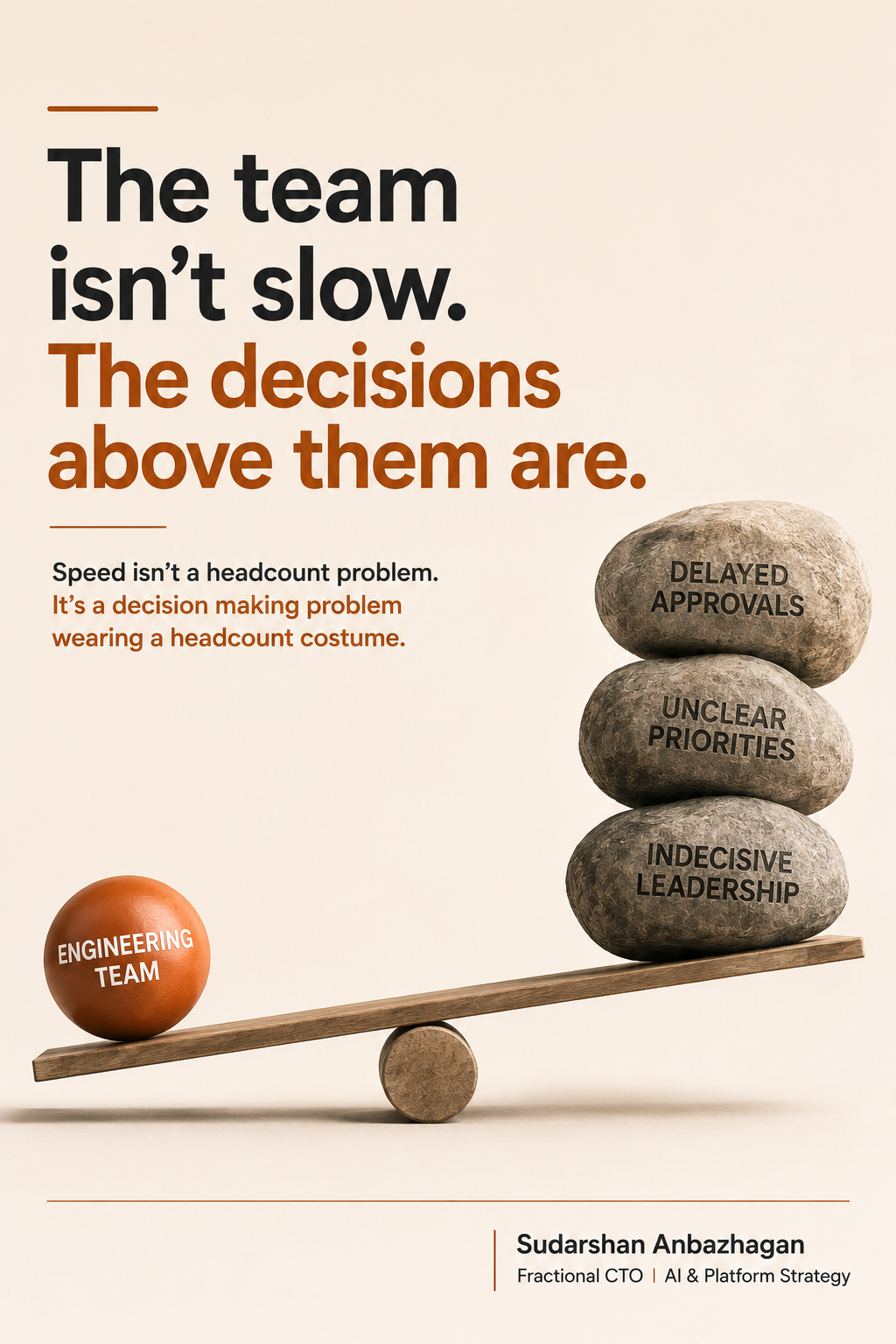
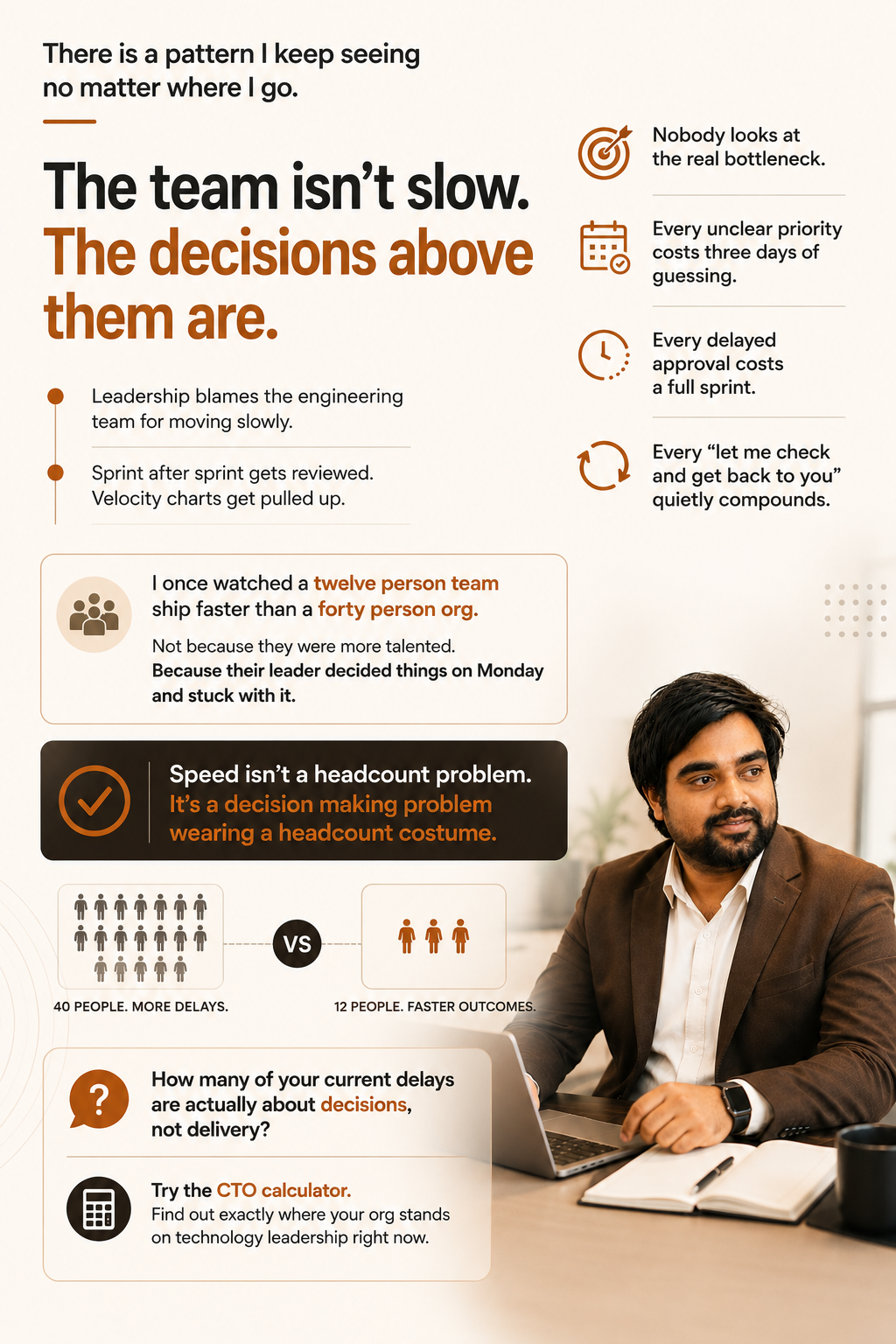
Every technology leader I sit down with insists their delivery problem is a resourcing problem. More engineers, more sprints, more velocity. In our engineering reviews across SuperBotics’ 500+ successful deployments, we consistently observe a different pattern once we actually open the hood. The team is busy. Tickets move. Standups sound healthy. And yet the roadmap has not advanced in months. That gap between activity and outcome is rarely a skills problem. It is decision debt, and it is the single most under-diagnosed drag on fractional CTO technology governance framework across growing companies today.
Decision debt behaves nothing like technical debt. Technical debt shows up in code reviews, in slow builds, in bugs that keep resurfacing. Decision debt hides in plain sight. It looks like progress because the team is still shipping something. But when you trace any given ticket back to the choice that shaped it, you often find the choice was never actually made. It was assumed, deferred, or quietly inherited from whoever spoke last in a meeting three months ago.
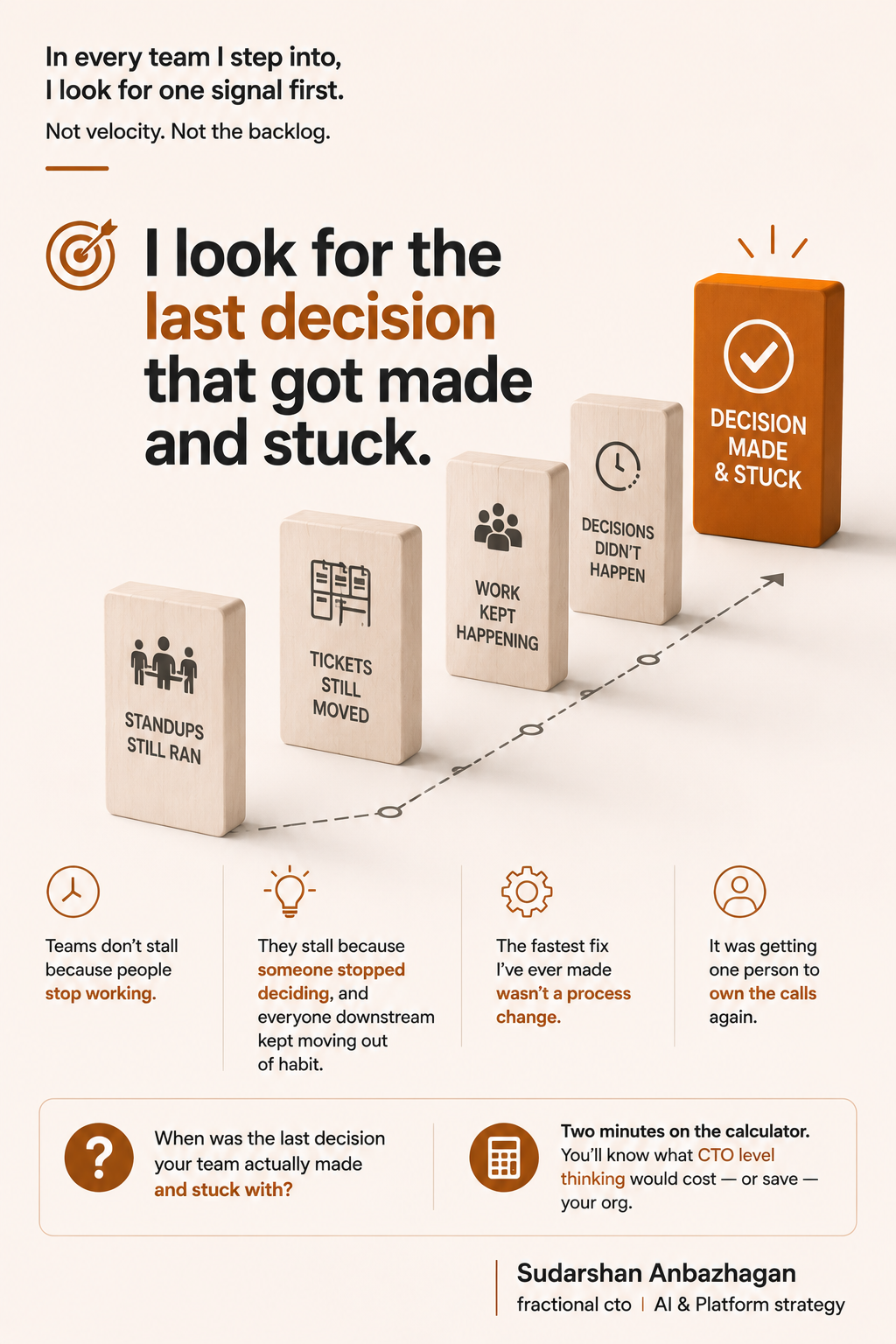
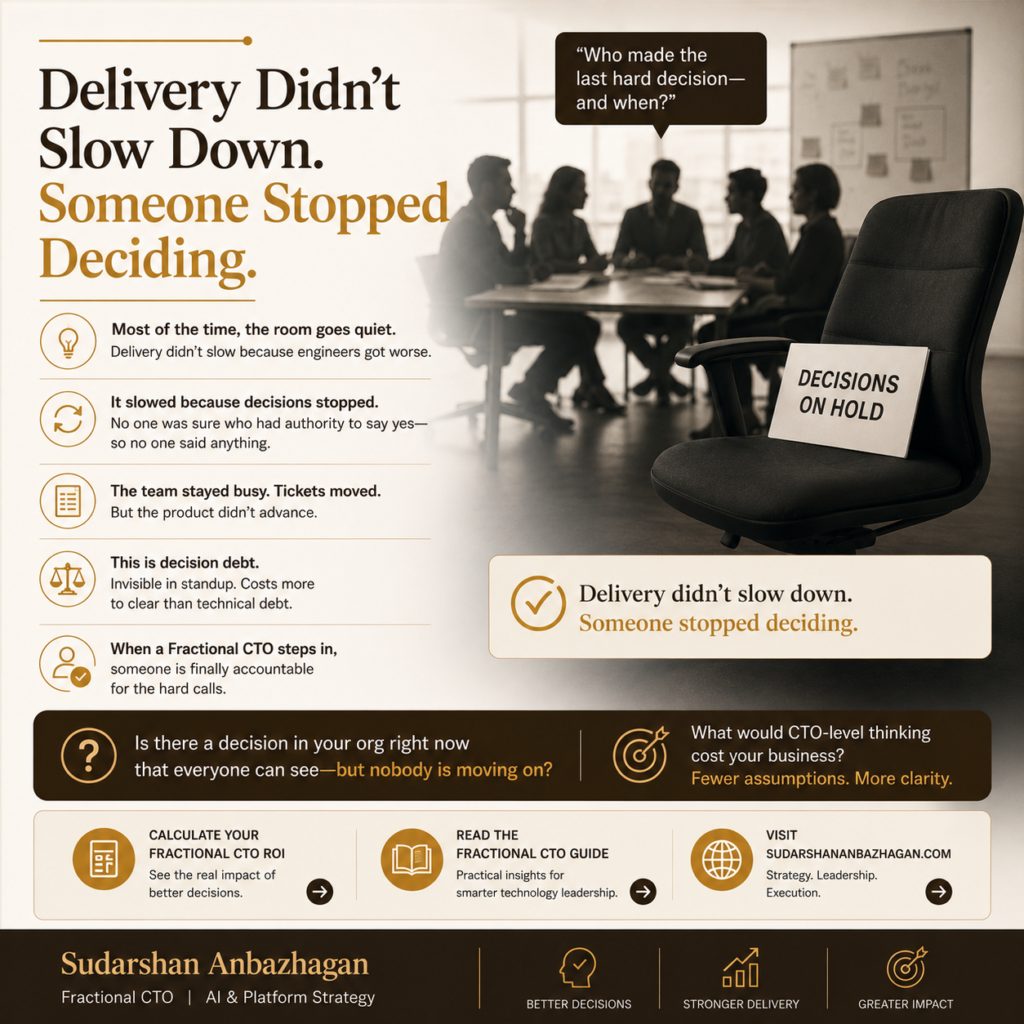
The question I ask in nearly every engagement is deceptively simple. Who made the last hard decision, and when. Most rooms go quiet. Not because nobody is capable of deciding. Because nobody was ever handed clear authority to say yes on the calls that matter, so the responsibility drifted until it belonged to no one.
Most leaders who have run this calculation are surprised by where the real cost sits.
→ Calculate Your Fractional CTO ROI
→ Read the Fractional CTO Guide
How Decision Debt Accumulates Inside Fractional CTO Technology Governance Frameworks
Decision debt rarely arrives as one dramatic failure. It accumulates the way interest does, quietly, in small unresolved choices that each feel too minor to escalate. A vendor selection gets postponed because two stakeholders disagree and nobody owns the tiebreak. An architecture question gets punted to “next sprint” three sprints running. A hiring decision waits on a headcount approval that itself is waiting on a strategy conversation that keeps getting rescheduled.
None of these individually stall a company. Together, they compound into an organization where engineers are highly active but strategically stationary. I have walked into teams running SOC 2 remediation, MLOps pipeline builds, and RAG framework integrations simultaneously, all technically excellent work, while the underlying question of which of those three actually matters most this quarter remained unanswered for six months.
This is exactly the vacuum a fractional CTO technology governance framework is built to close. Not by adding another layer of process, but by assigning someone the explicit mandate to make the calls that have been silently orphaned. When that mandate exists, decision debt stops compounding because every unresolved question has a name attached to it again.
The Three Places Decision Debt Hides Most Often
- Architecture calls that get relitigated in every planning cycle because no one closed them the first time
- Vendor and tooling decisions stuck between departments with no tiebreaker authority
- Team structure choices deferred until “we have more clarity,” which never arrives on its own
Cross-geography engineering teams are especially prone to this pattern. When decision authority is unclear across time zones, every escalation adds a day, and every day compounds the debt further. Managing delivery inconsistency in cross-geography engineering teams almost always traces back to exactly this root cause rather than to skill or effort.
Why Managing Delivery Inconsistency in Cross-Geography Engineering Teams Starts With Naming an Owner
The hidden risk in most delivery slowdowns is not visible in any dashboard. It is the decision nobody was ever explicitly told they could make.
I have reviewed enough distributed engineering organizations, spanning US-Europe market targets and India delivery centres, to notice a consistent signature. The teams with the fastest delivery are not the teams with the most senior engineers. They are the teams where a single person, at any given moment, can be asked “who decided this” and answer without hesitation.
Governance entities like SOC 2, GDPR, and HIPAA compliance frameworks are often used as evidence that a company has strong decision hygiene. In practice, compliance checklists and decision ownership are two entirely separate muscles. A company can pass every audit and still have no functioning mechanism for resolving a disputed architecture call inside a single sprint. The audit tells you what was documented. It says nothing about who is actually empowered to decide the next thing.
| Signal | Healthy Decision Ownership | Decision Debt Present |
|---|---|---|
| Architecture disputes | Resolved within one planning cycle | Relitigated every quarter |
| Escalation path | Named owner responds within a day | Escalation sits with no clear recipient |
| Vendor decisions | Closed with a documented tiebreaker | Deferred indefinitely between stakeholders |
The Three-Phase Pod Calibration Window, a framework I built out of repeated engagements across cross-functional pods, addresses this directly. In the first phase, every open decision within a pod is inventoried and assigned an explicit owner, not a committee. In the second phase, each owner is given a fixed window, typically five working days, to close the decision or formally escalate it upward with a recommendation attached. In the third phase, the pod reviews which decisions actually moved delivery forward, retiring dead process and reinforcing what worked. Pods that run this calibration consistently report measurably faster time from decision to delivery.
What CTO-Level Thinking Actually Costs Versus What Indecision Costs
Leaders often frame the fractional CTO conversation around cost avoidance, as though the primary value is skipping a full-time salary. That framing understates the real return. The actual value shows up in the decisions that stop languishing. When a Fractional CTO steps into an organization, the first visible change is rarely a new architecture diagram. It is a backlog of stalled decisions finally getting resolved in weeks instead of quarters.
Product delivery in Appium and Playwright test automation pipelines, for instance, frequently stalls not because the testing frameworks are hard to implement, but because nobody has decided which test coverage threshold actually matters for release. That is a business decision wearing a technical costume, and it is exactly the kind of call that decision debt swallows whole.
Fewer assumptions and more clarity is not a slogan. It is a measurable operating difference. Teams operating under decision debt tend to over-engineer the parts they can control, like code quality, while under-investing in the parts that actually gate delivery, like sequencing and prioritization. A fractional CTO technology governance framework rebalances that investment by making the invisible decisions visible again.
A Practical Diagnostic for Leaders Right Now
- Pick the last three delivery delays your team experienced
- Trace each one back to a specific decision that was late, not a specific person who was slow
- Ask who currently owns the authority to make that same category of decision today
If the honest answer to that third question is “nobody, really,” the organization is carrying decision debt right now, whether or not it shows up on a dashboard yet.
Building Decision Ownership Into Odoo Views and React Native Infrastructure Decisions
The same pattern extends into specific technical implementation choices that get treated as purely engineering matters. Decisions about Odoo views configuration, or whether a mobile build should run on React Native infrastructure versus native development, are frequently treated as low-stakes technical preferences. They are not. Each of those choices locks in months of future maintenance cost and team structure, and each deserves an explicit owner rather than a default inherited from whoever built the last similar system.
Virudhunagar-headquartered delivery models, where SuperBotics runs cross-geography governance for clients across 14 countries, reinforce this lesson daily. When a decision owner is named for infrastructure choices at the outset of an engagement, the same team that used to take six weeks to align on a framework choice now closes it within days, because the ambiguity that used to stall the room has been engineered out from the start.
Is there a decision in your organization right now that everyone can see is stalled, but nobody is actually moving on? That question, asked honestly in a leadership meeting, tends to surface more decision debt in ten minutes than a quarter of retrospectives ever will.
The Human Dimension: Why Teams Stop Deciding Even When They Are Capable
The uncomfortable part of decision debt is that it rarely stems from a lack of capability. Most engineering teams I work with are more than qualified to make the calls sitting unresolved in front of them. What is missing is not judgment. It is psychological permission. Engineers who have watched a previous decision get overturned by a stakeholder three levels up learn quickly that deciding carries risk and staying quiet carries none. That lesson, learned once, quietly reshapes behavior across an entire organization.
This is why simply telling a team to “be more decisive” almost never works. The instruction ignores the actual mechanism causing the freeze. A Fractional CTO addresses this by doing something subtler than issuing directives. They make explicit, publicly, which decisions belong at which level, and they protect the people who make calls within their assigned authority, even when those calls turn out to be imperfect. That protection is what actually restores the willingness to decide. This mirrors what strong trust in technology leadership looks like in practice, consistency in how authority is exercised, not just competence in what gets decided.
Technology leader credibility is built less through the decisions a leader personally makes and more through the decisions they successfully delegate and stand behind. Teams that see their leadership absorb accountability for a delegated decision, rather than distancing from it when it goes sideways, decide faster the next time, because the cost of deciding has visibly gone down.
What This Looks Like Over a Full Quarter, Not Just a Single Sprint
Clearing decision debt is not a one-time cleanup exercise. It behaves more like technical debt in one important respect: left unmanaged, it accumulates again. The difference is that decision debt accumulates faster when a company is growing, because growth constantly creates new categories of decisions that did not exist a quarter ago. New markets require new compliance judgment calls. New hires require new escalation paths. New product lines require new build-versus-buy decisions.
The organizations that stay ahead of this treat decision ownership as a living map rather than a one-time org chart exercise. Every quarter, the map gets revisited. Decisions that were once ambiguous but are now routine get pushed down to the team level, freeing senior time for the genuinely new ambiguity that growth has just introduced. Decisions that keep resurfacing despite having a named owner get investigated, because a recurring dispute over an already-decided question is itself a signal that something structural, not just interpersonal, needs fixing.
That quarterly discipline is a core part of the Three-Phase Pod Calibration Window in practice. It is not applied once and forgotten. It runs as a standing rhythm, and the pods that maintain it consistently outperform the ones that treat it as a one-off intervention triggered only when delivery visibly stalls.
Delivery did not slow down because the team got worse. It slowed down because deciding stopped being anyone’s explicit job. Naming that job again, clearly and without ambiguity, and protecting the people who hold it, is very often the fastest and least expensive fix available to a growing technology organization, and it is precisely the gap a fractional CTO technology governance framework is designed to close before it costs another quarter.
The gap between a full-time CTO and a Fractional one is rarely what organisations expect before they see the numbers.
→ Calculate Your Fractional CTO ROI
→ Read the Fractional CTO Guide