
How a Fractional CTO Prepares a Company for Its First Enterprise Client
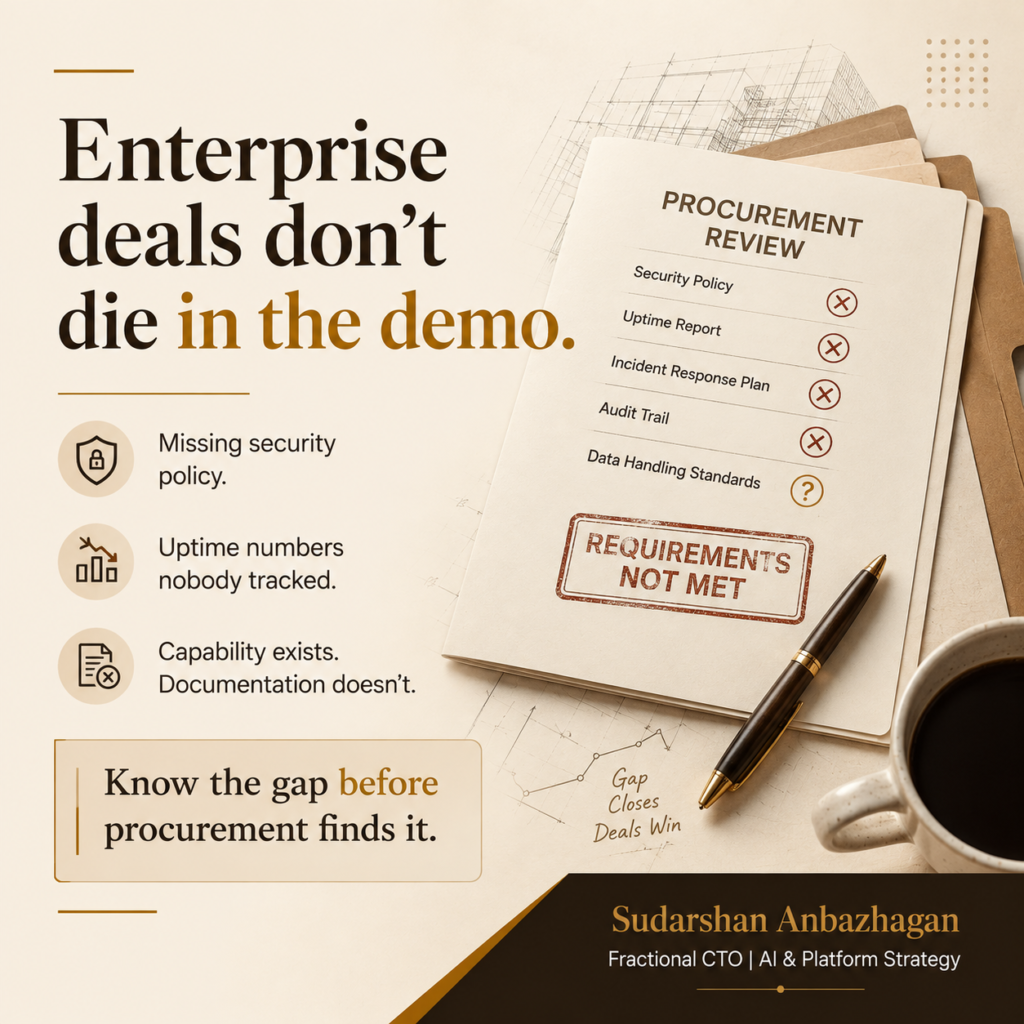
Enterprise deals rarely collapse in the demo. They collapse three weeks later, in a due diligence email that asks for a security policy that has never been written, an uptime history nobody has been tracking, or a data retention answer that takes two days to construct because the information lives in three people’s heads instead of one document.
In our engineering reviews across SuperBotics’ 500+ successful deployments and 150+ enterprise launches, this pattern shows up with almost predictable regularity. The capability the company needed was usually already there in some form. What was missing was never written down in a way that could survive a procurement review, and that gap is what actually kills the deal, not the underlying technology.
Why This Gap Stays Invisible Until It Is Expensive
A growing company’s engineering team is usually competent enough to build and ship a product that works. That is a different skill from being able to produce, on short notice, the documentation an enterprise buyer’s security and procurement teams require before they will sign anything.
The two skills get confused constantly, because the founder sees a product that works reliably in production and reasonably assumes the company is enterprise ready. Reliability in production and readiness for enterprise due diligence are not the same thing, and the difference only becomes visible once a deal is far enough along that procurement starts asking specific, written questions.
The uncomfortable part is timing. Most companies discover this gap during the exact deal they can least afford to lose, because that is the first time anyone has asked these questions with real consequences attached.
The Five Areas Procurement Almost Always Tests
Across engagements preparing companies for their first serious enterprise buyer, the questions cluster around a consistent set of areas. A Fractional CTO’s job in the run up to a deal is closing these gaps before the buyer finds them, not after.
| Procurement Area | What Gets Asked |
|---|---|
| Security posture | Written policy, access controls, incident response process |
| Uptime and reliability | Historical uptime data, monitoring approach, escalation path |
| Data handling | Where data lives, who can access it, retention and deletion policy |
| Business continuity | What happens if a key engineer leaves or infrastructure fails |
| Compliance alignment | Relevant certifications or a credible path toward them |
None of these require a company to become a different business overnight. Most require a few weeks of deliberate documentation and a handful of process decisions that should have been made anyway, just made earlier than the deal forced them to be.
The First 90 Days Before the Deal, Not After
The companies that navigate their first enterprise deal smoothly almost always started this work before the deal was seriously in motion, not once legal sent over a security questionnaire with a two-week deadline.
A Fractional CTO stepping into this role typically runs a structured readiness sequence in the weeks leading up to a company’s first real enterprise conversations. In practice, three moves account for most of the ground covered.
- Audit what already exists informally, in Slack threads, individual engineers’ heads, or half-written internal docs, and consolidate it into something a buyer’s security team can actually read.
- Identify the two or three gaps that would stall a deal fastest, such as no written incident response process or no clear data deletion policy, and close those first.
- Assign a single owner for enterprise readiness going forward, so the next deal does not start this process from zero again.
This is not a one-time audit that gets filed away. The companies that keep winning enterprise deals treat this as a living capability, refreshed each time a new buyer’s questions reveal a gap the last round missed.
Most leaders who have run this calculation are surprised by where the real cost sits.
→ Calculate Your Fractional CTO ROI
→ Read the Fractional CTO Guide
Why Founders Rarely See This Coming
Most founders’ attention, understandably, sits on the sales conversation itself. They are focused on the pitch, the pricing negotiation, the relationship with the buyer’s champion inside the organisation. Technical due diligence tends to feel like a formality until it stops one, and by then there is very little time to close a gap that took the engineering team months to accumulate.
The founders who avoid this scramble tend to share one habit. They ask a technical leader, well before the first serious enterprise conversation, a simple question: if a large buyer’s security team reviewed us tomorrow, what would stop the deal. The answer to that question, asked early enough, is the entire roadmap for what needs fixing before it matters.
What This Looks Like From the Inside of an Engagement
In our engineering reviews across SuperBotics’ work with founders preparing for their first serious enterprise buyers, the readiness work rarely takes the shape people expect. It is not a heavy compliance project. It is closer to disciplined documentation, paired with a small number of process changes that make the documentation actually true.
A written incident response plan matters less for the document itself, and more for what writing it forces a team to decide in advance, rather than improvising it live during an actual incident while an enterprise buyer is watching. The same is true of data handling, access control, and business continuity. The value is in the decisions the documentation forces, not the paperwork itself.
The Gap That Closes Deals or Costs Them
Enterprise buyers are not looking for perfection. They are looking for evidence that a company has thought about the questions that matter before being asked, because that is the clearest signal available that the company will still be reliable eighteen months into the relationship, long after the sales team has moved on to the next deal.
The gap between a company that has done this work and one that has not rarely shows up in the product itself. It shows up entirely in how the company answers the third follow up email from procurement, and whether that answer arrives in hours or in a week of scrambling.
The gap between a full-time CTO and a Fractional one is rarely what organisations expect before they see the numbers.
→ Calculate Your Fractional CTO ROI
→ Read the Fractional CTO Guide