
Vendor or GCC: The Real Difference Is What You Own in Five Years
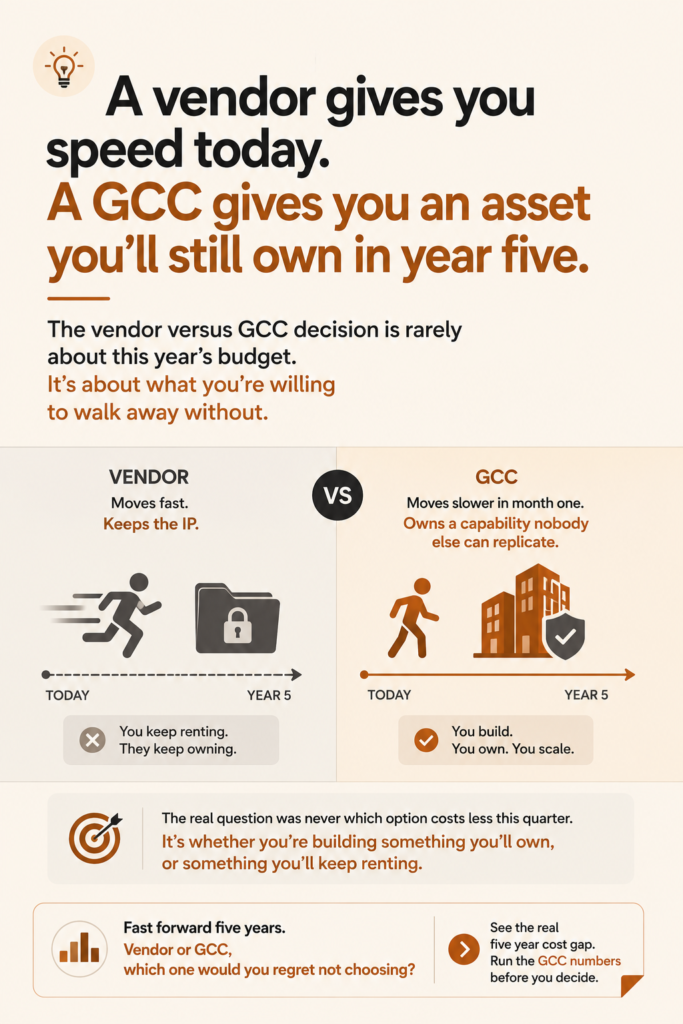
The vendor-versus-GCC decision is rarely about this year’s budget, even though almost every leadership conversation about it starts there. It is actually about what you are willing to walk away without, five years from now, when the initial urgency that started the conversation has long since faded and only the underlying asset, or the absence of one, remains.
A vendor gives you speed today. That is the entire and legitimate value proposition, and for many short-term needs it is the right one. A Global Capability Centre gives you something structurally different: an asset you will still own in year five, built specifically around your business rather than rented from someone else’s capacity pool. The two models are not competing on the same axis, and comparing them as if they were is where most companies get the decision wrong before they have even started evaluating vendors.
I have sat through this evaluation with clients across 14+ countries, and the pattern in how the comparison gets framed internally is almost always the same, and almost always unfair to whichever option the framing was not designed to support.
Why the Standard Comparison Is Rigged Before the Meeting Starts
Most leadership teams compare these two options by pricing the vendor’s invoice against the GCC’s setup cost, side by side, in the same fiscal year. That comparison stacks a twelve-month operating expense against a five-year capital asset, and the math was rigged before anyone opened the spreadsheet.
A vendor moves fast in month one and keeps the intellectual property that gets built along the way. A GCC moves slower in month one, sometimes noticeably slower, and by month twenty-four owns a capability that nobody else in the market can replicate at the same depth, because it was built around your specific operating context rather than a generic service catalogue.
The real question was never which option costs less this quarter. It is whether you are building something you will own outright, or something you will keep renting indefinitely, quarter after quarter, with the rental price subject to renegotiation every time the contract comes up.
What Ownership Actually Means in Practice
Ownership is not a legal abstraction here, it shows up in very concrete ways once a capability centre has matured past its first year of operation. The team retains institutional knowledge about your specific customers, your specific architecture decisions, and the specific reasons past choices were made, none of which transfers cleanly when a vendor contract ends or a vendor’s own staffing rotates.
A vendor relationship, even an excellent one, resets a meaningful portion of that context every time personnel changes on their side, because the knowledge lived in the vendor’s organisation, not yours. A GCC accumulates that context inside your own organisation, where it compounds rather than resets.
Vendor Versus GCC: A Five-Year Comparison
| Dimension | Vendor Model | GCC Model |
|---|---|---|
| Speed to start | Fast, often within weeks | Slower, typically 3 to 6 months to stand up |
| Cost structure | Operating expense, recurring, often escalating | Higher upfront capital cost, amortised over years |
| Intellectual property retention | Stays largely with the vendor | Stays with your organisation |
| Institutional knowledge | Resets with vendor staff turnover | Compounds inside your own team |
| Five-year total value | Recurring cost, no residual asset | Owned capability, appreciating strategic asset |
The GCC cost model looks very different once you replace assumptions with real numbers.
→ Calculate Your GCC Cost Model
→ Read the GCC Strategy Guide
When the Vendor Model Is Actually the Right Call
None of this makes vendors the wrong choice universally. A vendor is often the correct decision for genuinely short-term needs, for capabilities outside your core differentiation, or for situations where the eighteen-month maturity runway a GCC requires simply does not match the business’s current cash position or board expectations.
The mistake is not choosing a vendor. The mistake is choosing a vendor by default, without ever honestly running the five-year comparison, because the vendor’s proposal arrived faster and easier to evaluate than the GCC business case did. Speed of the decision process should never substitute for the quality of the decision itself.
The Sequence That Leads to the Right Choice
- Identify whether the function in question is core to your long-term differentiation or a genuinely commoditised capability available at similar quality across many vendors.
- If it is core, run the true five-year total cost comparison, including intellectual property retention and institutional knowledge value, not just the twelve-month invoice.
- If it is not core, the vendor model is very likely the more capital-efficient choice, and building a GCC around it would be over-engineering a decision that does not need ownership.
- Revisit this classification annually, because a function that was commoditised two years ago may have become a genuine differentiator as your product has evolved.
Fast-Forward Five Years
Most leadership teams find this exercise clarifying rather than complicated, once they run it honestly instead of defaulting to whichever option was easier to explain in this quarter’s board deck. Fast-forward five years, and ask which option, vendor or GCC, you would regret not having chosen for this specific capability.
That single question, asked before the contract or the infrastructure decision gets signed, tends to be worth more than the entire vendor evaluation process most companies run instead.
The teams that build GCCs that scale always start with one thing — a clear picture of what it actually costs before they commit.
→ Calculate Your GCC Cost Model
→ Read the GCC Strategy Guide
This decision connects closely to our earlier piece on the GCC maturity model, which looks at what happens after the ownership decision has already been made.