
The GCC Mandate Review Most Leadership Teams Skip
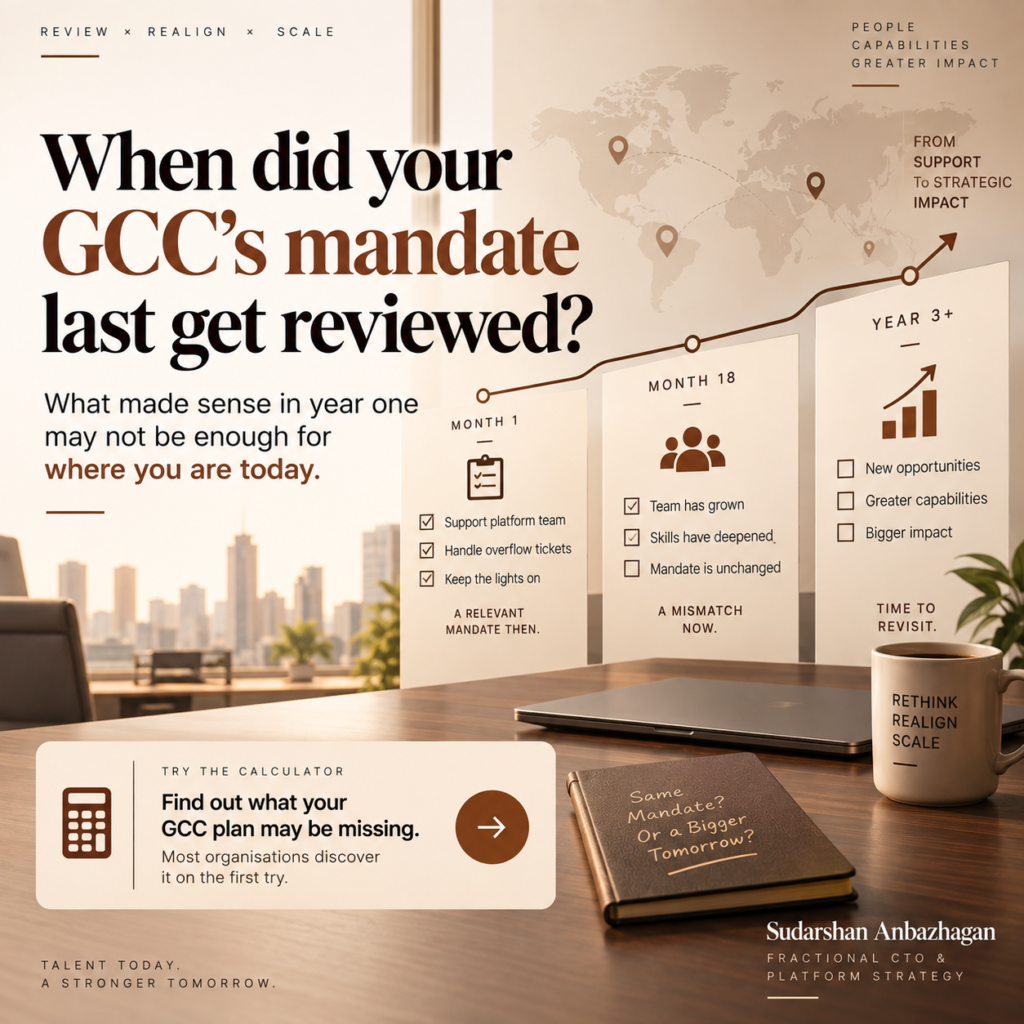
For a long time, I believed a Global Capability Centre’s mandate was something you defined once, at kickoff, and moved on from. Fifteen years and more than five hundred engagements across fourteen countries have changed that view entirely. Support the platform team. Handle overflow tickets. Keep the lights on across a second time zone. That mandate makes complete sense in month one of a GCC’s life, when the centre is small, unproven, and focused on demonstrating basic operational reliability to sceptical stakeholders back at headquarters.
The trouble begins by month eighteen. The team has grown. The skills inside it have deepened considerably, often well beyond what the original mandate ever anticipated. And yet the mandate itself, the actual written scope of what the centre is meant to be doing, remains frozen exactly where it was left in the original kickoff deck. Nobody revisited it, not out of neglect, but because nobody was ever assigned the job of revisiting it on purpose.
In our engineering reviews across cross geography delivery engagements, we consistently observe that the GCCs which genuinely outgrow their original scope share one specific habit, and it has almost nothing to do with talent. Someone inside the organisation revisits the mandate on a deliberate schedule, rather than waiting for a crisis, a budget review, or an uncomfortable headquarters question to force the conversation into the open.
Why GCC Mandate Review Gets Skipped Even in Mature Organisations
A GCC mandate review is one of those governance tasks that never feels urgent enough to schedule and, precisely because of that, almost never gets scheduled at all. The centre is delivering. Tickets are closing. Uptime looks fine on the dashboard headquarters checks. Every operational signal available to a busy executive suggests the current mandate is working, and reviewing something that appears to be working rarely makes it onto a crowded quarterly agenda ahead of problems that are visibly on fire.
This is precisely the trap. Operational health and strategic relevance are two entirely different measurements, and a GCC can score well on the first while quietly drifting on the second. A capability centre can be executing its original mandate flawlessly while that mandate itself has become the wrong one for where the business actually is now. Nobody notices this drift through the operational dashboard, because the dashboard was built to measure execution against the old mandate, not the fit of the mandate itself against current business needs.
A capability centre that is still doing exactly what it was hired to do three years ago is not stable. It is stalled.
The Tiered GCC Maturity Evaluation Lifecycle
Over years of advising GCC leadership teams through this exact blind spot, I developed a structured lifecycle that treats mandate review as a scheduled operational discipline rather than an occasional strategic exercise. I call it the Tiered GCC Maturity Evaluation Lifecycle, and it runs on a fixed cadence rather than waiting for a triggering event.
- Every two quarters, document the centre’s current capability level against its original founding mandate, noting specifically where actual capability has exceeded the written scope
- Identify which headquarters functions are currently sending work to the centre informally, outside the documented mandate, because this shadow demand is usually the clearest signal of where the mandate has already expanded in practice
- Formally propose a mandate expansion, contraction, or reaffirmation to the appropriate governance stakeholders, with the informal shadow demand data used as supporting evidence rather than anecdote
The second step in this lifecycle is the one leadership teams consistently underestimate. Shadow demand, the requests a capability centre absorbs informally because a headquarters colleague simply knows the team is capable, is almost always a leading indicator of where the formal mandate needs to expand. A centre that has been quietly handling architecture review requests for eighteen months, despite a written mandate that only mentions support tickets, is telling the organisation something important about its actual maturity level, if anyone bothers to look for the signal.
| Frozen Mandate Approach | Reviewed Mandate Approach |
|---|---|
| Scope fixed at kickoff, unrevisited for years | Scope reviewed on a fixed two quarter cadence |
| Shadow demand absorbed informally, unrecognised | Shadow demand tracked as evidence for mandate expansion |
| Talent growth outpaces the documented role | Documented role updated to match actual capability |
| Crisis or budget review forces the conversation | Scheduled review replaces crisis driven renegotiation |
What Stalled Mandates Actually Cost the Organisation
The cost of a frozen mandate rarely shows up as a single dramatic failure. It shows up as talent attrition among the centre’s strongest performers, who correctly sense that their actual contribution has outgrown the job description they were hired against, and who eventually leave for a role elsewhere that recognises the capability they have already built. I have seen this pattern repeat across enterprise clients operating GCCs supporting SOC 2 and GDPR regulated platforms, where the technical sophistication required to support compliance heavy operations had grown substantially, while the formal mandate still described the centre in terms appropriate to a much earlier, simpler stage of the relationship.
It also shows up as a persistent, low grade frustration at headquarters, where stakeholders sense that the centre could be doing more but lack a structured process for actually renegotiating what more looks like. Without a scheduled review mechanism, this frustration tends to surface only during budget conversations, at precisely the moment when a mandate discussion is most likely to be conflated with a cost cutting exercise rather than treated as the strategic conversation it actually is.
How to Introduce Mandate Review Without Triggering Anxiety
Introducing a scheduled mandate review for the first time in an established GCC requires some care, because teams that have never had their scope formally reviewed can reasonably interpret a sudden review as a precursor to downsizing. I address this directly by framing the first review explicitly as a capability recognition exercise rather than a cost audit, and by ensuring the centre’s own leadership co authors the shadow demand documentation rather than having it imposed from headquarters.
In practice, this framing shift changes the entire tone of the conversation. A centre leadership team that helps build the case for their own mandate expansion, backed by concrete shadow demand evidence they have gathered themselves, engages with the review process as an opportunity rather than a threat. I have run this exact process with cross geography teams supporting clients across the US and Europe, and the mandate expansions that resulted were, in every case I have observed, welcomed by the centre’s own team as overdue recognition rather than experienced as disruption.
The GCC cost model looks very different once you replace assumptions with real numbers.
→ Calculate Your GCC Cost Model
→ Read the GCC Strategy Guide
How This Differs From a Broader Maturity Assessment
It is worth being precise about what a mandate review is not, because I have seen organisations conflate it with the much larger, less frequent exercise of assessing a GCC’s overall maturity level against a broader operating model framework. A full maturity assessment, the kind that examines whether a centre has progressed from execution to strategic partnership, is valuable but heavy, and most organisations can only realistically undertake it once every year or two. A mandate review is deliberately lighter. It asks a narrower, more mechanical question, does the written scope of this centre still match what it is actually doing, and it is designed to run every two quarters precisely because it should never require the same depth of analysis as a full maturity assessment.
Treating these as the same exercise is one of the most common reasons mandate review gets skipped in practice. Leadership teams look at the calendar, see that a full maturity assessment was completed eight months ago, and conclude the mandate question has already been addressed. It has not. The mandate can drift meaningfully within a single quarter, particularly during periods of rapid hiring or when a centre absorbs a new client account, long before the next scheduled maturity assessment would ever catch it.
What I Would Ask Your Leadership Team This Quarter
If your organisation operates a GCC that has been running for more than a year, the single most useful question to raise at your next leadership meeting is simple. When did this centre’s mandate last get reviewed on purpose, rather than by accident during a budget cycle. If nobody in the room can answer with a specific date and a specific outcome, that absence is itself diagnostic, regardless of how well the centre is currently performing against its existing scope.
This connects directly to the broader operating model discipline described in our piece on the GCC maturity model, where the shift from an execution centre to a genuine strategic partner depends less on the centre’s own capability and more on whether the organisation has built a mechanism to formally recognise that capability as it grows. A GCC does not stall because its people stop growing. It stalls because the paperwork around what they are allowed to do stops growing with them.
When did your GCC’s mandate last get reviewed, on purpose, not by accident.
The teams that build GCCs that scale always start with one thing, a clear picture of what it actually costs before they commit.
→ Calculate Your GCC Cost Model
→ Read the GCC Strategy Guide