
I asked an engineering team a simple question during a review session not long ago. The team had been delivering well for years. Consistent timelines. Low attrition. A track record that most organisations would point to with genuine pride. The question I asked was this: when was the last time the parent organisation asked for your perspective, not just your delivery? The room went quiet. Not because the answer was difficult. Because the answer was immediate, and everyone in that room already knew it.
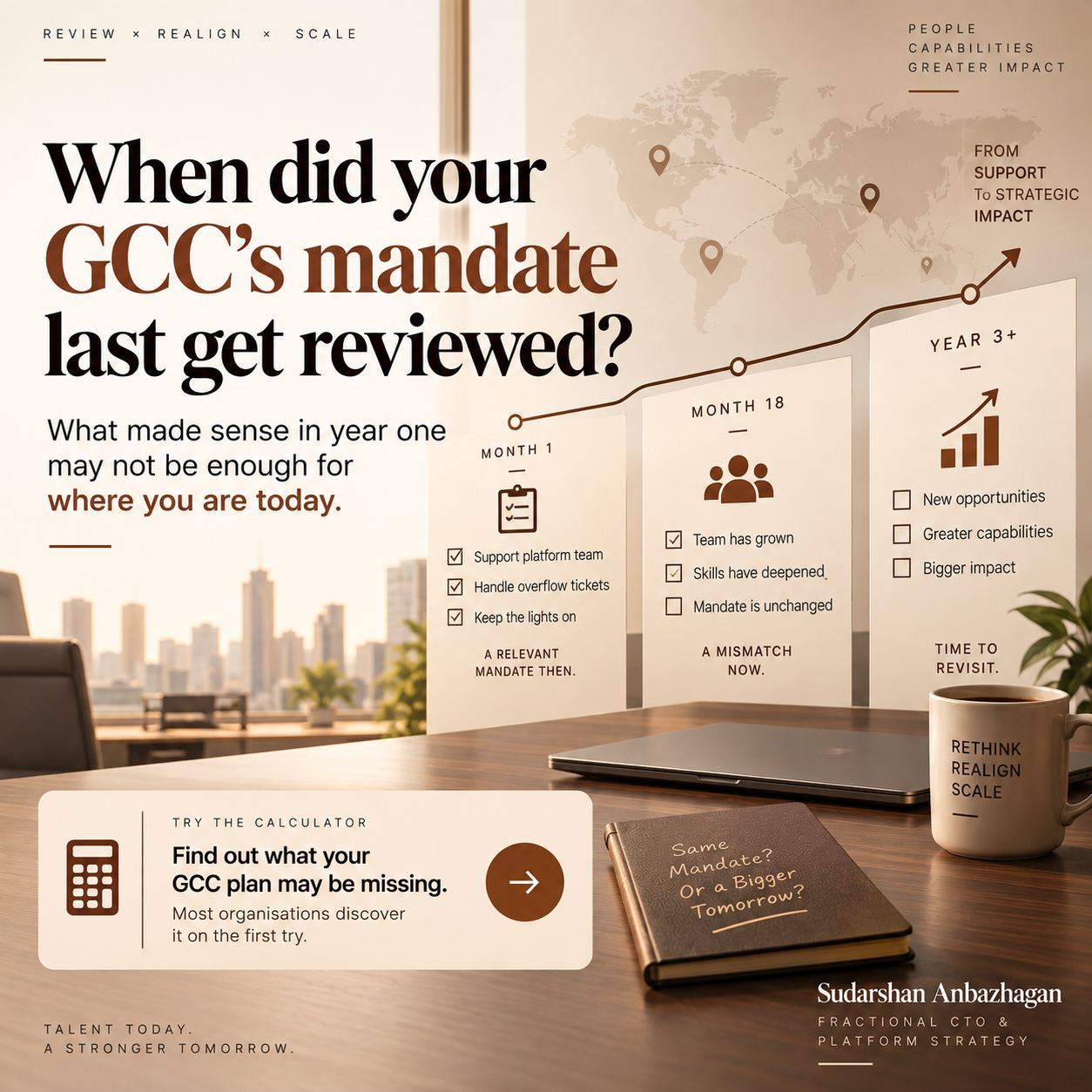
That silence tells you more about a GCC’s current maturity than any delivery scorecard. The team was not underperforming. They were performing exactly as the relationship had been designed. Tasks in, outputs out. Trusted to execute. Not yet trusted to shape. That is the maturity wall that most GCCs reach eventually, and it is not a performance problem. It is a partnership problem. And it is entirely solvable, if the organisation and the GCC leadership are both willing to move.
Over 15 years of leading and building cross-geography technology teams across 14 countries, I have watched this pattern repeat with enough consistency to recognise it as structural rather than accidental. The GCCs that break through it share specific characteristics. The ones that stay stuck share different ones. The difference almost always comes down to whether the maturity of the relationship was deliberately designed, or simply left to develop on its own.
Stage One: Reliability Is the Foundation, Not the Destination
Every GCC begins at the same place: proving that it can deliver. Timelines are met. Quality is consistent. The parent organisation begins to trust the team with more complex work. This stage is not just necessary, it is genuinely valuable. Without it, nothing else is possible. A GCC that has not demonstrated execution reliability has no credibility to offer anything beyond execution, and asking for strategic influence before trust has been earned rarely ends well.
The problem is not Stage One. The problem is staying in Stage One long after the capability to move forward exists. Many GCCs spend years at the reliability stage not because they lack the capability to contribute more, but because the organisational structure around them was never designed to absorb anything more than execution outputs. The parent organisation got what it originally needed. The relationship calcified. And both sides settled into a dynamic that was comfortable but not particularly productive for either of them.
I have seen this in engagements where a GCC team had built deep domain knowledge, developed genuine insights about the product and the market, and had clear opinions about what should be built next. That knowledge existed inside the team and never moved upstream, because no one had built the channel for it to travel through.
Stage Two: Operational Influence Is Where the Relationship Begins to Shift
The second stage of GCC maturity is characterised by a shift from following processes to improving them. The team starts surfacing risks earlier than they are asked to. They contribute ideas about how workflows could be restructured. They share opinions on execution approaches rather than simply implementing what was specified. This is not a dramatic transformation. It is a gradual expansion of the team’s contribution surface, and it requires the parent organisation to create the space for it.
What I consistently observe in GCCs that move successfully into this stage is that the shift is initiated by leaders on both sides simultaneously. The GCC leader begins bringing more than delivery updates to reviews. The parent organisation leader begins asking more than status questions. That parallel movement is what creates the conditions for operational influence to take root. When only one side shifts, the dynamic does not change. The relationship moves when both parties decide to move it.
In the Managed Teams we build and run at SuperBotics, the transition from Stage One to Stage Two is something we design into the engagement structure from the beginning. The first 90 days are about establishing delivery credibility. From month four onwards, we build structured channels for the team’s operational observations to reach the decision-makers who can act on them. That design choice is what prevents the relationship from calcifying at execution.
Stage Three: Strategic Partnership Requires a Different Kind of Trust
The third stage is the real transformation point, and it is the one that most GCCs aspire to but relatively few reach. At Stage Three, the GCC has a genuine voice in priorities, planning, and direction. The parent organisation asks the team not just to deliver against a defined roadmap but to contribute to shaping it. The question that signals this shift is straightforward: what do you think we should do next? When a parent organisation begins asking that question and genuinely listening to the answer, the relationship has changed fundamentally.
Reaching this stage requires two things that have nothing to do with technical capability. The first is an organisation willing to extend real ownership, which means creating decision-making forums where the GCC has a genuine seat, not just a listening role. The second is a GCC leadership team confident enough to hold that ownership, which means being willing to advocate for a position, defend it with reasoning, and accept accountability for the outcomes. Both of those requirements are harder than they sound, and both are learnable.
What I have seen consistently across GCC engagements at this maturity level is that the organisations and teams that arrive here do not stumble into it. They build toward it deliberately, with a shared understanding of what the relationship is designed to become. The milestones are agreed. The expectations are explicit. The leadership on both sides has made a conscious decision that the partnership is worth investing in beyond the transactional.
What Holds GCCs Back at Each Stage
The most common barrier at Stage One is the absence of structured onboarding that builds delivery credibility quickly enough to create momentum for the next stage. Teams that take too long to establish reliable execution lose the window of early organisational goodwill that would otherwise open doors to greater contribution.
At Stage Two, the most consistent blocker is the absence of formal channels for operational intelligence to flow upstream. The team develops insights. Those insights have nowhere to go. Over time, the team stops developing them, because the effort of doing so produces no visible outcome. Organisations that want to move their GCCs forward need to build explicit mechanisms for this knowledge transfer, and they need to be visibly responsive when the knowledge arrives.
At Stage Three, the barrier is almost always cultural rather than structural. It is the unspoken belief, on one side or both, that strategic thinking belongs at headquarters and execution belongs offshore. That belief does not usually get articulated. It shows up in meeting formats, in who gets invited to planning sessions, in whose opinions are solicited and whose are politely received and then set aside. Changing it requires explicit leadership intent and consistent follow-through over a long enough period for the team to genuinely trust that the shift is real.
The Question That Separates Mature GCCs from the Rest
If I had to identify the single question that separates a GCC operating at Stage Three from one still working through Stage One or Two, it would be this: does the team have a view on what the organisation should prioritise next, and does anyone at headquarters want to hear it?
That question has two parts for a reason. The team having a view is a function of the GCC’s own investment in understanding the business beyond its immediate delivery scope. Headquarters wanting to hear it is a function of the parent organisation’s willingness to treat the GCC as a genuine capability partner rather than a delivery resource. When both conditions are true simultaneously, the relationship is operating at its highest potential.
The GCCs that deliver the most sustained value over time, and the ones where client partnerships consistently extend well beyond initial expectations, are the ones where both sides made an early and deliberate decision to build toward something more than execution. That decision does not require a restructuring. It does not require a new tool or a new process. It requires a conversation between two leadership teams about what kind of relationship they are genuinely willing to build, and then the discipline to build it.
A GCC that is trusted to think strategically is not just a more valuable asset. It is a fundamentally different kind of partner. And that difference, compounded over years, is what separates the organisations that grow sustainably from the ones that keep finding themselves in the same room, having the same conversation, wondering why the relationship never quite moved forward.