
5 Essential Rules for Inventory Accuracy That Guarantee Cash Flow
The most dangerous inventory operation is not the one that is chaotic. It is the one that feels organised while the same stockouts happen every quarter on schedule. The team is working hard. The warehouse looks structured. The reports are being filed. Leadership is reviewing the numbers. And yet the pattern of stockouts, cash flow pressure, and overstock write-offs repeats with a regularity that starts to feel inevitable rather than preventable. That feeling of inevitability is the most expensive thing in the operation, because it is the signal that the business has begun to manage its inventory accuracy problem rather than solve it.
Here is the myth hiding underneath that organised-looking operation. Most teams assume that if the process looks structured, the rules governing it must be working. The truth is that in most operations, the rules governing inventory decisions either do not exist formally or are applied differently by every person responsible for them. A reorder point calculation that three different buyers execute with three different assumptions is not a rule. It is a preference. And preferences produce unpredictable outcomes regardless of how capable the individuals applying them are. That inconsistency is invisible until you look for it deliberately, and it costs the business in three directions simultaneously: stockouts, overstock, and working capital pressure.
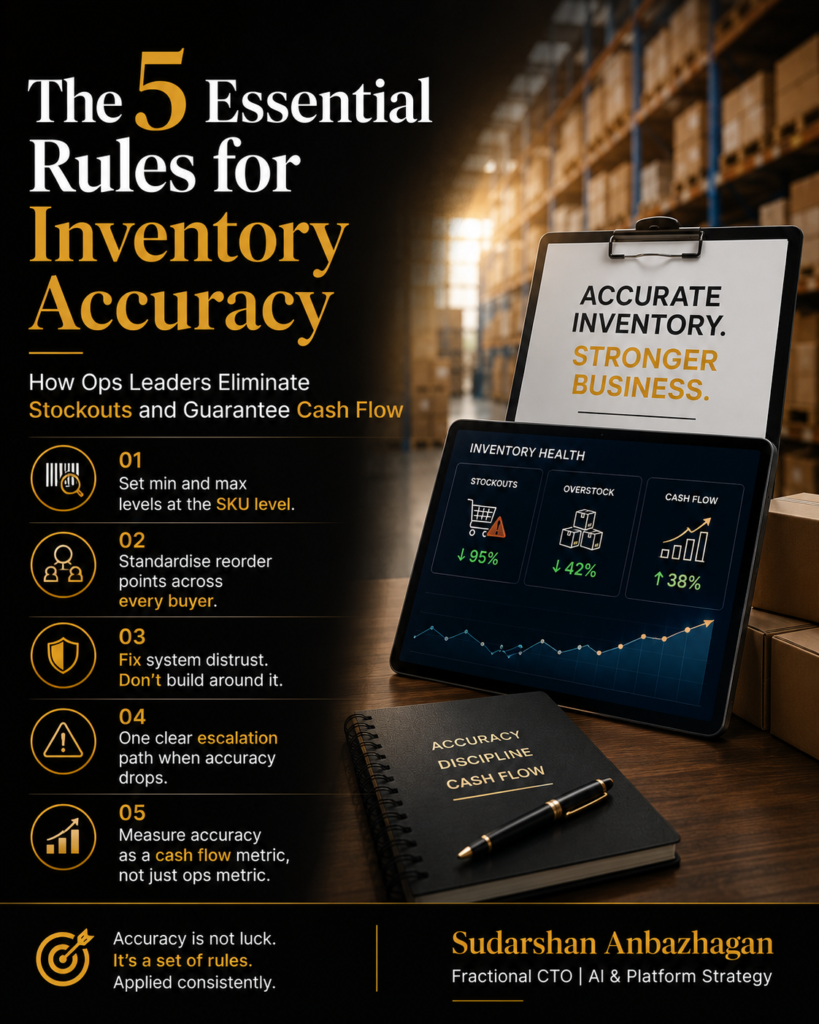
Five rules applied consistently change this pattern more reliably than any technology upgrade or process redesign. I have seen these rules transform inventory performance in retail, manufacturing, and distribution environments across multiple continents. What makes them work is not their complexity. It is their specificity and the discipline with which they are owned at the right level of the organisation.
Rule 1: Define Min-Max Stock Levels at the SKU Level, Not Category Level
Category thresholds create false confidence. When a category appears to be within acceptable parameters, the individual SKUs creating stockout or overstock risk are invisible inside the average. Inventory accuracy lives at the SKU level, and the protection against inaccuracy has to be where the risk actually lives. Defining minimum and maximum stock levels at the category level is a reporting convenience that trades operational precision for administrative simplicity. In a stable, low-SKU-count environment that trade-off may be acceptable. In any operation with meaningful product variety or velocity variation across SKUs, it is a structural risk embedded into the purchasing process.
The organisations that move to SKU-level thresholds almost always discover, within the first review cycle, that their category-level parameters were masking a small number of high-risk SKUs that were creating a disproportionate share of their stockout and overstock events. Those SKUs are fixable once they are visible. They are a recurring cost as long as they are hidden inside a category average.
Rule 2: Standardise the Reorder Point Calculation Across Every Buyer
When different people apply different logic to the same decision, the system produces unpredictable results regardless of how good the technology is. This is one of the most consistently underestimated sources of inventory inaccuracy in operations with multiple buyers or procurement team members. Each person has developed their own version of the reorder calculation based on their experience, their risk tolerance, and the informal knowledge they carry about specific suppliers or SKU behaviour. That informal knowledge is valuable. The inconsistency in how it is applied is not.
Standardising the reorder point calculation means documenting one method, agreeing it across the buying team, and reviewing it quarterly to ensure it reflects current lead time data and demand conditions. The informal knowledge that experienced buyers carry does not disappear in this model. It informs the quarterly review rather than operating as a parallel, undocumented system. One method, documented, reviewed consistently, produces outcomes that the business can measure, predict, and improve. Multiple undocumented methods produce outcomes that feel random because, from a system perspective, they are.
Rule 3: Address System Distrust Directly, Not Around It
If your team manually verifies system counts before purchasing decisions, the issue is not counting frequency. The issue is that the system is not trusted. This is a critically important diagnostic distinction. Many operations respond to system distrust by adding more counting cycles or more manual verification steps, which treats the symptom while leaving the cause untouched. Every process built on untrusted data inherits the inaccuracy of that data. Every manual verification step added to compensate for system distrust increases operational cost and introduces new opportunities for human error.
Addressing system distrust directly means identifying where the divergence between system counts and physical actuals is occurring, understanding why it is occurring, assigning ownership for closing the gap, and establishing a verification cadence calibrated to the specific SKUs and locations where drift is highest. This is not a one-time project. It is an ongoing governance discipline. As I explored in the broader context of inventory inaccuracy and its ROI impact, the organisations that close this gap are the ones that treat data integrity as a leadership accountability rather than an IT maintenance task.
Rule 4: Create One Clear Escalation Path When Accuracy Drops Below Threshold
Most inventory accuracy exceptions are handled on an ad hoc basis. When a discrepancy is discovered, whoever finds it determines what happens next based on their judgment, their workload, and the informal norms of their team. That variability means that identical inventory accuracy problems produce different responses in different parts of the operation, and the responses that happen under pressure are almost always less effective than the responses that would have been planned in advance.
Define the threshold. Name the owner. Build the escalation path before the exception arrives. Decisions made under operational pressure without a defined process are the most expensive decisions any operation makes, both in the direct cost of the decision and in the indirect cost of the inconsistency it creates. When a specific inventory accuracy threshold is crossed, a specific person receives a specific notification and follows a specific protocol. That predictability is what makes accuracy recovery systematic rather than heroic.
Rule 5: Report Inventory Accuracy as a Cash Flow Metric, Not Just an Operations Metric
When inventory accuracy is reported only inside operations reviews, it stays an operations problem. The decisions that would improve it permanently, the technology investments, the process redesigns, the governance changes, sit at a level of the organisation that does not see operations metrics with enough frequency or context to act on them. When the leadership review connects inventory accuracy to working capital outcomes, the conversation changes at every level below it.
Buying behaviour tightens. Forecasting discipline improves. The stakes become visible to the people who have the authority to fund the improvements that would change them. The operations that consistently guarantee cash flow through inventory accuracy are not the most sophisticated. They are the most consistent. If you reviewed your inventory rules today, how many are formally documented and enforced uniformly, and how many exist only in the habits of your most experienced people? The answer to that question is a direct predictor of how predictable your cash flow will be next quarter.