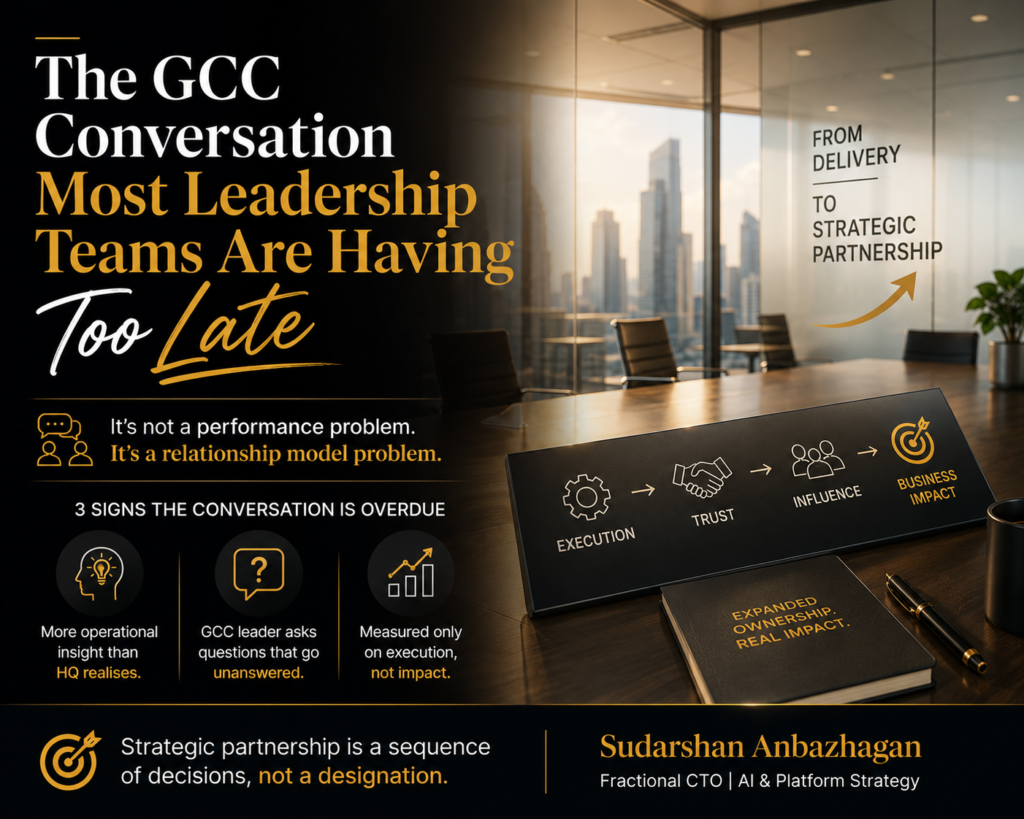

The GCC Conversation Most Leadership Teams Are Having Too Late
Every GCC I have worked with faces the same invisible wall at some point. The team is performing. Delivery is consistent. Attrition is managed. The SLAs are clean. Projects come in on scope and within timeline. From every measurable operational perspective, the engagement is working. And yet a quiet frustration begins to build at the headquarters level. Not frustration with performance. Frustration with potential that is not being reached, with capability that exists in the GCC and is not being accessed, with a relationship that was designed for execution and has not evolved to match what the team has become.
Here is the myth that creates this wall, and it is a myth that operates simultaneously on both sides of the relationship. At headquarters, the myth is that a high-performing GCC will naturally evolve into a strategic GCC partner over time, that trust built through consistent delivery will organically create the conditions for a deeper collaboration. At the GCC level, the myth is that demonstrating execution excellence consistently will eventually be recognised and rewarded with expanded ownership. Both beliefs feel reasonable. Neither is how the evolution actually happens.
The truth is more specific. Capability matures on its own. The relationship model does not. A GCC team that has been delivering for three years is not the same team it was on day one, but if the governance structure, the communication rhythms, and the success metrics are unchanged from the original engagement design, the relationship will stay anchored to whatever it was at the start. Strategic partnership does not emerge from accumulated execution trust. It is the result of a deliberate decision made by headquarters to change the relationship model, combined with GCC leaders confident enough and clear enough to hold the expanded ownership that follows.
Three Signals That the GCC Leadership Conversation Is Already Overdue
In my experience working across GCC engagements in India, Europe, and the US, there are three consistent signals that a leadership team has been having the wrong conversation about their GCC for longer than they realise. The first is that the GCC team holds more operational context than headquarters actually knows. Team members are solving problems they were never formally asked to solve. They are improving processes quietly, without recognition, because they have the context and the capability to see what needs to change. But there is no formal channel through which that intelligence reaches the people at headquarters who have the authority to act on it strategically. The insight is present. The pathway for it to create value above the execution layer is missing.
The second signal is that the GCC leader is asking questions about business direction that are going unanswered. When a GCC leader asks about market priorities, product roadmap decisions, or organisational strategy, that is not curiosity about things outside their remit. That is a leader who is ready for a different relationship and has no formal pathway to get there. The questions are the signal. The absence of a structured response to those questions is how the relationship stays where it was designed rather than evolving to where the capability now sits.
The third signal is the most structural. Headquarters measures the GCC only on execution metrics. If every success metric in the relationship is delivery-based, velocity, quality, SLA compliance, throughput, then the relationship will stay delivery-based regardless of how much trust exists on both sides. The metrics shape the conversation. The conversation shapes the relationship. And the relationship determines what the GCC is actually being asked to contribute. When execution is the only dimension being measured, execution is the only dimension that gets invested in, even when the team is capable of and interested in contributing at a higher level.
What the GCC Leadership Conversation Actually Needs to Include
The conversation that changes a GCC relationship is not a broad philosophical discussion about partnership and trust. It is a specific, structured exchange that addresses four things. First, a clear statement from headquarters on what expanded ownership looks like in practice. Not a general expression of trust. Not a commitment to involving the GCC more. Specific domains where the GCC team’s judgment is formally invited, where their input shapes decisions rather than informs them, and where their accountability extends beyond delivery to outcome. That specificity is what makes the shift real rather than rhetorical.
Second, a review of how success is currently measured and how it needs to change to reflect the relationship both sides want. If the current metrics only measure execution, adding one outcome-level metric, even a simple one, changes the conversation at every level below it. The GCC team begins to think differently about their contribution. Headquarters begins to ask different questions in review meetings. The relationship starts to operate on a different level simply because what is being measured has expanded.
Third, a timeline for the evolution that is explicit and owned rather than implied and hoped for. Strategic partnership does not happen in a single conversation. It is a sequence of decisions made consistently over six to eighteen months, with clear checkpoints at which both sides assess whether the expanded ownership is producing the outcomes that justify it. The organisations that reach genuine strategic GCC partnership are the ones that treat the evolution as a managed process, not as a natural consequence of continued strong delivery. As I explored in my post on the GCC maturity model, the transition from execution to strategic contribution requires deliberate design, not just accumulated trust.
Why the Timing of This Conversation Matters More Than the Content
The most common version of this conversation happens when a GCC relationship is already in some form of distress. Attrition has increased. Delivery quality has softened. The GCC leader is having conversations with other organisations. By the time the conversation about strategic evolution happens under those conditions, it is reactive rather than generative, and the trust deficit that has accumulated makes it harder to land well. The content of the conversation is essentially the same. The context has changed significantly.
The organisations that build the strongest GCC relationships are the ones that have this conversation when the relationship is performing well, when the team is energised, when the GCC leader is still fully invested in the long-term direction of the engagement. That timing is not the moment that most headquarters teams feel urgency to change the model. Everything is working. The instinct is to protect what is working rather than redesign it. But redesigning a high-performing relationship from a position of strength is far more likely to produce the strategic partnership both sides want than waiting until the performance signals tell you that the current model has already peaked.
GCC teams that reach their full potential are not always the ones with the strongest talent. They are the ones whose parent organisations decided, at the right moment, to ask a different question. Not what did you deliver this quarter, but what do you think we should do differently next year? That question, asked genuinely, with the authority to act on the answer, is what changes everything. If you asked your GCC leader today what they would change about how they contribute to business strategy, how long do you think they have been sitting with that answer?