
The GCC Model UK Enterprises Are Using to Drive Innovation, Not Just Cost Savings
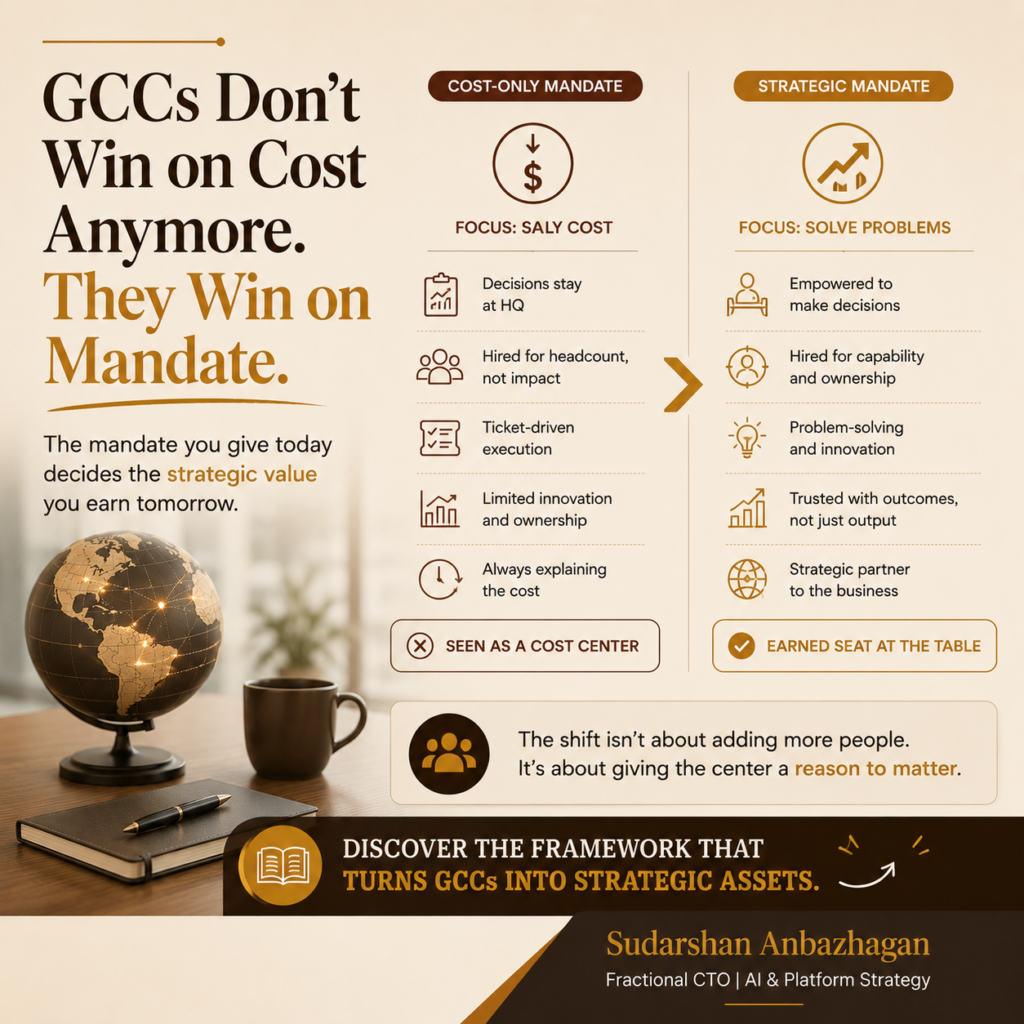
Cost savings used to be the entire pitch behind a Global Capability Centre. It is now the least interesting part of the story for the enterprises getting the most value from one. Across the GCC engagements I have advised for UK and European organisations, the centres earning genuine strategic weight inside their business share one common trait. Leadership stopped measuring them purely on cost and started giving them a mandate to solve problems, not simply execute tickets handed down from headquarters.
That single shift in mandate changes almost everything downstream. It changes who gets hired into the centre, how teams are structured around outcomes rather than tasks, and what the centre is trusted to decide without escalating three time zones back to headquarters. Centres that stay locked to a cost only scorecard rarely make this jump on their own, no matter how skilled the people inside them are. The mandate has to change first. Innovation follows. It is never the other way around.
Why the GCC Model UK Enterprises Favour Has Shifted Away from Pure Cost Arbitrage
The economics that originally justified most GCC investments have not disappeared, but they have stopped being the differentiator they once were. Labour cost arbitrage is now available to nearly every competitor pursuing the same market, which means it has quietly become table stakes rather than a genuine advantage. Enterprises that continue treating their centre purely as a cost lever are competing on a dimension that no longer separates them from anyone else pursuing the same strategy.
What does still separate enterprises is whether their centre has been given a genuine mandate to shape decisions rather than simply execute them. A GCC treated as a strategic capability, not just a delivery function, becomes a source of competitive differentiation precisely because that mandate shift is harder to copy than a cost structure. Any competitor can open a centre in the same city and offer similar salaries. Far fewer are willing to grant that centre real decision making authority early enough for it to matter.
The Three Signals That a Centre Has Earned Strategic Weight
Across the UK enterprise engagements I have reviewed, three signals consistently separate a centre that has become a genuine innovation partner from one still operating purely as a cost efficient delivery arm.
The centres earning real strategic weight share one trait: leadership stopped measuring them on cost and started giving them a mandate to solve problems, not just execute tickets.
| Signal | Cost Only Centre | Strategic Partner Centre |
|---|---|---|
| What gets asked of the centre | Can you build this by Friday | What should we build, and what should we stop building |
| Who is in strategic meetings | Centre leadership hears decisions after the fact | Centre leadership shapes decisions before they are finalised |
| What gets measured | Cost per output, utilisation rates | Business outcomes the centre’s judgement actually moved |
None of these three signals require additional headcount or a larger technology budget to shift. They require a deliberate decision by headquarters leadership to invite the centre’s leadership into rooms it was previously excluded from, and to keep inviting them even when the early contributions are imperfect.
The Mandate Expansion Framework
I use a structure I call the Mandate Expansion Framework in nearly every GCC engagement where a UK or European enterprise is trying to move their centre from execution arm to strategic partner. It sequences the shift deliberately rather than leaving it to happen by accident over several years.
- Phase one, Invite judgement on smaller decisions. Give the centre’s leadership a genuine say on lower stakes calls first, so the muscle for exercising judgement gets built before higher stakes decisions arrive.
- Phase two, Measure outcomes the centre actually influenced. Replace cost and utilisation metrics with a small number of business outcome measures the centre had real input into shaping.
- Phase three, Expand the mandate as trust compounds. Each successful round of judgement earns the centre a slightly larger seat at the table, until the distinction between headquarters and centre decision making genuinely narrows.
Enterprises that follow this sequence rarely experience the friction that comes from expanding a centre’s mandate too quickly, before trust has been earned through smaller decisions made well. They also rarely stall permanently at the cost only stage, because the framework gives leadership a concrete next step rather than a vague aspiration to eventually treat the centre as more strategic.
What UK Leadership Needs to Understand About This Shift
The leadership teams who make this transition successfully tend to share one underlying belief that is easy to state and genuinely difficult to practise. They accept that a centre cannot demonstrate strategic judgement if it is never given a decision to exercise judgement on. Waiting for a centre to prove readiness before granting any real mandate creates a circular problem that never resolves itself, because readiness for judgement is built through practising judgement, not through delivering tickets faster.
This requires a degree of comfort with imperfection that many headquarters leadership teams find harder than it sounds. The centre’s first few strategic recommendations may not be as polished as headquarters would produce internally, precisely because the centre has not yet had the reps that headquarters has accumulated over years. Enterprises that treat those early imperfections as evidence the experiment failed rarely get a second attempt. Enterprises that treat them as an expected part of building judgement tend to see the centre mature quickly into something genuinely valuable.
Anchoring This to What I Have Seen Across UK Engagements
In the centres I have advised for UK based organisations specifically, the ones that made this shift fastest were rarely the largest or best resourced. They were the ones where a single senior leader at headquarters personally sponsored the mandate change and defended it when early results were imperfect. That sponsorship mattered more than any process document, because it signalled to the wider organisation that the centre’s judgement was genuinely being taken seriously rather than tolerated as an experiment likely to be quietly reversed.
That kind of sponsorship is not something a framework can manufacture on its own. It requires a leader willing to spend some of their own credibility backing a centre’s early, imperfect strategic contributions, in the belief that the long term value of a genuine strategic partner outweighs the short term discomfort of an occasionally rough recommendation. This is, incidentally, the same quality this transition has in common with the broader trust building work required across the first ninety days of any GCC’s founding, where the earliest structural decisions quietly shape everything that follows.
Is Your GCC Still Measured Only on Cost Today
If your organisation’s centre is still evaluated primarily on cost efficiency and utilisation, the question worth asking is not whether the centre is capable of more. Most centres are. The question is whether headquarters has actually created the conditions for that capability to surface, by inviting judgement into rooms the centre has historically been excluded from. Has your GCC earned a real seat at the table today, or is it still waiting to be asked what it thinks?
The Human Leadership This Transition Actually Requires
Leading a centre through this specific transition is a distinct leadership challenge from running a centre that has already earned its strategic mandate. The leader in charge during the shift itself is managing two audiences simultaneously, often with conflicting expectations. Headquarters wants to see evidence the expanded mandate is justified before extending it further. The centre’s own team wants to see that the increased responsibility being asked of them comes with genuine authority, not just additional accountability without matching decision rights.
The leaders who navigate this well tend to over communicate in both directions during the transition period, in a way that can feel excessive compared to a more mature, stable operating relationship. They report progress to headquarters more frequently than strictly necessary, specifically to build the evidence base that justifies the next phase of mandate expansion. They also spend real time with their own team explaining why certain decisions are still escalating during this period, so that the team does not read a temporary constraint as a permanent ceiling on how far their judgement will ever be trusted.
That communication overhead is temporary by design. As the centre’s judgement earns consistent trust, the frequency of that reporting naturally decreases, because the evidence base has already been established. Leaders who skip this intensive communication phase, assuming the mandate expansion will simply speak for itself, tend to see the transition stall midway, with headquarters reverting to old habits under any pressure and the centre’s team growing frustrated that expanded responsibility never actually arrived.