
The First 90 Days of a GCC: Why Structure Beats Speed
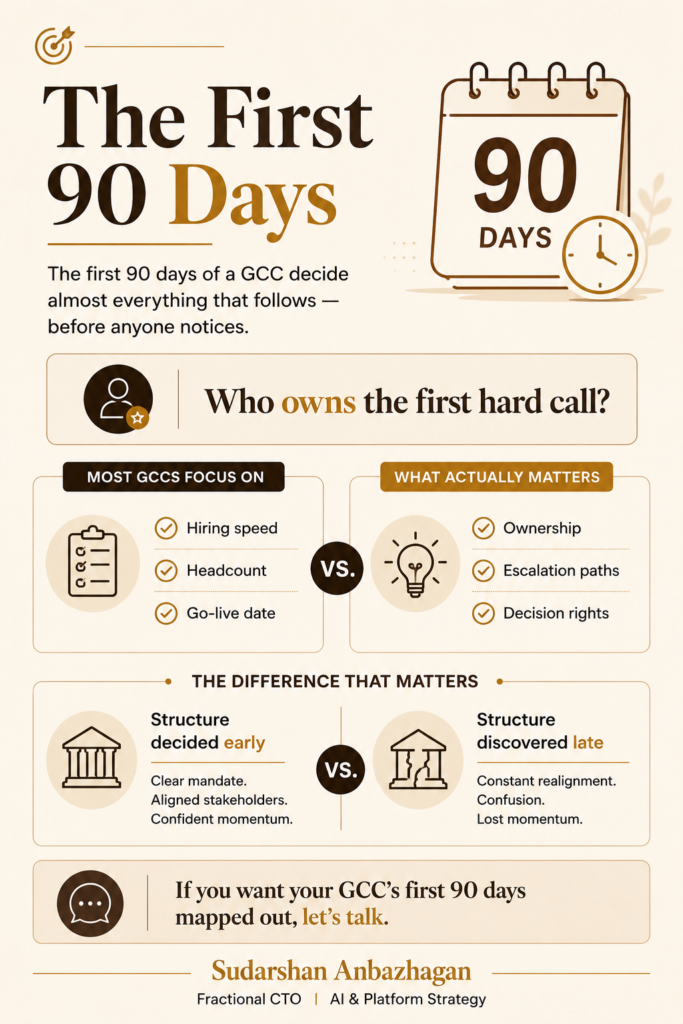
Most leadership teams walk into a Global Capability Centre launch asking the same question: how fast can we hire. It feels like the right question because hiring is visible, measurable, and easy to report upward. But across the GCC engagements I have led, the first 90 days of a GCC almost never fail on talent. They fail on a much quieter gap. Nobody decided, before the first person joined, who owns the outcome once the team is in place.
That gap does not announce itself in week one. Everyone is busy. Desks fill up, systems get provisioned, the first sprint gets planned. It is only by month four or five that leadership starts noticing a pattern they cannot quite name. Every decision seems to travel further than it should. Every escalation takes a day longer than expected. What looks like a talent or communication issue is, in almost every case I have reviewed, a structural one that was left open on day one and never closed.
In our engagements across SuperBotics’ 500 plus successful deployments spanning fourteen countries, the pattern repeats with striking consistency. Centres that struggle at month six are not the ones with weaker engineers. They are the ones where ownership, escalation, and success criteria were treated as details to figure out later rather than decisions to make before go live.
Why the First 90 Days of a GCC Decide the Next Three Years
A Global Capability Centre is, structurally, a bet on how decisions will travel across geography. In the first 90 days, that structure is still soft. Nobody has built habits around it yet. Every process is new, every reporting line is fresh, and every person on the team is still learning who to call when something does not fit the plan. That softness is temporary and it is valuable, because it means structure is still cheap to change.
By month six, the softness is gone. Whatever pattern got established, intentionally or by accident, has hardened into how things work here. If the India team learned in week one that every architectural call needs headquarters sign off, that habit does not reverse itself later. It becomes the default, and reversing a default costs far more than building the right one from the start would have.
This is why global capability centre India engagements that succeed long term almost always share one trait. Leadership treated the first quarter as a design phase, not a ramp up phase. The infrastructure, the hiring, the tooling. All of that is the easy part and it rarely determines outcomes. The decisions about ownership, escalation, and what success actually means are the part that determines whether the centre becomes a strategic asset or stays a cost line that never quite justifies itself.
The Three Questions Nobody Asks Before Day One
Across the centres I have advised, three questions consistently separate the ones that mature quickly from the ones that stall. None of them are technical. All three are structural, and all three are answerable before a single hire is made.
The most expensive mistake in a GCC launch is not a bad hire. It is an unanswered ownership question that everyone assumes someone else will eventually answer.
| Question | What Gets Skipped | What It Costs by Month Six |
|---|---|---|
| Who signs off on architecture | A named decision owner | Every call escalates three time zones away |
| Who owns an escalation | A defined path, not a person’s goodwill | Escalations pile up on whoever answers fastest |
| Who is accountable for a slipped date | A single point of accountability | Delivery slips become nobody’s problem to fix |
Each of these questions takes an afternoon to answer properly. Left unanswered, each one takes months to unwind, because by the time the gap becomes visible, an entire team has already built working habits around the ambiguity. Those habits are what leadership eventually has to undo, and undoing a habit is always harder than never forming it.
The Real Cost of Deferred Governance in a Global Capability Centre
Governance is the part of a GCC launch that gets deferred most often, usually with good intentions. Speed pressure is real, and a governance conversation feels like it can wait until the team is settled. In practice, deferring it does not remove the need for governance. It simply means the team invents its own version of it, informally, without anyone having agreed whether that version is the right one.
A GCC governance framework built after the fact is rarely as clean as one built before go live. By the time leadership notices the gap, the centre has already accumulated six months of decisions made under an implicit structure nobody chose deliberately. Correcting that structure means asking people to unlearn habits they built in good faith, which understandably creates friction that a Day One conversation would never have caused.
The centres I have seen mature fastest into genuine cross geography team leadership models are the ones that treated governance as infrastructure, not paperwork. They defined, in writing, before the first day of operations, exactly what decisions the India team could make independently and exactly which ones needed escalation. That single document did more to accelerate trust between headquarters and the centre than any quarterly business review that came after it.
The Three Layer Ownership Lock
Over the course of these engagements, I have relied on a structure I call the Three Layer Ownership Lock, and I introduce a version of it in nearly every GCC engagement during the first two weeks.
- Layer one, Decision Rights. A short, named list of who can approve what, without ambiguity or shared ownership between two people who might both assume the other is deciding.
- Layer two, Escalation Path. A single, predictable route for anything that falls outside decision rights, so that an unclear situation never depends on who happens to be online at the time.
- Layer three, Outcome Metrics. A small set of measures, agreed before operations begin, that describe whether the centre is moving the business forward rather than simply logging hours or closing tickets.
None of these three layers requires new technology or a large budget. They require an uncomfortable conversation in week one instead of a much larger one in month eight. Centres that lock in these three layers early consistently show fewer escalations, faster onboarding for new hires, and a noticeably shorter path to the kind of strategic trust that lets a GCC move from execution partner to genuine decision making partner.
What the Human Side of GCC Leadership Requires in the First Quarter
Structure alone does not build a functioning centre. The people leading it in that opening quarter carry a weight that rarely shows up in a project plan. They are building trust with a headquarters team that has never worked with them, while simultaneously earning credibility with a local team that is watching closely to see whether leadership actually means what it says about ownership.
The leaders who navigate this well are not the ones who move fastest. They are the ones who spend the early weeks listening before they start directing, understanding what each stakeholder actually cares about and where past experiences with distributed teams left them cautious. By the time they make a first real structural recommendation, it is already shaped by what that specific organisation needs rather than a generic GCC playbook copied from somewhere else.
That kind of leadership is not something a company can outsource entirely to process documents. It is why the centres that succeed fastest are usually the ones where a credible fractional or dedicated technology leader is present from week one, not brought in after the first governance gap has already caused friction. Someone has to hold the ownership conversation accountable across both sides of the relationship, and that role rarely fills itself.
Building the First 90 Days Around Outcomes, Not Activity
The single biggest shift I have seen change a GCC’s trajectory is moving the measurement conversation away from activity and toward outcomes, starting in week one rather than at the first annual review. Hours logged and tickets closed describe effort. They say nothing about whether the centre is actually moving the business forward, and leadership teams that rely on activity metrics in year one are almost always surprised, later, by how little those numbers predicted real outcomes.
A small number of outcome metrics, agreed before the first hire joins, changes the entire tone of every conversation that follows. It turns a monthly review from a status update into an honest conversation about what needs to change, whether in approach, in support, or in direction. That is a far more useful conversation than one built around utilisation rates, and it only becomes possible when the outcomes were defined clearly before operations began rather than reconstructed after the fact.
Leadership teams that get this right in the first quarter tend to see the effect compound. Trust builds faster because expectations were explicit from day one. Escalations drop because the escalation path was never ambiguous. And the centre itself starts being invited into strategic conversations earlier, because it has already demonstrated, with real outcome data, that it can be trusted with judgment and not just execution. That trajectory closely mirrors what separates an execution centre from a genuine strategic partner in the GCC maturity model, and it is rarely an accident when a centre reaches that stage quickly.
What This Means for Leadership Planning a GCC Right Now
If your organisation is exploring a Global Capability Centre this year, the most valuable planning session you can hold will not be about headcount or infrastructure. It will be the ninety minute conversation where leadership agrees, in writing, who owns architecture, who owns escalation, and what outcome metrics will define success before the first person is hired. That conversation is inexpensive now and becomes progressively more expensive the longer it is postponed.
The GCC centres that become genuine strategic assets by year two are consistently the ones that treated the first 90 days as the only window where structure is still cheap to design. They did not hire fastest. They decided fastest, on the handful of questions that actually determine whether a distributed team becomes an execution arm or a true extension of the business.
What did your organisation actually decide in the opening quarter of your last cross-geography initiative? If the honest answer is that hiring started before ownership was defined, there is still time to close that gap before it hardens into how things work. The centres that make that shift early are the ones still reaping the benefit three years later.