
The GCC plans that struggle in the boardroom usually have very good numbers. The cost model is tight, the hiring timeline is realistic, and the projected savings look convincing on every slide. I have reviewed many of these plans with leadership teams in the US, UK, and Europe, and the pattern holds with surprising consistency. A strong GCC business case for board approval is rarely rejected because of its arithmetic. It stalls because a board member asks a question the slides were never built to answer.
That moment is familiar to anyone who has presented a global capability centre proposal. The CFO has signed off on the cost per seat, the HR team has validated the talent market in India, and the operating plan runs cleanly to month eighteen. Then a director leans forward and asks who at headquarters will be accountable if the centre drifts from its purpose in year three. The room goes quiet, not because nobody has an opinion, but because nobody has written the answer down.
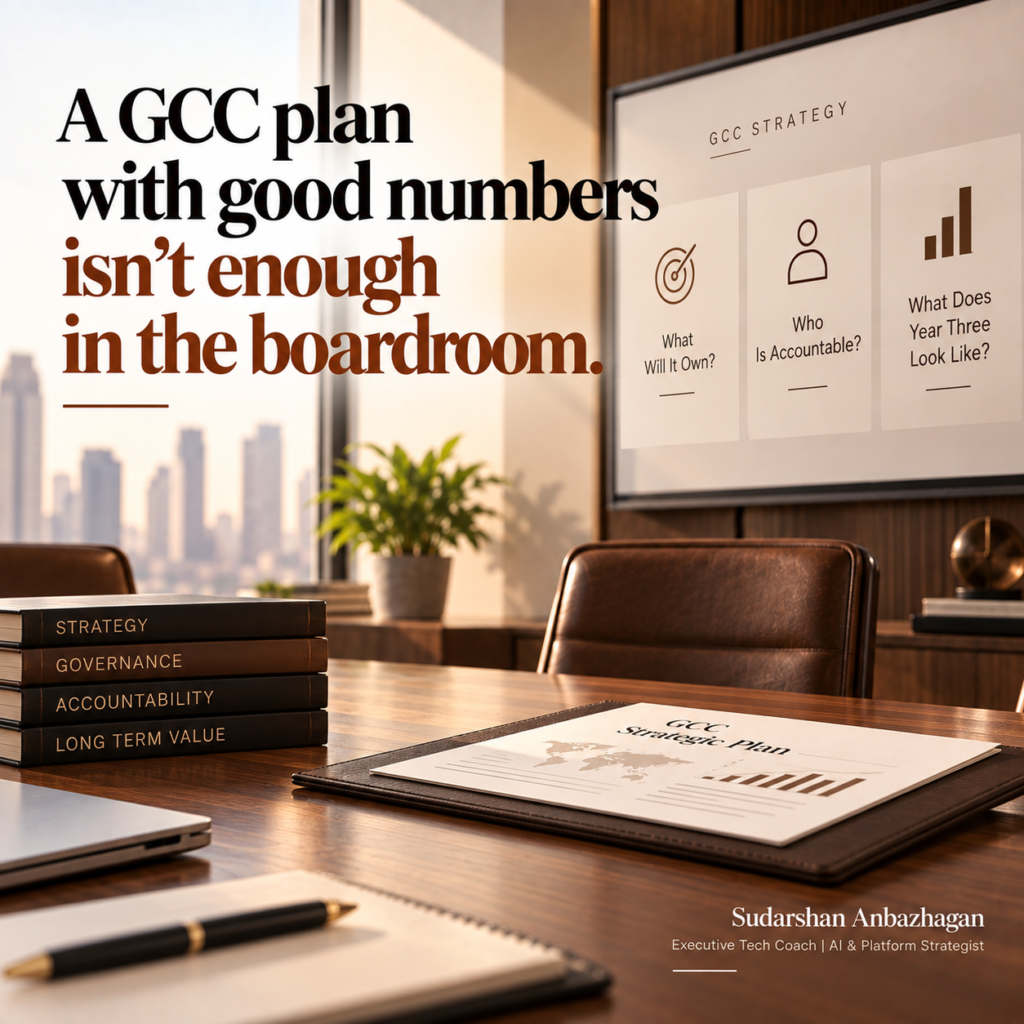
In my experience, boards are rarely asking about cost per seat. They assume the finance team has done that work properly. What they want to understand is what the centre will own, who answers for it if it underperforms, and what the organisation will have built by year three if cost savings turn out to be the only thing it delivers.
The GCC cost model looks very different once you replace assumptions with real numbers.
Why Strong GCC Numbers Still Stall in the Boardroom
Directors approach a GCC proposal the way they approach any long-term commitment of capital and reputation. They are not only asking whether the investment pays back. They are asking whether the organisation will be able to govern it well once the initial enthusiasm fades and the executive sponsor moves on to other priorities. A cost model answers the first question well, but it says almost nothing about the second.
Across 15 years of GCC and cross-geography delivery engagements, I have noticed that the proposals which move quickly through a board share one quality. They treat ownership and accountability as part of the business case rather than as an operational detail to be sorted out after approval. The cost model still matters, and it still needs to be rigorous, but it is no longer the page that carries the decision.
The hidden risk: a GCC approved purely on savings tends to be managed purely on savings. When cost per seat becomes the only success measure, the centre is structurally prevented from ever becoming more than a cheaper version of what already exists.
This is the heart of why the ownership question matters so much to directors. A board that approves a GCC as a cost play is, whether it realises it or not, approving a ceiling on what the centre can become. The directors who ask about year three are usually the ones who have seen that ceiling before, and they want reassurance that this proposal was designed to rise above it.
The Three Questions Behind Every GCC Board Discussion
When I prepare leadership teams for a GCC board presentation, I encourage them to anticipate three questions that sit beneath almost every director’s comments. These questions are rarely asked in exactly these words, but nearly every challenge in the room traces back to one of them.
The first question is what the centre will own. Boards want to know whether the global capability centre will hold end to end responsibility for defined products, platforms, or functions, or whether it will execute tasks handed over from headquarters. The answer shapes everything from talent strategy to long-term value, and a vague answer signals that the leadership team has not yet decided.
The second question is who at headquarters is accountable if the centre drifts. Directors understand that distance creates risk. They want a named executive, not a steering committee, whose role explicitly includes the centre’s outcomes. The third question is what year three looks like if savings are all the centre delivers. This is the question that tests whether the organisation has a plan for capability, or only a plan for cost.
| Board Question | Cost Led Plan Answers | Ownership Led Plan Answers |
|---|---|---|
| What will the centre own? | Tasks transferred from existing teams | Named products, platforms, or functions end to end |
| Who is accountable at headquarters? | A steering group or the vendor manager | One named executive with the outcomes in their role |
| What does year three look like? | Lower cost per seat, same scope | Expanded ownership and local leadership depth |
| How is success measured? | Savings against onshore baseline | Savings plus outcomes owned and delivered |
Building a GCC Business Case for Board Approval Around Ownership
When I help a leadership team prepare a GCC case today, there is one page that gets written before the cost model. I call it the Year Three Ownership Page, and it has become the most important document in every board pack I contribute to. It is a single page, written in plain language, that answers the three board questions before anyone has the chance to ask them.
The page is deliberately short because its purpose is clarity rather than completeness. Directors read dozens of pages before a board meeting, and the page that answers their real question in two minutes earns disproportionate attention. The structure below reflects what has worked across engagements with companies setting up centres in India for US and European parent organisations.
- Ownership scope: the specific products, platforms, or functions the centre will own by the end of year one, year two, and year three.
- Accountable executive: the name and role of the headquarters leader whose objectives include the centre’s outcomes.
- Local leadership plan: how and when senior leadership roles inside the centre will be filled, and what decisions they will hold.
- Drift signals: the two or three early indicators that the centre is sliding back toward pure execution, and who reviews them.
- Year three picture: a short description of what the organisation will have built beyond savings if the plan works.
Writing this page first changes the cost model as well. Once the leadership team has committed to what the centre will own, the budget has to include the leadership and architecture roles required to hold that ownership. I have written about this in more depth in the five year cost comparison most boards get wrong, because a cost model built after ownership is defined looks quite different from one built before.
How the Room Changes When Ownership Comes First
A plan that answers the board’s real questions before they are asked changes the tone of the room almost immediately. I have watched the same leadership team present two versions of a GCC proposal a few months apart, one led by cost and one led by ownership. The first presentation produced a long list of follow-up questions and a request to return next quarter. The second produced a discussion about timing.
The conversation moves from “can we afford this?” to “how soon can we start?” That shift happens because directors can see that the leadership team has thought about the parts of a global capability centre that usually go wrong. The numbers still matter, and weak numbers will still sink a proposal. They are simply not what earns the approval once they meet a reasonable standard.
There is also a human dimension here that is easy to overlook. Directors are personally accountable for the decisions they approve, and a GCC is a visible, multi-year commitment. When a proposal names an accountable executive and describes the drift signals honestly, it gives directors confidence that they are not being asked to approve an optimistic plan. They are being asked to approve a governed one, and that is a much easier decision to support.
What Year Three Should Look Like
The centres I have seen succeed over the long term, many of them within client relationships that now average 6.8 years, all shared a clear picture of year three from the very beginning. By that point, the centre owned something meaningful, had local leaders making real decisions, and was contributing to the parent organisation’s roadmap rather than only executing it. Savings were still present, but they had become a secondary benefit rather than the headline.
Getting there depends far more on leadership decisions made before approval than on anything the centre does after it opens. That is why I encourage every leadership team to test their plan against the mandate questions early. If you want a structured way to do that, my piece on the GCC mandate review most leadership teams skip walks through the questions I use with executive teams before a board meeting.
If your board asked who owns your GCC’s outcomes in year three, would your plan have a name on that page? If the answer is yes, your proposal is already ahead of most. If the answer is not yet, that single page, the foundation of any GCC business case for board approval, is the most valuable thing you can write before your next board meeting, because boards do not approve spreadsheets; they approve the people they trust to own what comes after.
The teams that build GCCs that scale always start with one thing: a clear picture of what it actually costs before they commit.