
Vendor Versus GCC: The Five Year Cost Comparison Most Boards Get Wrong
Every leadership team I have sat with eventually reaches the same fork in the road. One side of the table wants to sign with a vendor because the proposal is ready and the timeline is short. The other side wants to build a Global Capability Centre because the long term math looks better on paper. Both sides are usually arguing from the wrong comparison, and that is the part nobody notices until year three.
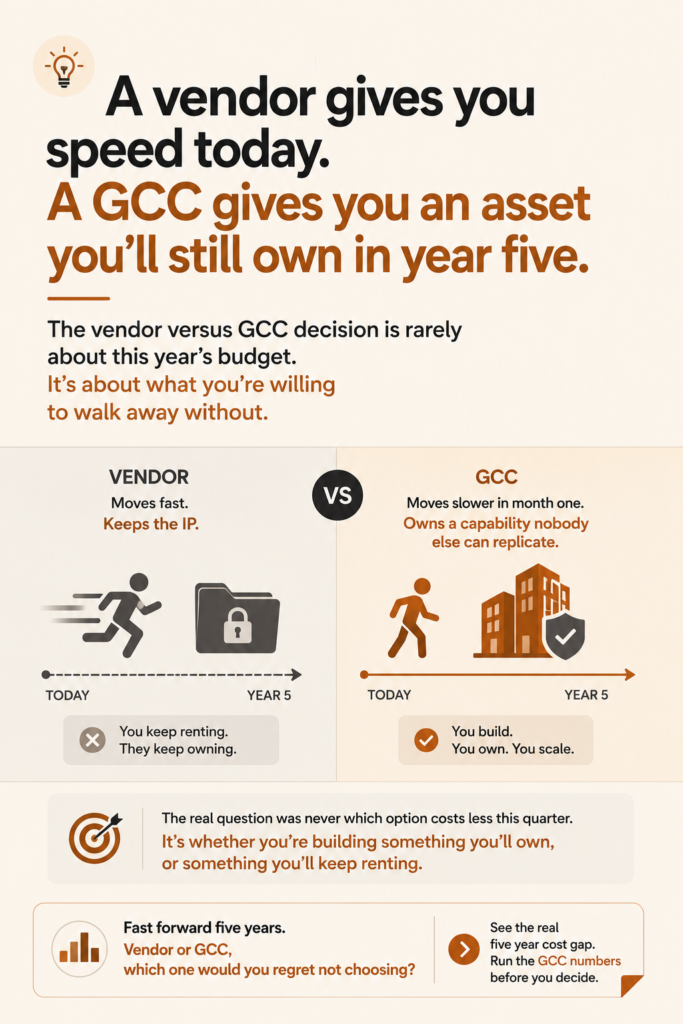
A vendor relationship is built for speed. You sign a statement of work, a team gets assigned, and delivery starts within weeks. That speed is real and it matters when a product launch or a compliance deadline will not wait for a hiring cycle. What a vendor does not give you is ownership. The intellectual property, the institutional knowledge, and the specialised skill that gets built over eighteen months of solving your specific problems belongs to the vendor’s business, not yours. When the contract ends, most of that capability walks out the door with them.
A Global Capability Centre works on a different timeline entirely. In our engineering reviews across SuperBotics’ 500+ successful deployments, we consistently observe that a GCC moves slower in the first two quarters because you are hiring, training, and building governance from scratch. By month twenty four, the picture reverses completely. The centre now owns a capability that took years to develop, staffed by people who understand your product, your customers, and your technical debt at a depth no external vendor will ever reach.
The GCC cost model looks very different once you replace assumptions with real numbers.
→ Calculate Your GCC Cost Model
→ Read the GCC Strategy Guide
The Comparison Most Leadership Teams Get Backwards
The mistake I see most often in boardrooms is comparing a vendor’s quarterly invoice against a GCC’s twelve month setup cost. That comparison is rigged before anyone opens the spreadsheet, because it stacks a short term operating expense against a long term capital investment. It is the same error as comparing the cost of renting an apartment for one year against the cost of buying a house, without ever mentioning that one of those choices builds equity and the other does not.
The real question a board should be asking is not which option is cheaper this quarter. It is which option you will regret not choosing once you look back in five years. A vendor gives a company optionality today at the cost of ownership tomorrow. A GCC gives a company friction today in exchange for a durable asset that compounds in value the longer it operates. Neither choice is universally correct, but pretending the two options are financially equivalent is where most of these decisions go wrong.
A twelve month vendor invoice and a five year capability asset are not the same unit of comparison, yet they get placed on the same slide in almost every board deck I have reviewed.
I have watched companies sign three consecutive one year vendor contracts, each time convinced they were saving money against the alternative of building internally. Add up those three years of invoices and the number frequently exceeds what a properly governed GCC would have cost to stand up and run over the same period, with nothing to show for it once the third contract ends. The vendor kept the knowledge. The company kept the invoices.
What a GCC Actually Buys You That a Vendor Cannot
Ownership of a capability is not an abstract concept. It shows up in very concrete ways once a GCC matures past its first eighteen months. The team knows why previous architectural decisions were made, not just what the current state of the system looks like. They can anticipate edge cases in your specific customer base because they have lived through the last three product cycles. None of that institutional memory transfers when a vendor contract rolls over to a different account manager or a different delivery pod.
There is also a talent retention dimension that rarely makes it into the initial cost comparison. Vendor staff are managed against the vendor’s margin targets and career ladders, not yours. A GCC lets you build retention structures, career paths, and compensation bands that are designed around keeping the specific people who understand your business for the long haul. Average client partnership tenures across the engagements we run at SuperBotics sit around 6.8 years, and that kind of continuity is nearly impossible to replicate inside a rotating vendor staffing model.
Where the Financial Comparison Actually Belongs
| Dimension | Vendor Model | GCC Model |
|---|---|---|
| Time to first delivery | Weeks | Two to three quarters |
| Ownership of IP and process knowledge | Stays with vendor | Stays with your company |
| Cost trajectory over five years | Recurring invoice, rarely declines | Front loaded, declines per unit of output as the team matures |
| Talent continuity | Depends on vendor’s internal staffing decisions | Controlled directly by your retention strategy |
A table like this one only tells the truth if you commit to running the comparison over the full five year window rather than the first twelve months. Leadership teams that make this decision well are the ones willing to model both paths out to year five before a single contract gets signed, rather than defaulting to whichever option produces the lower number on this year’s budget line.
The vendor path is not a mistake in every situation. Short term projects, highly specialised one off work, and initiatives where the underlying technology will likely be replaced within eighteen months are often better served by a vendor relationship that does not require the multi year commitment a GCC demands. The mistake is applying vendor economics to a decision that is actually about which capability you want to own for the next five years, and vice versa.
The Question Worth Asking Before the Next Renewal
Every renewal cycle is a natural moment to ask the harder question. Not whether the current vendor’s pricing is competitive, but whether the work being renewed is core enough to your business that owning the capability outright would change your competitive position over the next five years. If the answer is yes, the true cost of continuing to rent that capability year after year deserves the same scrutiny that a GCC’s setup cost usually receives.
The organisations that get this right are rarely the ones with the most sophisticated financial models. They are the ones who asked, early and honestly, what they wanted to own by year five rather than what they wanted to spend this quarter. That single reframing changes which option looks obviously correct, and it changes it well before the spreadsheet gets built.
The teams that build GCCs that scale always start with one thing, a clear picture of what it actually costs before they commit.
→ Calculate Your GCC Cost Model
→ Read the GCC Strategy Guide