
Why the Best Technology Leaders Spend More Time Listening Than Building
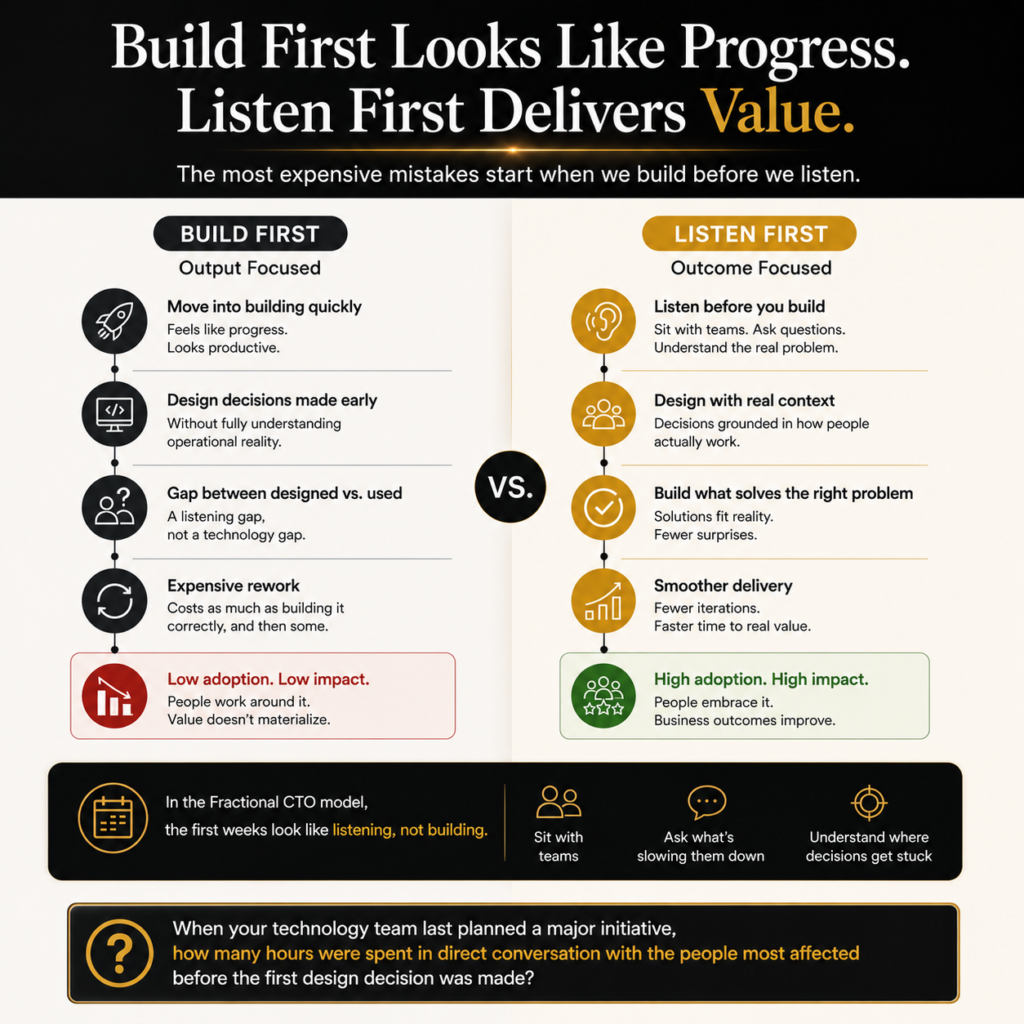
There is a pull in technology work toward visible output. Something to show. Something deployed. Something built. It feels like progress. And sometimes it is. But some of the most expensive technology mistakes I have seen came from moving into building before enough listening had happened. The gap between what a system is designed to do and how people actually use it is almost never a technology gap. It is a listening gap. Someone made a design decision at some point without fully understanding the operational reality of the people who would live inside that system.
The rework that follows a listening gap costs as much as building it correctly the first time, and frequently more. The technical cost of rework is measurable, the additional sprints, the architectural changes, the testing cycles. The organisational cost is harder to measure but often larger: the trust that was damaged when a system was delivered that did not fit the real workflow, the time invested by operational teams in workarounds that the system should have obviated, the accumulated frustration that makes the next technology initiative harder to adopt before it even begins.
In fifteen years of leading technology teams at SuperBotics and working as a Fractional CTO across organisations in the US, UK, and Europe, I have developed a strong view about the single quality that most reliably distinguishes technology leaders who build things that get adopted from those who build things that require significant course correction after delivery. It is not technical depth. It is not strategic vision. It is the discipline of listening before building, and the organisational courage to hold that discipline under delivery pressure.
The Listening Before Building Framework: The Four Conversations That Prevent Rework
In SuperBotics’ delivery methodology, I apply what I call the Listening Before Building Framework: four structured conversations that must happen before any significant technology design decision is made. The first is the operational reality conversation: how do the people closest to the problem actually do their work today, including all of the workarounds and unofficial processes that the formal system does not capture? The second is the friction conversation: where does the current system or process create the most friction, and what have people learned to work around rather than report because they assume it cannot be fixed?
| Conversation | Who It Involves | What It Surfaces |
|---|---|---|
| Operational Reality | Frontline team members | How work actually happens, not how it’s documented |
| Friction Inventory | Operations and support leads | Workarounds, unofficial processes, known gaps |
| Decision Boundary | Middle management | Where decisions get stuck and why |
| Strategic Context | Senior leadership | What success looks like in 18 months |
The technology leaders who build things that actually get adopted are not always the fastest. They are the ones who spent the most time with the people closest to the problem before the first design decision was made.
What Listening Looks Like Under Delivery Pressure
The hardest place to maintain a listening discipline is precisely when it matters most: under delivery pressure. When a deadline is approaching, when stakeholders are watching for visible progress, when the team is ready to build and waiting for direction, the pressure to move directly to decisions rather than investing another week in conversations is intense. Every experienced technology leader has felt this pressure and has at some point capitulated to it in ways they later regretted.
The practical approach I have found most effective is not to resist the pressure but to make the listening time-bounded and structured. Two days of directed conversations with the people closest to the work is not a delay to delivery. It is an investment that will save multiples of that time in rework. Making this explicit to stakeholders, not as a request for permission but as a professional judgment about how to deliver well, is part of the leadership role. The technology leader who can say with confidence “we are taking two days to understand the real problem before we begin designing the solution” and mean it is exercising exactly the kind of judgment that makes their delivery reliable.
The Trust Accumulation That Listening Produces
Beyond the direct impact on delivery quality, consistent listening practice produces something less measurable and more valuable: trust. When the people closest to the work see that their input genuinely shaped the systems they use, they bring a different quality of engagement to the next initiative. They share problems earlier. They contribute ideas more openly. They adopt new systems with more willingness because they have experienced that their operational reality is considered rather than overridden.
This trust accumulation is one of the most durable competitive advantages a technology team can build. It does not appear in any delivery metric. It does not show up in sprint velocity or release frequency. It shows up in the quality of information that flows into the technology function when the next problem needs to be solved, and in the speed with which new systems get embedded into actual working practice rather than existing alongside unofficial workarounds forever.
Listening as a Leadership Practice, Not a Project Phase
The discipline that produces the highest quality technology delivery is not a phase that precedes building. It is a continuous practice that runs alongside everything else. The best technology leaders I have worked with maintain an ongoing listening posture with the people whose work their technology supports. Not through formal surveys or quarterly feedback cycles. Through regular direct conversations that treat the operational reality of those people as the primary source of truth about whether the technology is working.
This posture does not emerge naturally under the conditions of most technology organisations. It has to be built deliberately, modelled by leadership, and protected under the delivery pressure that would otherwise crowd it out. When it is built and maintained, the quality of what gets built improves continuously and the rework that consumed months of effort in previous years becomes rare. The investment in listening is not a cost to delivery. It is the discipline that makes delivery genuinely excellent.
When your technology team last planned a major initiative, how many hours were spent in direct conversation with the people most affected before the first design decision was made? That number is worth knowing. More on technology leadership and delivery excellence on this blog.