
Before You Approve the Next Platform Rebuild, Answer This One Question
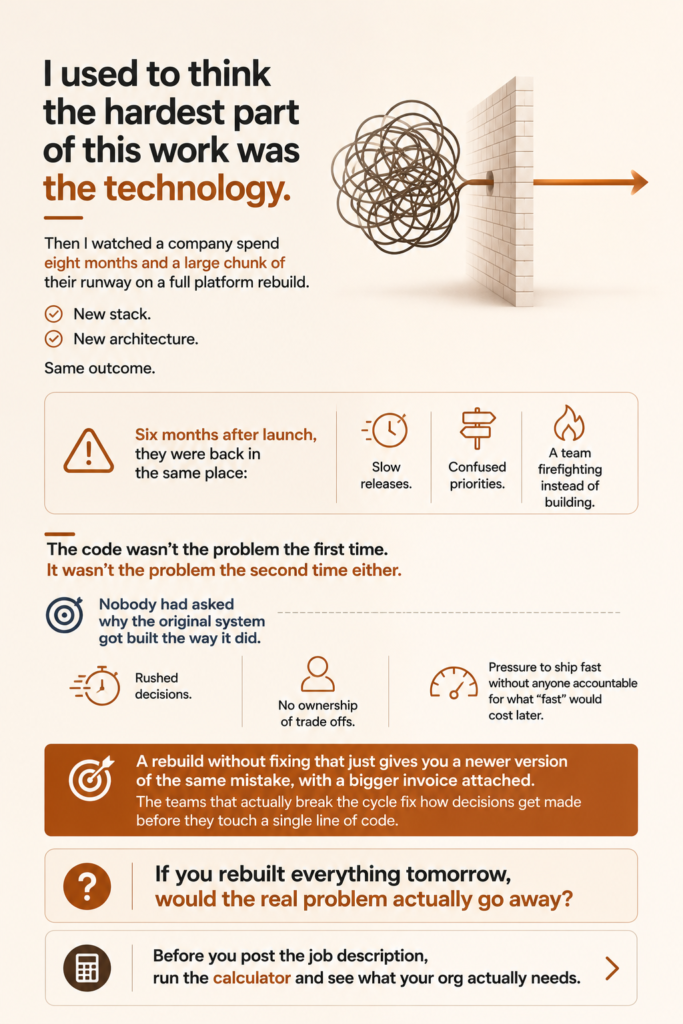
I used to think the hardest part of this work was the technology. That assumption held until I watched a company spend eight months and a meaningful share of its runway on a full platform rebuild. New stack, new architecture, a genuinely talented team executing the plan well. Six months after launch, the company was back in the same place. Slow releases, confused priorities, a team firefighting instead of building the next thing that mattered.
The code was never the actual problem the first time, and it was not the problem the second time either. Nobody on the leadership team had asked why the original system got built the way it did in the first place. Rushed decisions under deadline pressure. No clear ownership of the trade offs that were made along the way. Pressure to ship fast without anyone accountable for what that speed would cost the business eighteen months later.
A Rebuild Without This Question Repeats the Mistake at a Higher Price
A rebuild that skips this diagnostic step does not solve the underlying problem. It gives the organisation a newer version of the same mistake, wrapped in a more modern codebase and attached to a considerably larger invoice. In our engineering reviews across SuperBotics’ 500+ successful deployments, the pattern is consistent enough to treat as a rule rather than an exception. Teams that actually break this cycle fix how decisions get made before they touch a single line of code.
The most expensive rebuild is the one an organisation does twice, and the second one almost always costs more than the first because expectations are higher and patience is lower.
The diagnostic question is simple to state and uncomfortable to answer honestly. What decision, made differently at the time, would have prevented the need for this rebuild in the first place? If leadership cannot produce a clear answer to that question, the rebuild is not actually ready to begin, no matter how confident the engineering plan looks on paper.
Most leaders who have run this calculation are surprised by where the real cost sits.
→ Calculate Your Fractional CTO ROI
→ Read the Fractional CTO Guide
Why Engineering Teams Cannot Answer This Question Alone
This is not a question an engineering team can answer by itself, and it is unfair to expect them to. The decisions that produced the original system were almost always business decisions dressed up as technical ones. A deadline that could not move. A feature that had to ship before a specific customer renewal. A hiring freeze that forced a smaller team to make architectural shortcuts nobody planned to keep permanently. Engineers inherit those constraints. They rarely get to name them out loud in a way that changes how the next rebuild gets planned.
- Identify the specific business pressure that shaped the original architecture, not just the technical symptoms it produced
- Name who had the authority to push back on that pressure at the time, and whether that authority still exists today
- Confirm that the new rebuild plan removes the same pressure rather than simply working around its latest symptom
What Changes When the Decision Layer Gets Fixed First
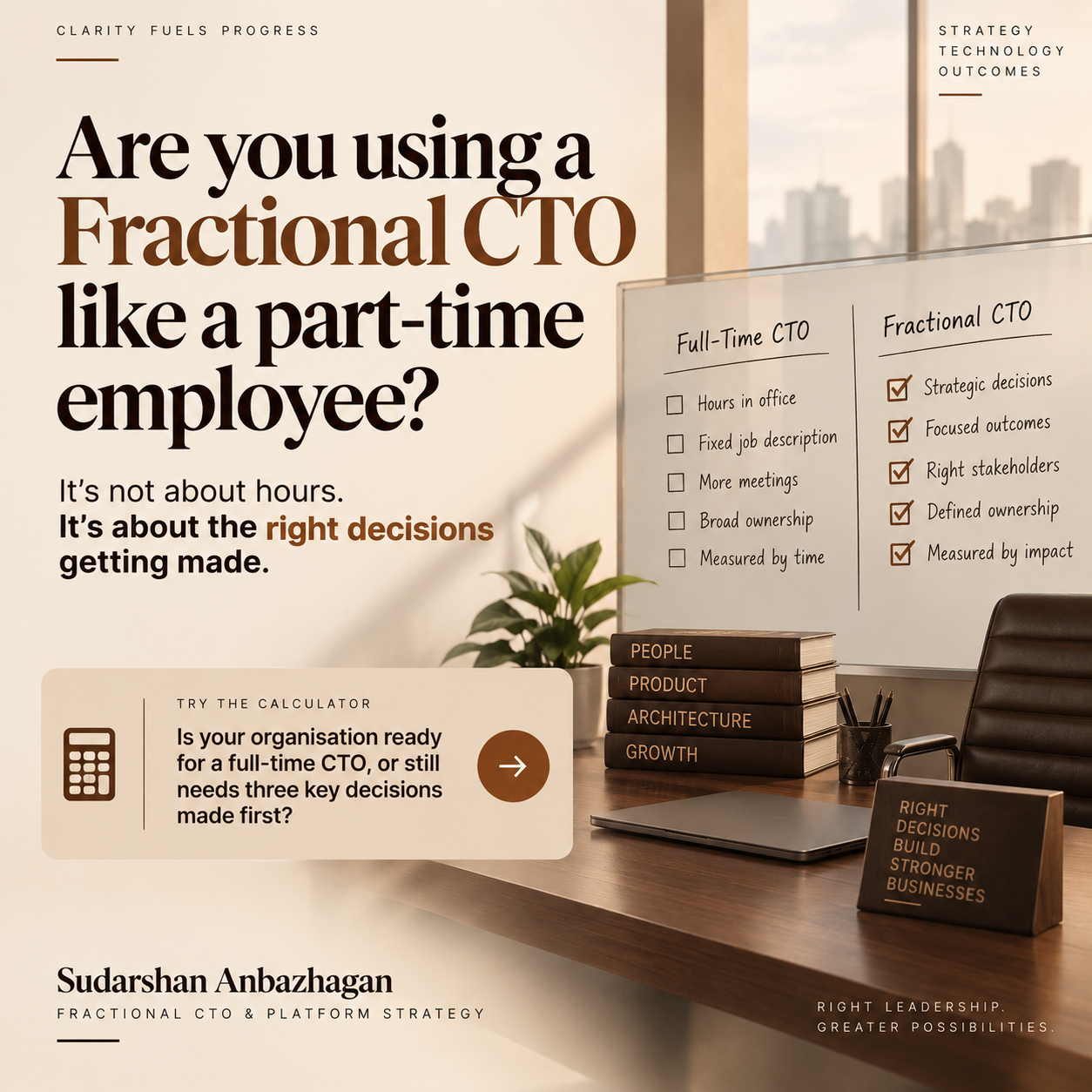
Rebuilds that succeed on the second attempt share a common pattern. Before any code gets written, someone with the authority and the technical judgement to make the call identifies exactly which decision needs to be made differently this time, and holds that decision in place even when the same deadline pressure that caused the first failure resurfaces. That role rarely exists by default inside a growing company, which is precisely the gap a Fractional CTO is positioned to close.
| First Rebuild Pattern | Second Rebuild Pattern |
|---|---|
| New codebase, same decision process | New codebase, decision process fixed first |
| Pressure resurfaces, same shortcuts taken | Pressure named early, shortcuts flagged and owned |
| Same result within eighteen months | Durable outcome that survives the next deadline |
The Question to Ask Before Signing Off on the Budget
Every rebuild proposal that lands on a leadership team’s desk deserves this question before the budget gets approved. If everything were rebuilt exactly as planned tomorrow, would the real problem that caused the first system to fail actually go away, or would it simply move to a newer codebase and wait for the next deadline to resurface? Organisations that ask this question honestly, before the engineering work begins rather than after it finishes, are the ones who only pay for this lesson once.
Before you post the job description, run the calculator and see what your org actually needs.
→ Calculate Your Fractional CTO ROI
→ Read the Fractional CTO Guide