
What a Managed Team Looks Like When It Is Fully Embedded in Your Business
I got a call from a CEO last year, about eight months after we had placed a managed team with his organisation. I expected a performance review conversation. What I got was something different. He said: “I stopped thinking of them as your team three months ago.” That sentence told me everything I needed to know about how the engagement had developed. It also told me something more important: that full embedment, the state where a managed team genuinely functions as part of the organisation rather than alongside it, had been achieved in less than a year. That is not guaranteed. It is not automatic. And understanding what produces that outcome is one of the most valuable things a business leader can know before entering a managed team engagement.
The managed team model is one of the most misunderstood approaches to building technology capability in growing businesses. At SuperBotics MultiTech, we have placed and led managed teams across 14 countries over fifteen years. The pattern that consistently separates the engagements that produce transformational outcomes from the ones that plateau at functional delivery is not technical capability. It is not service agreement design. It is whether the conditions exist for genuine embedment to develop, and whether leadership on both sides is invested in creating those conditions deliberately rather than waiting for them to emerge on their own.
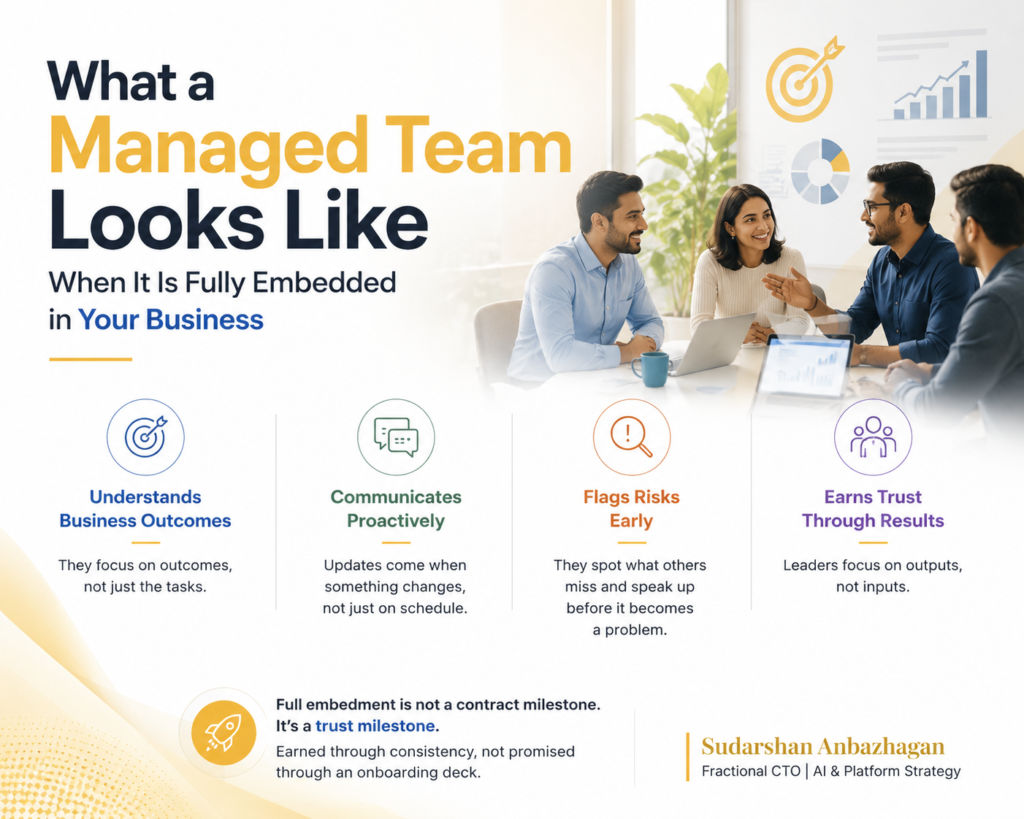
Full embedment is a specific operational state. It is not a feeling of familiarity or a comfortably established working routine. It is a condition where the managed team understands the business outcomes they are contributing to, not just the tasks they were engaged to complete, and where that understanding shapes how they approach their work, how they communicate, and what they choose to flag or escalate without being prompted. Achieving it requires four things to align over time, and recognising those four things clearly is what enables leadership teams to build toward them deliberately rather than hoping the engagement matures on its own trajectory.
The Difference Between a Functioning Managed Team and a Fully Embedded One
A functioning managed team delivers what it is asked to deliver. Timelines are met. Quality standards are maintained. Communication protocols are followed. The client receives the outputs specified in the service agreement, and the relationship operates within the parameters established at the outset. This is a good outcome. Many managed team engagements never achieve even this level of reliability. But it is not full embedment, and the distinction matters because the business value available from the two states is qualitatively different, not just quantitatively better.
A fully embedded managed team does something that a functioning one does not: it anticipates. It notices what is coming before it arrives. It flags risks that the internal leadership had not yet identified, because the team’s proximity to the operational work and their relative objectivity about the business environment gives them a vantage point that internal teams often lose over time. It asks questions about business direction not because it needs permission to do its job, but because the answers will improve the quality of the work. And it evolves its own processes in response to changing business conditions without waiting for a formal brief to trigger the change.
The distinction between a functioning managed team and a fully embedded one is the difference between a vendor relationship and a capability partnership. The first delivers what is specified. The second contributes to outcomes that were never explicitly specified because the team understands the business well enough to identify what is needed before it is formally requested.
The practical business value of full embedment is significant. In technology delivery, it means faster problem identification and resolution, better technical decisions that reflect business context rather than pure technical merit, and reduced management overhead for the internal team that is partnering with the managed team. In operations support, it means proactive process improvement rather than reactive problem solving, better risk management because risks are surfaced before they become incidents, and stronger business continuity because the team’s understanding of the operation is deep enough to maintain performance through change and disruption.
The Four Conditions That Produce Full Embedment
After fifteen years of managing these engagements across geographies and industries at SuperBotics MultiTech, I have identified four conditions that consistently produce full embedment when they are present and consistently prevent it when they are absent. These conditions are not fixed by the service agreement. They are created through the decisions both sides make about how the engagement is structured, how communication flows, and what kind of relationship is genuinely built over time.
The first condition is outcome understanding rather than task understanding. When a managed team is briefed on what they are doing without context about why, they execute competently within the scope they have been given and nothing more. When they understand the business problem their work is designed to address, the delivery target their output feeds into, and the consequences to the business when their work is late or below quality, they bring a different quality of attention to everything they do. The specifics matter. Not “this sprint contributes to the Q3 release” but “the Q3 release is the threshold we need to meet to support the US market expansion that the CEO has committed to the board.” That specificity changes how the team prioritises under pressure, how they handle trade-off decisions, and what they proactively raise when they see a risk to the outcome.
The second condition is communication fluidity rather than communication formality. Early in most managed team engagements, communication follows a structured protocol. Status updates at defined intervals. Escalations through a designated channel. Issues logged in a specified format. This structure is appropriate and necessary in the establishing phase. Full embedment begins when that structure is still present as a backstop but is no longer the primary channel through which meaningful communication happens. When a managed team member reaches out to an internal counterpart not because a report is due but because something changed this morning that the client needs to know about, the relationship has moved past the formal structure. That transition happens naturally when the relationship has been built with enough genuine investment, and it produces a communication cadence that is far more operationally valuable than the scheduled update cycle it supplements.
| Condition | Absent State | Present State | Business Impact |
|---|---|---|---|
| Outcome understanding | Task-level execution only | Proactive, context-driven contribution | Faster, better decisions |
| Communication fluidity | Scheduled updates only | Real-time, trust-based exchange | Faster risk identification |
| Risk visibility | Problems escalated reactively | Risks surfaced proactively | Fewer incidents, lower recovery cost |
| Output trust | Micromanaged inputs | Trusted outputs, delegated ownership | Reduced management overhead |
The Trust Milestone That Changes Everything
The third condition is that leadership stops micromanaging the inputs and starts trusting the outputs. This transition is the single most significant marker of full embedment, and it is also the one that is most dependent on the track record that has been built over time. Trust at the output level is earned, not granted. It develops when a managed team has demonstrated, through consistent performance across enough situations including difficult and ambiguous ones, that their judgment can be relied upon to produce the right outcome without the client needing to specify every input decision.
What this trust milestone looks like in practice is a reduction in the granularity of direction that the client provides. Early in the engagement, the client specifies the approach as well as the outcome. In a fully embedded relationship, the client specifies the outcome and trusts the team to determine the approach. That shift represents a significant reduction in the client’s management overhead, because specifying approach requires far more client time and attention than specifying outcome. It also represents a significant increase in the quality of the work, because the managed team’s proximity to the operational detail typically means they are better positioned to determine the optimal approach than a client who is reviewing progress from a distance.
Building toward this trust milestone requires deliberate investment from both sides. The managed team needs to demonstrate judgment in a series of situations where the stakes are real but contained enough that the cost of a wrong decision is recoverable. The client needs to create the conditions for those demonstrations to happen by progressively extending decision authority rather than waiting for the track record to be complete before any delegation occurs. The engagements that reach full embedment fastest are the ones where both sides actively invest in this progressive trust-building process rather than waiting for it to happen organically.
The Role the Managed Team Plays in Creating Its Own Embedment
The fourth condition is one that places a direct responsibility on the managed team rather than on the client organisation, and it is often underappreciated in discussions about managed team engagement quality. A managed team that understands the business outcomes it is contributing to, and has the genuine capability to contribute to those outcomes at a strategic level, has a responsibility to proactively demonstrate that capability rather than waiting to be invited to do so.
This means raising questions about business direction when the answers would improve the quality of the work. It means flagging operational risks that are visible from the managed team’s vantage point even when the brief did not ask for risk identification. It means suggesting process improvements proactively when improvements are visible rather than waiting for a formal review cycle to make them. It means, in short, behaving like a capable and invested part of the organisation rather than like a well-disciplined vendor waiting for the next instruction.
At SuperBotics MultiTech, we train our managed teams explicitly on this responsibility. The client relationship is not fully served by excellent execution of the agreed scope. It is fully served when the team is actively working to understand the business environment they are contributing to and proactively applying that understanding to improve their contribution. The managed teams that reach full embedment fastest are consistently the ones that bring this posture to the engagement from the first week, before the relationship has had time to establish formal patterns that are harder to shift later.
When the Relationship Has Not Embedded After Six Months
If your managed team still feels external after six months, the question worth asking is not whether the team is performing adequately on the contracted deliverables. The question is what would need to change in the structure of the relationship for the conditions for full embedment to develop. The answer is almost always one of two things: the client side needs to provide more business context and progressive delegation, or the managed team side needs to demonstrate more proactive contribution and genuine investment in understanding the business environment.
Both of those changes are available at any point in an engagement. The relationship does not need to be restarted. It needs a deliberate conversation about what full embedment would look like in this specific context, followed by specific agreements on both sides about what each party will do differently. That conversation, which I have initiated in engagements that have plateaued at functional delivery without progressing toward genuine partnership, is almost always the turning point that changes the trajectory of the relationship.
The managed team model, structured correctly and invested in deliberately, is one of the most powerful approaches to building technology and operational capability without the overhead of a full employment structure. But it only delivers at that level when both sides are honest about what they are building together, and committed to creating the conditions for full embedment rather than settling for the easier outcome of a well-functioning service relationship. The difference between those two outcomes, measured in business value over a three-year engagement, is rarely small.