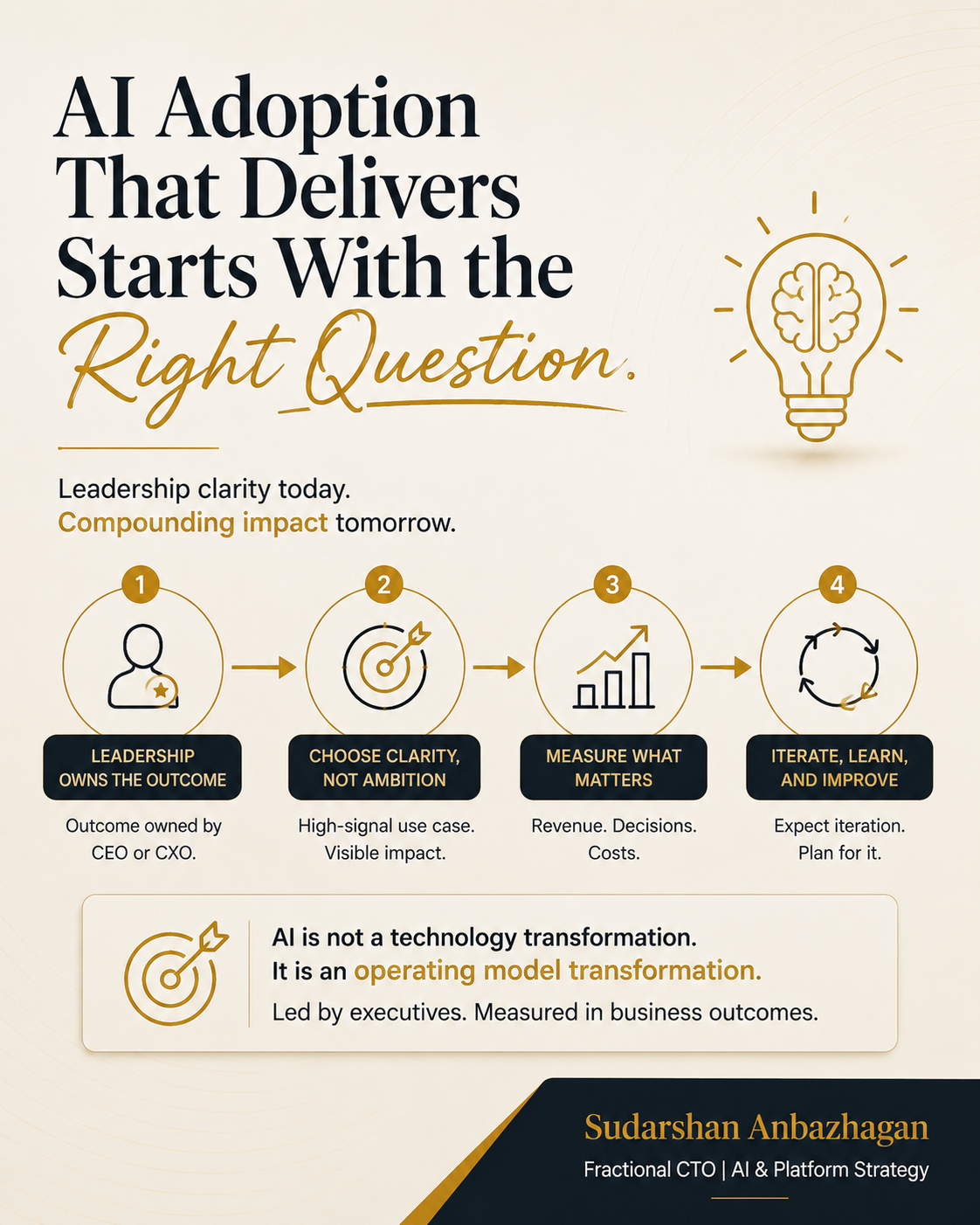
What AI Actually Requires From Leadership Before It Can Deliver Business Value
I walked into a meeting once where a leadership team had just completed a six-month AI implementation. They had invested significantly. They had the right vendor. Strong technical team. Executive sponsorship at the top. And twelve months later, the business outcomes were almost invisible. Not because the AI did not work. The models performed as specified. The integrations were complete. The vendor had signed off. The outcomes were invisible because leadership had not done what AI actually requires before it can deliver anything meaningful, and by the time that was clear, the organisation was carrying both the implementation investment and the credibility cost of a transformation that had not transformed anything.
This is the part of AI adoption that is not talked about clearly enough in most enterprise technology conversations. AI does not fix unclear thinking. It amplifies whatever clarity or confusion already exists in an organisation. A clear problem definition, fed into a well-designed AI solution, produces measurable value. A vague problem definition, fed into the same solution, produces impressive demonstrations and modest operational outcomes. The difference between those two results is almost never in the technology. It is in the leadership work that happened, or did not happen, before the technology was introduced.
After fifteen years of technology leadership at SuperBotics MultiTech across 14 countries, and specifically through the AI adoption engagements that have defined the past three years of my work as a Fractional CTO, I have identified four things that leadership must have done before any AI initiative can deliver measurable business value. None of them are technical. All of them are within the control of a committed leadership team. And all of them are missing more often than they are present in the AI projects I review and inherit.
Why AI Rewards Clarity and Punishes Ambiguity
The relationship between AI and organisational clarity is not intuitive until you have seen both cases side by side. An organisation with clearly defined processes, clean data governance, explicit decision ownership, and a workforce that understands why change is happening will get more value from a modest AI solution than an organisation with the same technology operating in a context of process ambiguity, data inconsistency, undefined accountability, and a sceptical or uninformed workforce. The technology is the same. The outcome is not.
This is because AI operates on what exists in the organisation rather than on what the organisation intends to have. The model learns from the data that is available. The recommendations it generates are shaped by the decision logic it has been trained on. The adoption it achieves is determined by whether the people whose behaviour is being augmented or changed understand and support what is happening. Each of these inputs to AI performance is a leadership output. Leadership decides what data governance looks like. Leadership decides how decision authority is allocated. Leadership decides how change is communicated and why. When those decisions have been made well, AI performs well. When they have not, it does not, regardless of how sophisticated the model is.
The organisations getting real value from AI right now are not the ones with the most advanced models. They are the ones where leadership did the thinking that AI cannot do for them. That thinking happens in four specific areas, and skipping any one of them creates a gap that technology cannot bridge.
The First Requirement: Defined Business Problems, Not Technology Aspirations
Before AI can deliver anything meaningful, the business problem it is meant to solve must be defined with precision that goes far beyond the aspiration level. Not “we want to improve efficiency.” Not “we want to use AI to be more competitive.” Not “we want to automate manual processes.” Those are statements of direction, not definitions of problems. They cannot be solved because they are not specific enough to design a solution against, and they cannot be measured because they do not define success with enough clarity to know when it has been achieved.
The definition that enables AI to deliver is the kind that describes the problem in operational terms with quantified impact. “We lose twelve hours per week at the handoff point between our warehouse management system and our dispatch process, because the integration requires manual verification of 340 order records per day. That manual step produces a 4.3 percent error rate that generates 18 customer escalations per week at an average resolution cost of 85 dollars per incident.” That is a defined problem. It has a location in the process. It has a measurable cost. It has a clear success condition. An AI solution designed against that definition has a specific target to hit and a specific measurement to determine whether it has hit it.
The discipline of getting from aspiration to definition is leadership work. It requires someone with enough authority to require specific answers, enough operational knowledge to recognise when the answers are still vague, and enough persistence to keep the conversation at the definition level until the precision is genuinely achieved rather than merely declared. In my experience as a Fractional CTO, this is the step that takes longest and is most frequently shortcutted. The organisations that do it properly produce AI deployments that are measurably successful. The ones that shortcut it produce AI deployments that are technically impressive and operationally ambiguous.
The Second Requirement: Data Governance as a Leadership Priority
AI learns from data. The quality of what it learns is determined by the quality of the data it is trained on and the quality of the data it operates on after deployment. If the data governance structure of an organisation is weak, which means if there is no clear answer to who owns specific datasets, how they are maintained, what the standard of accuracy is expected to be, and who is accountable when they degrade, then AI built on that data structure will produce unreliable outputs regardless of model sophistication.
Data governance is treated as an IT function in most organisations. It is a system management responsibility. Someone in the technology team owns it. This is the structure that consistently produces data quality problems in AI projects, because data governance at the level AI requires is not a system management responsibility. It is a business leadership responsibility. The decisions that determine data quality are business decisions: what information is captured at each process step, how it is standardised, what the accuracy expectation is, and what happens when the accuracy degrades below an acceptable threshold. These decisions cannot be made by a system administrator. They require someone with business authority to define the standard and business accountability to maintain it.
| Leadership Requirement | What It Involves | Who Owns It | Risk If Absent |
|---|---|---|---|
| Defined business problem | Operational precision, not aspirational direction | C-suite or VP level | AI solves the wrong problem well |
| Data governance | Ownership, standards, accountability for data quality | Business leadership, not IT | Unreliable AI outputs |
| Decision boundary clarity | What AI informs vs. what humans retain | Leadership with domain authority | Confusion, resistance, adoption failure |
| Frontline investment | Understanding, trust, participation | People managers and senior leadership | Adoption fails despite working technology |
Making data governance a leadership priority before an AI initiative begins means identifying, for each data source the AI will rely on, who owns that data, what the accuracy standard is, how compliance with that standard is monitored, and what the escalation path is when accuracy drops below the defined threshold. It also means making those ownership and accountability assignments explicit in the governance structure of the AI project rather than leaving them implicit in the assumption that the technology team will manage data quality as part of the implementation.
The Third Requirement: Decision Boundary Clarity
Deciding which decisions AI will inform and which decisions humans will retain is leadership work that must happen before deployment, not after. Left ambiguous, this boundary creates more operational confusion than the problem the AI was intended to solve. It produces hesitation among frontline staff who are uncertain about when they should act on an AI recommendation and when they should override it. It produces accountability gaps when AI-informed decisions produce poor outcomes and no one is clearly responsible for either the AI’s recommendation or the human’s response to it. And it produces cultural resistance, because people feel that AI is making decisions about their work without understanding the implications of that framing.
In my Fractional CTO engagements, I spend considerable time on decision boundary mapping before any AI deployment begins. The questions are: which decisions will AI make autonomously within defined parameters, which decisions will AI inform with a recommendation that a human reviews and acts on, which decisions will AI provide analysis for while humans retain full judgment authority, and which decisions are explicitly excluded from AI involvement because the human context required for good judgment in those decisions is not accessible to an AI model. Answering these questions clearly and formally is the leadership work that determines whether AI is adopted smoothly or resisted persistently.
The Fourth Requirement: Frontline Investment in the Outcome
AI adoption fails at adoption, not at implementation. This is one of the most consistent findings across the AI engagements I have been part of, and it is the one that is most frequently underestimated in the planning phase. The technology can be perfectly implemented, the business problem can be clearly defined, the data can be clean and well-governed, and the deployment can be technically flawless, and the AI still fails to deliver its business case if the frontline teams whose behaviour needs to change are not genuinely invested in the outcome.
Frontline investment is not achieved through communication campaigns. It is not achieved through training alone. It is achieved when frontline teams understand the real why behind the change, not the business case version presented in a launch communication, but the specific operational reality that the AI is designed to improve and how their experience of their own work will change as a result. It is achieved when their concerns about what the AI means for their roles, their judgment, and their professional contribution are addressed directly and honestly rather than managed through reassurance. And it is achieved when their knowledge of how the work actually happens is incorporated into the AI design rather than treated as an obstacle to implementation.
The organisations that achieve high frontline adoption rates in AI deployments consistently involve frontline teams early in the design process, treat their operational knowledge as an input to solution design rather than a risk to be managed, and give them genuine visibility into how the AI’s recommendations are generated and what the thresholds for human override look like. That involvement takes more time in the planning phase. It produces dramatically better results in the adoption phase, which is where the business case for every AI investment is ultimately won or lost.
The Leadership Investment That Precedes the Technology Investment
What I have described across these four requirements is a leadership investment that needs to happen before the technology investment begins to pay off. That sequence is counterintuitive in an environment where the technology conversation is exciting and the leadership preparation work feels like administrative overhead. But the organisations that are delivering real, sustained, measurable business value from AI in 2026 are not the ones that moved fastest to deploy. They are the ones that moved most deliberately through the leadership preparation that made the deployment land correctly.
The question worth bringing to your own organisation right now is not which AI tools you should be deploying or which competitors are ahead of you in AI adoption. It is which of the four requirements described here is least developed in your current AI initiative or in the organisation’s readiness for the next one. That honest assessment, taken seriously, is worth more than any technology roadmap, because it identifies the specific leadership work that will determine whether the next AI investment produces transformational outcomes or joins the growing population of impressive implementations that delivered modest business value.
AI is genuinely powerful. But it is powerful in proportion to the leadership clarity that surrounds it. The organisations that understand this early are the ones that will look back from a position of competitive advantage at the end of this decade. The organisations that treat it as primarily a technology challenge will spend the same investment and produce a fundamentally different result.