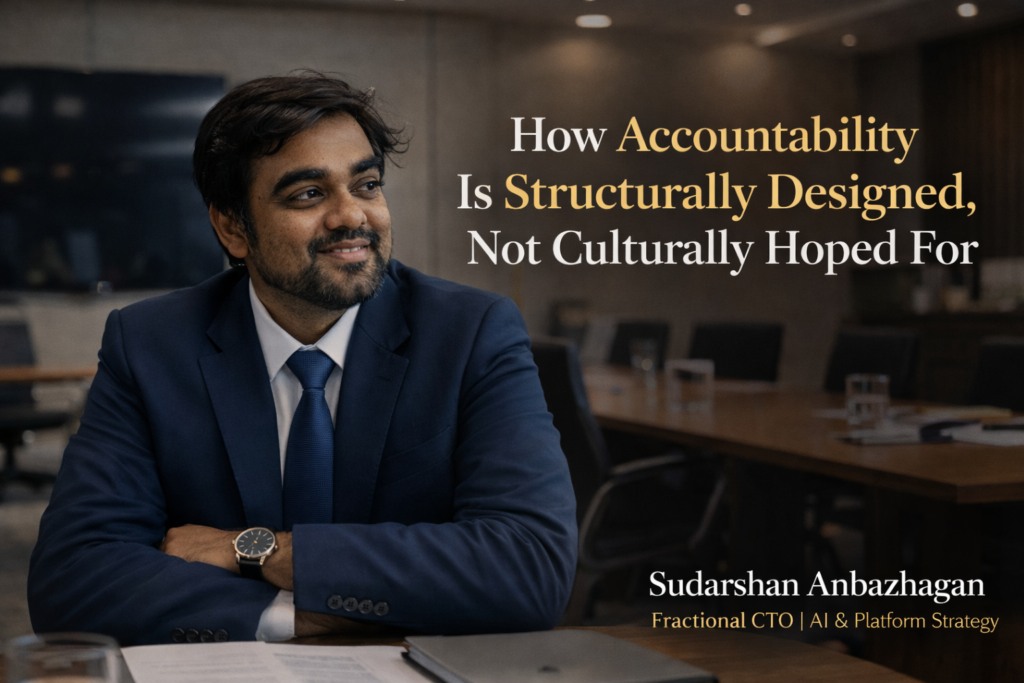

The Question That Reveals Everything About an Organisation
I have walked into GCC engagements where everything looked right on paper. Talented teams, clearly articulated values, leadership that genuinely cared about doing things well, and a real desire across the organisation to perform at a high level. And yet, somewhere between the strategy documents and the daily execution, outcomes were quietly slipping. Milestones were being missed. Escalations were arriving late. Reviews were surfacing the same issues cycle after cycle. The conversations that followed always circled back to one question that, on the surface, seemed almost too simple to ask in a room full of senior leaders: who actually owns this outcome?
That question is deceptively simple. In my experience as a Fractional CTO stepping into distributed technology teams and GCC environments across 14 countries, the pause that follows it tells me more about an organisation’s operating model than any governance document or cultural alignment survey ever could. The pause is not about intent. It is not about the quality of the people in the room. It is almost always about structure. Specifically, whether the structure was designed to make accountability clear, or whether accountability was left to emerge from culture, goodwill, and shared professional standards that everyone assumed the other person was also operating from.
Accountability in a GCC is not something that can be wished into existence through values statements or all-hands meetings. It is something that has to be built into how work flows, how decisions get made, and how outcomes are tracked in real time across geographies. The organisations that understand this distinction are the ones that consistently deliver at scale, quarter after quarter, regardless of team size, geography count, or the complexity of what they are building.
What the Operating Model Actually Signals About Accountability
When I step into an organisation as a Fractional CTO, one of the first things I examine is not the technology architecture or the team structure in isolation. I look at how the operating model is designed to create or distribute ownership. In high-performing GCCs, this is never accidental. The operating model is the real accountability system, whether the leadership team has explicitly named it that way or not. It determines whether one person owns each outcome or whether responsibility is spread across a group in a way that makes it nearly impossible to trace a result back to a clear decision and a named individual who made it.
Shared ownership has its place in collaboration and creative work, and the best teams I have worked with are deeply collaborative in how they build things together. But collaboration and accountability are not the same thing, and the most common confusion I see in GCC environments is treating them as interchangeable. A team can build something together with genuine collective effort, and one person can still be clearly responsible for whether it meets the standard, ships on time, and solves the right problem. That clarity is what makes escalation rare, execution consistent, and leadership reviews focused on the future rather than relitigating the past.
What I have learned stepping into organisations across 14 countries is that the operating model answers the accountability question before it is ever asked. When it is designed with clarity, teams do not need to escalate every ambiguity upward or wait for a leadership decision before they move. They execute because the structure supports them to do so confidently, and because everyone in the system understands exactly who is responsible for what and at which level of the organisation that responsibility sits.
Single Ownership Is the Foundation, Not the Exception
One of the most consistent patterns I observe across the GCC engagements I have led over 15 years is this: the teams that deliver reliably and sustain that reliability over long periods are the ones where every material outcome has a named owner. Not a group. Not a shared responsibility matrix with five names and an asterisk. One person who is accountable for the result and who knows with full clarity that they are. This is not about pressure or blame. It is about removing the ambiguity that causes good people to hesitate, defer, or assume that someone else is carrying the weight of an outcome that was never explicitly assigned to anyone.
In my experience, the moment an organisation shifts from group accountability to individual outcome ownership, something changes in how teams carry their work day to day. The quality of decisions improves because the person making them knows they will be accountable for the outcome. The speed of resolution increases because there is no ambiguity about who needs to act when something requires a response. And the leadership layer spends less time arbitrating ownership disputes and more time thinking about the next level of organisational performance. This shift is structural, not cultural. It happens because the operating model was redesigned, not because the team attended a workshop on ownership mindset.
Decision Rights Defined Before the Work Begins
The second structural signal I look for when I step into a GCC is whether decision rights are established before a project or initiative starts, rather than discovered mid-execution. This is particularly important in environments where teams are distributed across locations, time zones, and sometimes reporting lines that cross multiple geographies. When decision rights are undefined at the start, the team spends energy on alignment rather than execution, and the cost of that misalignment compounds with every sprint, every release cycle, and every quarterly review that surfaces the same unresolved ambiguities.
Decision rights answer four questions that every distributed team needs answered clearly, and the GCCs that perform consistently have found a way to answer all four before the work begins:
- Who decides: the person or role with final authority over the outcome, whose call closes the conversation and sets the direction for everyone else.
- Who executes: the person or team responsible for doing the work and delivering the output to the agreed standard, on time and without needing to be directed at every step.
- Who is consulted: the people whose input is required before a decision is finalised, and whose perspective shapes the quality of the outcome in a material way.
- Who is informed: the stakeholders who need to know what has been decided and what is in motion, without being required to weigh in or influence the direction.
After 15 years of this work, one thing is consistently true: the organisations that define decision rights early invest a small amount of time upfront and recover it many times over in the execution phase. Teams do not wait for alignment meetings to make progress. They already know what falls within their authority and what requires a different conversation. That clarity is what separates the teams that operate with energy and momentum from the ones that operate with caution, delay, and a growing backlog of unresolved ambiguity that leadership eventually has to clear.
Real-Time Visibility Across Locations as a Structural Accountability Tool
The third structural element that shapes accountability in a GCC is visibility. Not visibility in the sense of surveillance or micromanagement, which are the wrong tools for the wrong problem, but visibility in the sense of shared situational awareness across a distributed operation. When leaders and teams can see what is happening as it happens, accountability becomes practical rather than procedural. People do not wait for a monthly review to discover that something went off course three weeks ago. They see it in real time and respond in real time, which is an entirely different operating posture.
In many of the GCC engagements I have stepped into, reporting cycles were designed for a world where monthly or weekly reviews were the primary mechanism for surfacing information. That rhythm made sense when teams were co-located and informal communication filled the gaps between formal check-ins naturally. In a cross-geography model operating across multiple time zones, those informal channels are not always available at the moment they are needed, and the gaps between formal reporting windows become the spaces where drift quietly builds into delays and missed commitments. The cost of that drift is not always visible in a single quarter, but it accumulates into a structural performance problem over time.
Real-time visibility tools and operating rhythms are not about adding overhead to already busy teams. They are about giving distributed teams the same situational awareness that a co-located team takes for granted when they can turn to each other across a desk. When everyone can see the same picture at the same time, course correction happens earlier, decisions are grounded in current reality rather than last week’s report, and accountability is exercised before it becomes a performance conversation that arrives too late to change anything meaningful about the outcome that is already in motion.
Feedback Loops That Are Frequent Enough to Matter
Structure alone does not sustain accountability over time. It needs an operating rhythm that reinforces it through consistent, well-designed feedback. What I have observed in the GCCs that perform over the long term is that their feedback loops are short enough to catch drift early and regular enough that teams expect and welcome them as a natural part of how the work moves forward, rather than treating them as an interruption or an evaluation exercise imposed from above. The cadence matters more than the format, and the GCCs that get this right have moved away from treating feedback as an event and toward treating it as a continuous operating condition.
A brief, well-structured weekly check-in where a team reviews progress against outcomes, surfaces blockers with honest candour, and confirms that ownership is still clearly held where it should be is more valuable than a detailed monthly review that arrives too late to change the trajectory of the current sprint or release cycle. This is the operating rhythm I focus on establishing in the first 90 days of any Fractional CTO engagement. Not a reporting structure designed to keep leadership informed about what already happened, but a living operating rhythm that keeps accountability visible, active, and self-correcting before issues escalate.
The feedback loop design I return to consistently across GCC engagements includes four elements that work together as a system:
- Weekly outcome reviews that are short, structured, and focused entirely on what is being delivered against what was committed, without drifting into status updates on activity that does not connect to an outcome.
- Real-time escalation paths that are clearly defined so that when something goes off course, the right person knows immediately and the response does not have to wait for the next scheduled touchpoint.
- Monthly operating reviews at the leadership level that assess whether the structural design is still serving the work, and whether ownership assignments need to be refined as the scope of the engagement evolves.
- Quarterly retrospectives focused not on team performance as a verdict, but on operating model health as a diagnostic, asking honestly what structural elements are working and what needs to be adjusted for the next quarter.
The Human Dimension of Structural Accountability
There is a dimension of this conversation that does not get enough attention in frameworks and governance models, and that is the human experience of accountability within a distributed team. What I have consistently observed across 500 projects and 14 countries is that people do not resist accountability when the structure supports them to succeed within it. They resist accountability when it is applied retroactively to situations that were never clearly defined in the first place, when they are held responsible for outcomes that were never explicitly assigned to them, or when the system around them was designed in a way that made it impossible for any one person to have a clear view of what they were expected to deliver and on what timeline.
That distinction is important, because it means the human response to accountability in a GCC is largely a function of how thoughtfully the structure was designed before the work began. When I step into an engagement and begin establishing clearer ownership, tighter decision rights, and more frequent feedback rhythms, the change in how teams carry themselves is almost immediate. There is less hesitation in decision-making. There is more confidence in raising issues early rather than hoping they resolve before the next review. There is a greater sense of personal ownership over the work itself, which is what genuine accountability feels like when the structure underneath it is sound and designed with the team’s success in mind.
The GCCs that have built the strongest and most durable cultures of accountability are not the ones with the most inspiring leadership messages or the most comprehensive values frameworks. They are the ones where the operating model was thoughtful enough to make accountability feel natural rather than imposed, and where the feedback structures were designed with enough care that teams could see their own performance clearly and correct it themselves, without waiting to be told.
What This Looks Like in the First 90 Days of a GCC Engagement
When I step into a GCC as a Fractional CTO, the first 90 days are not about adding tools or rewriting architecture. They are about examining the structural foundations that either support or undermine the organisation’s ability to hold itself accountable to its own commitments. That work is diagnostic before it is prescriptive, because the right structural interventions look different depending on where the operating model has gaps, and no two organisations arrive at the same starting point. The diagnosis has to come before the design.
The diagnostic framework I work through consistently includes four structural questions that reveal the most about where accountability is strong and where it is fragile:
- For every active outcome in the organisation, can you name one person who owns it? If the honest answer is not consistently yes, the ownership model needs to be redesigned before anything else changes, because every other structural improvement will be undermined by the ambiguity at the centre.
- Are decision rights documented and communicated before each initiative begins, or are they inferred from hierarchy and past practice? If decisions are being discovered rather than designed, the operating model has an ambiguity problem that will compound under pressure and across geographies.
- Does the leadership team see what is happening across all geographies in real time, or are they working from reports that reflect a reality that is already several days old? The answer to this question determines how quickly the organisation can respond to drift before it becomes a missed commitment with real consequences.
- How long does it take from the moment a problem surfaces to the moment a corrective action is in motion? If that gap is measured in weeks rather than days, the feedback loop design needs to be rebuilt with a shorter cycle at its centre and clearer escalation paths at every level.
These four questions, answered honestly by the leadership team, almost always reveal where the structural work needs to focus. And in my experience across engagements that have spanned 14 countries and 150 enterprise launches, addressing these structural foundations produces results that no culture initiative alone has ever been able to replicate or sustain over the long term.
Structure Creates Accountability. Operating Rhythm Sustains It. Culture Strengthens It Over Time.
After more than 15 years of stepping into organisations across 14 countries, what I know with confidence is this: the GCCs and distributed technology teams that deliver consistently are not built on aspiration alone. They are built on structure that makes accountability the natural outcome of how work flows, not a quality that has to be constantly reinforced from the top by leaders who are managing the symptom rather than designing the system. Structure defines who owns what. Operating rhythm keeps that ownership alive through the real work of delivery. Culture deepens and sustains both over time. These three things work together, but the sequence matters enormously, and structure has to come first.
The most useful question a GCC leadership team can ask is not how accountable our culture is. The most useful question is how clearly does our operating model answer the question of who owns this, at every level of the organisation, before anyone needs to ask. That question, answered honestly, is where lasting organisational performance begins and where the most enduring GCCs I have worked with have built the competitive advantage that no amount of hiring, tooling, or cultural programming has ever been able to replicate on its own.
The organisations that scale with confidence are not the ones that hope their people will be accountable. They are the ones that built a system where accountability was the only natural outcome.