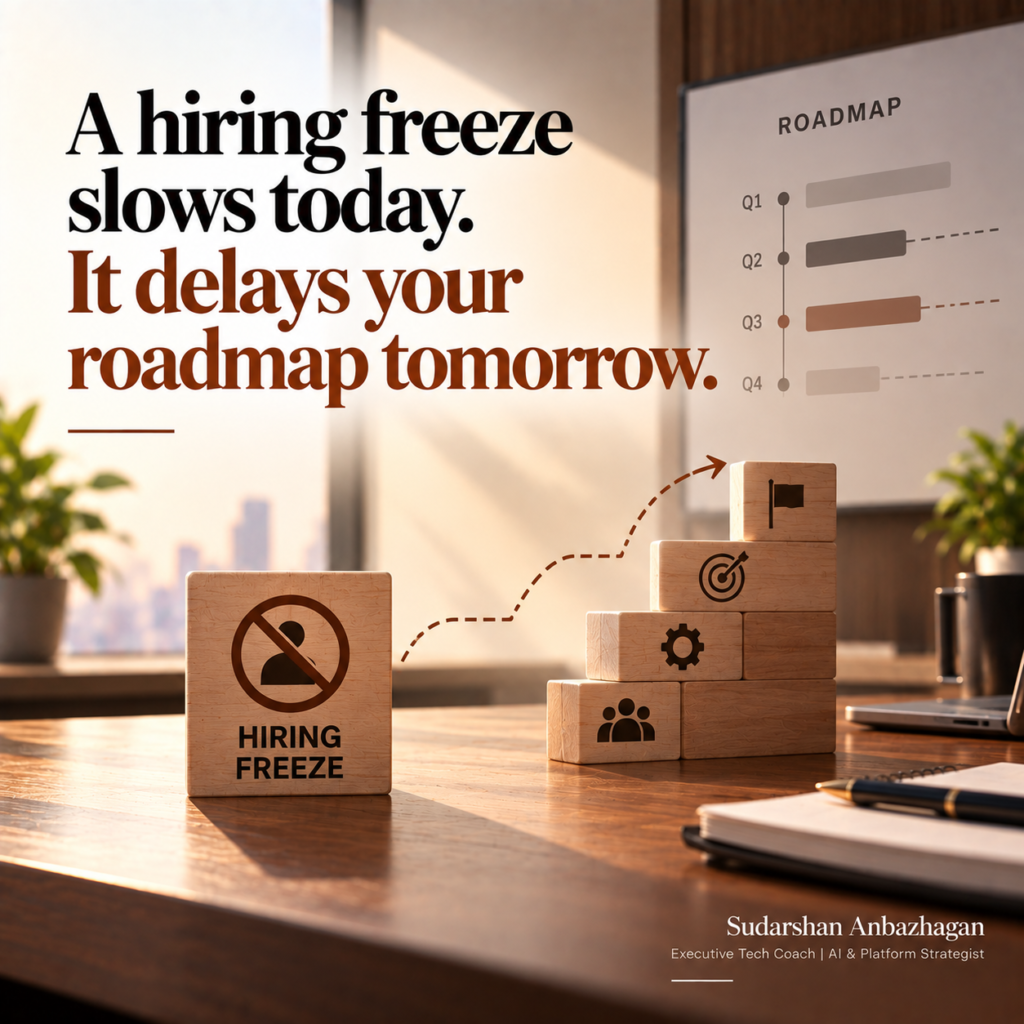

A hiring freeze gets announced in a single meeting. Its effect on the roadmap shows up quietly, months later, long after everyone has stopped talking about the announcement itself. Across 15 years of leading delivery teams for clients in more than 14 countries, I have watched this sequence many times, and I have come to believe that a hiring freeze and product roadmap delivery do not have to move in the same direction. The freeze is a financial decision. Whether the roadmap stops is a separate decision, even though most companies never make it explicitly.
The first signs are subtle. The open roles stay open, and the best people on the team quietly start carrying two jobs. Nobody complains loudly because everyone understands the business reason behind the freeze. Priorities that mattered in January slide to next quarter, and then slide again, and the roadmap slowly becomes a list of intentions rather than a plan.
By the time leadership notices, the cost has already been paid in several currencies at once. Revenue from delayed features has not arrived, competitors have moved, and the people who absorbed the extra work are tired in a way that does not appear on any dashboard. The freeze saved money on payroll, but it spent something harder to recover.
The numbers on a dedicated delivery pod look very different compared to what slow hiring actually costs over the same period.
Why a Hiring Freeze Quietly Stalls the Product Roadmap
I understand completely why companies freeze hiring. Permanent headcount is a long commitment, and when the next twelve months are hard to predict, adding permanent cost feels like a risk the business should not take. Boards and CFOs are right to be cautious in uncertain conditions, and I have never argued with a leadership team that chose prudence over optimism.
The difficulty is that a freeze is usually applied to everything at once. The same rule that stops a speculative new role also stops the engineer the roadmap was built around. Because the freeze is framed as a headcount decision, the delivery consequences are rarely discussed in the same meeting. The roadmap simply absorbs the impact, one delayed milestone at a time.
The hidden risk: during a freeze, the work does not disappear. It shifts onto the people who stayed, and the strongest performers carry the most. The roadmap delay is visible within a quarter, but the attrition it triggers often arrives six months later.
In our delivery reviews across SuperBotics’ 500+ projects, this second effect is the one leaders most often underestimate. The team members who take on two roles are usually the ones with the most options elsewhere. A freeze meant to protect the business can end up costing it the very people who would make the recovery possible once conditions improve.
The Two Question Split: A Framework for Frozen Budgets
What I have seen work is separating two questions that usually get treated as one. The first question is whether the company wants to add permanent cost right now. The second is whether the company still needs this work delivered. In most freeze conversations, a “no” to the first question is quietly assumed to mean a “no” to the second, and that assumption is where roadmaps stall.
The answer to the first question can be no while the answer to the second stays yes. When leadership teams make that distinction explicit, the conversation changes immediately. Instead of asking whether they can hire, they ask how the work can be delivered without adding to the permanent payroll. That is a very different question, and it has several good answers.
| Roadmap Item | Add Permanent Cost? | Still Need It Delivered? | Likely Path |
|---|---|---|---|
| Revenue linked feature | No | Yes | Scoped dedicated team |
| Compliance deadline work | No | Yes | Scoped dedicated team |
| Exploratory initiative | No | Not yet | Pause and revisit |
| Core platform ownership | Later | Yes | Interim team, hire after freeze |
Running every frozen role through these two questions usually takes a single leadership session. The result is a much smaller list of work that genuinely needs delivery capacity, separated from work that can safely wait. That smaller list is where the roadmap can keep moving, and it is almost always shorter than leaders expect when they first start the exercise.
Keeping Product Roadmap Delivery Moving With a Scoped Team
For the work that still needs delivering, a small dedicated team with a clear scope and a defined end point keeps the roadmap moving without adding to the permanent payroll. This is different from general outsourcing or staff augmentation, where individuals are added to an existing team without clear ownership. A scoped managed team owns a defined outcome, works to an agreed timeline, and hands over cleanly when the engagement ends.
The difference matters because a freeze is exactly the wrong moment to add management overhead. The internal team is already stretched, so any external capacity has to arrive with its own delivery leadership and accountability. I explained that distinction in more depth in the difference between a managed team and staff augmentation, and it becomes especially important when internal capacity is limited.
When I set up a scoped team during a freeze, I follow a short sequence designed to protect both the roadmap and the internal team’s time. The structure has held up across engagements in the US, UK, and Europe, with pods working from our delivery base and integrating with client teams across time zones.
- Define the outcome: write down the single roadmap item the team will deliver and what “done” looks like in business terms.
- Set the end point: agree a fixed duration or milestone at which the engagement ends or is formally reviewed.
- Name both owners: assign one owner on the delivery side and one on the client side, so accountability never sits with “the team.”
- Protect internal time: limit how much of the internal team’s week the engagement can draw on, and track it openly.
- Plan the handover: document what knowledge must transfer back so the work survives after the engagement closes.
That fifth step is what separates a scoped team from a dependency. When the handover is planned from the first week, the company keeps full ownership of what gets built. With a 98% on time release rate across our delivery history, I have learned that clean endings are designed at the beginning, not negotiated at the end.
What Leaders Learn When the Freeze Lifts
One of the less obvious benefits of this approach appears when the freeze eventually lifts. Companies that kept delivering through a scoped team often hire with far better clarity on what each role really needs. The engagement has shown them which skills the work actually required, how much ongoing capacity the product genuinely demands, and where permanent ownership should sit.
That clarity prevents a common post-freeze mistake, which is rushing to fill every role that was frozen exactly as it was originally written. Some of those roles no longer make sense. Others need a different profile than the original job description assumed. I wrote about the cost of waiting on long searches in why your product roadmap should not wait on a six month hiring search, and the same logic applies with even more force after a freeze.
There is also a human benefit that leaders consistently mention afterward. The people who stayed through the freeze were not asked to carry two jobs indefinitely. Their workload remained sustainable, their priorities remained clear, and they saw the roadmap continue to move. That experience builds trust in leadership at exactly the moment when trust is most fragile.
Delivering Through Uncertainty
A hiring freeze is a reasonable response to uncertainty, and I would never encourage a leadership team to abandon financial discipline. What I encourage instead is precision. Freeze permanent cost where it makes sense, and then ask separately which work the business cannot afford to delay. Those are two decisions, and treating them as one is what turns a sensible freeze into a stalled year.
The companies I have seen navigate uncertain periods well, many of them within partnerships that have lasted an average of 6.8 years, share one habit. They protect delivery on the work that matters most while staying disciplined on permanent commitments. That combination lets them emerge from uncertainty with their roadmap intact and their best people still in place.
So look at your roadmap today and ask which project is still waiting on a role that is currently frozen. Then ask whether that project needs a permanent hire, or whether it simply needs to be delivered. A freeze can pause your payroll growth, but it should never be allowed to pause the work that decides where your company will be when the freeze is over.
Most teams that move to the pod model ask the same question afterward: why didn’t we do this a year ago?

