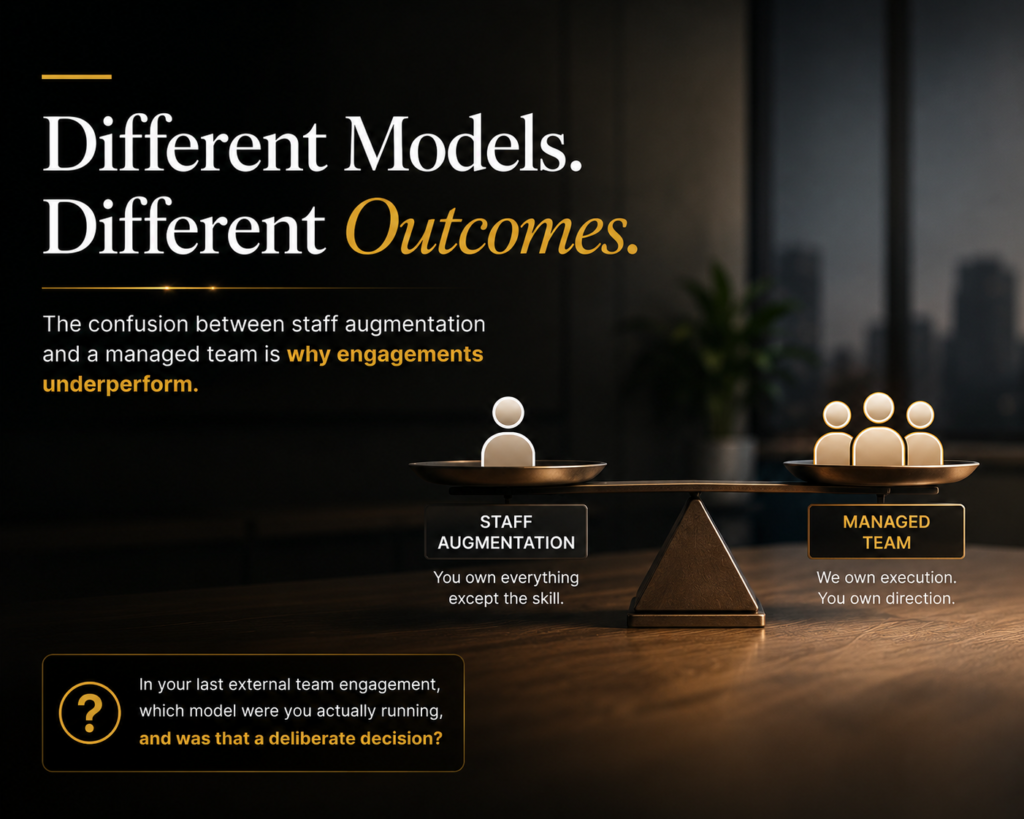

The Difference Between a Managed Team and a Staff Augmentation Model
The confusion between staff augmentation and a managed team is the most common reason managed team engagements plateau after six months. Organisations set up the engagement expecting a managed team but operationally treat it like augmentation. The result is a relationship that delivers competently at the task level and never develops the judgment and initiative that a genuine managed team model is capable of producing. Understanding the structural difference between these two models is not an academic exercise. It determines what ceiling the engagement can ever reach.
Staff augmentation is a resource model. You identify a skill gap in your existing team, source individuals with that skill externally, and those individuals work inside your delivery structure under your management. The accountability for outcomes sits entirely with your organisation. The external resource delivers their individual contribution. This model works well for specific skill gaps, short-duration surges, and situations where you have strong internal leadership and just need additional execution capacity.
A managed team is a capability model. You define an outcome you need to achieve, and the team takes ownership of the delivery pathway to that outcome. The accountability for the delivery approach, the team structure, the processes, and the quality of the output sits with the managed team provider, not solely with your organisation. The difference in daily operational experience between these two models is significant, and the difference in what they can produce over twelve to thirty-six months is even more so.
The Sudarshan Accountability Transfer Model: How Managed Teams Build Independence
In SuperBotics’ managed team engagements, I apply what I call the Accountability Transfer Model: a structured three-phase approach to moving from directive leadership to outcome ownership over the first ninety days. Phase One is Directive: the client defines every task, the team executes reliably, and the primary measure of success is delivery accuracy. Phase Two is Contextual: the client defines outcomes, the team proposes the approach, and the primary measure shifts to quality of judgment alongside delivery accuracy. Phase Three is Ownership: the team operates with full accountability for the delivery pathway, flagging constraints and opportunities proactively without waiting for questions.
| Dimension | Staff Augmentation | Managed Team |
|---|---|---|
| What you provide | Individuals with specific skills | A team with outcome accountability |
| Management responsibility | Yours entirely | Shared, shifting to provider over time |
| Risk ownership | Yours | Provider carries delivery risk |
| Value at 12 months | Same as month one | Compounding: team knows your business |
| Value at 36 months | Dependent on active management | Strategic asset with deep context |
The ceiling of a managed team engagement is set in the first thirty days by how clearly the outcome is defined and how genuinely the accountability for reaching it is transferred. Task-level setup produces task-level results, regardless of how capable the team is.
Where Organisations Misapply the Managed Team Model
The most common structural mistake is not protecting the outcome ownership that makes a managed team different. An organisation sets up a managed team engagement, defines outcomes, and then gradually, usually under delivery pressure, starts micromanaging the approach. Sprint by sprint, the team shifts from proposing and owning their delivery approach to executing instructions. Within six months the managed team is operationally indistinguishable from a staff augmentation arrangement, but with the overhead of a managed team structure on top of it.
This shift happens incrementally and with good intentions. A stakeholder sees a delivery decision they disagree with and overrides it. A deadline creates pressure and the easier path is to direct rather than trust. Each individual decision seems reasonable. The cumulative effect is the dismantling of the ownership model that made the engagement valuable. The way to prevent it is not through rigid process but through explicit conversations at setup about what the managed team relationship means in practice, what decisions the team owns, and where the escalation boundaries sit.
The Knowledge Accumulation Difference
The most significant long-term advantage of a managed team over staff augmentation is knowledge accumulation. A managed team that works with your organisation over two to three years develops an understanding of your systems, your priorities, your stakeholder dynamics, and your operational context that becomes genuinely valuable as a business asset. That knowledge lives in the team. It compounds. It makes the team more valuable each year of the engagement.
Staff augmentation does not produce this. Individual contributors working inside your team may develop valuable skills and knowledge, but that knowledge is attached to the individual, not the engagement structure. When the individual moves on, the knowledge leaves. A managed team model is designed to retain and compound institutional knowledge through the team structure, the processes, and the provider relationship rather than making it contingent on individual tenure.
If your current engagement is producing reliable delivery but no strategic compounding, the question worth asking is whether it is structured as a managed team or is functionally operating as augmentation. The answer to that question will tell you more about your next three years than any capability review. More perspectives on managed teams and technology delivery on this blog.