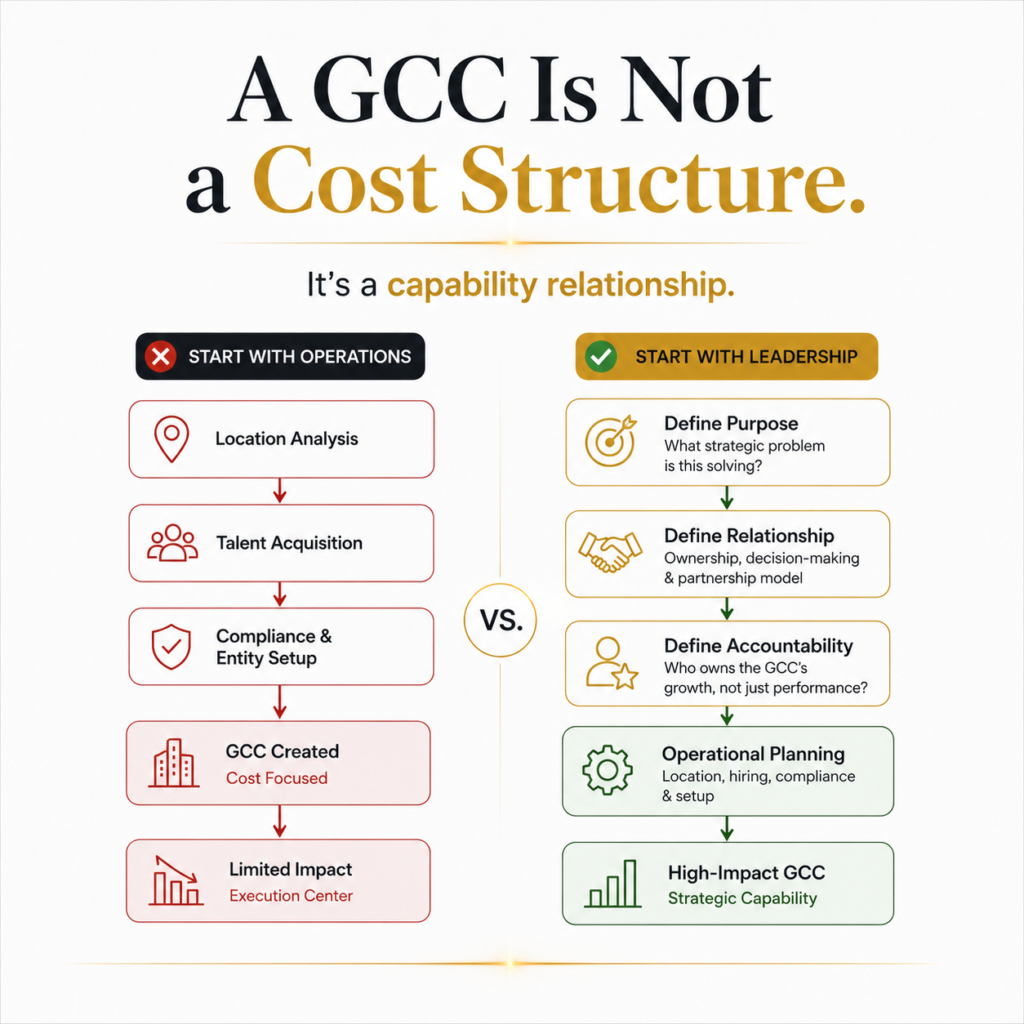

Why Setting Up a GCC Is a Leadership Decision Before It Is an Operational One
GCC planning conversations get operationally detailed very quickly. Location analysis. Entity structure. Talent acquisition timelines. Compliance mapping. All of it important. All of it solvable. But organisations that move through all of that correctly and still build a GCC that never reaches its potential share a common pattern. They resolved the operational questions before they answered the leadership ones.
A GCC is not a cost structure. It is a capability relationship. Relationships are not designed by procurement processes. They are shaped by the clarity of the people leading them and the quality of the decisions made before the first hire is made and the first desk is occupied. The operational decisions that follow, location, structure, hiring, governance, are all contingent on the leadership decisions being clear. When the leadership decisions are not clear, every operational decision that follows them is built on an unstable foundation.
In the GCC engagements I have worked through at SuperBotics over the past fifteen years, the single most reliable predictor of whether a GCC reaches strategic maturity is the quality of the leadership decisions made before setup began. Not the location chosen. Not the entity structure selected. Not even the initial talent pool. The leadership decisions that defined what the GCC was supposed to become and who was accountable for making sure it got there.
The Three GCC Leadership Decisions: The Pre-Setup Clarity Framework
Before operational planning begins, three leadership decisions need to be explicitly made. The first is the problem definition: what problem is this GCC solving that cannot be solved another way? This sounds like a simple question. In practice it is surprisingly difficult to answer with precision. “Cost savings” is not an answer, it is a metric. “Access to talent” is not an answer, it is a mechanism. The answer to this question describes a specific business capability gap that the GCC will close, and it needs to be specific enough that in year two the organisation can honestly evaluate whether it is being addressed.
The GCCs that stall at execution mode almost always stalled because nobody ever answered this question clearly enough to set a direction that would allow them to evolve beyond it.
| Leadership Decision | Poor Answer (Operational) | Strong Answer (Strategic) |
|---|---|---|
| Why are we building this GCC? | “To reduce costs by 30%” | “To own our AI delivery capability without headcount dependency” |
| Who owns this GCC’s success? | “The vendor manages it” | “[Named person] is accountable for strategic outcomes” |
| What will this GCC own in year two? | “Whatever we need built” | “Full ownership of [specific capability domain]” |
The Named Owner Requirement
The second leadership decision is ownership. Who, by name, is accountable for what this GCC becomes? This person is not the vendor manager. They are not the procurement lead. They are a senior leader within the client organisation whose professional mandate explicitly includes the strategic development of the GCC as a capability asset. Their accountability is not for delivery metrics. Their accountability is for the answer to the question: is this GCC becoming what we set it up to become?
When this role does not exist, when accountability for the GCC sits diffusely across a steering committee or is implicitly managed by the vendor, the GCC almost always stalls at Level One maturity. It delivers competently. It never develops judgment. It never reaches the point of genuine strategic contribution because nobody on the client side was accountable for building the conditions that would allow it to get there. The named owner is not a bureaucratic requirement. It is the structural condition that makes GCC evolution possible.
Defining the Year Two Mandate Before Year One Begins
The third leadership decision is the year two mandate. What will this GCC own, contribute, and be accountable for that it does not own today? This question must be answered before operational planning begins, not after the centre is running. The reason is that the year two mandate shapes every operational decision that follows, which capabilities to prioritise in hiring, which processes to transfer in the first six months, which governance structures to build from the start versus which to develop over time.
Organisations that define their year two mandate before setup begins build GCCs that reach that mandate. Organisations that defer this question until the centre is operational find themselves revisiting it under delivery pressure in year two, with a structure that was optimised for execution rather than evolution, a team that was hired for skills rather than strategic contribution, and a governance model that was never designed to support the transition they are now trying to make. The operational cost of retrofitting strategic ambition into an execution-optimised structure is significant. The leadership cost of defining the mandate before setup is modest.
What Happens When the Leadership Decisions Are Clear
When the three leadership decisions are clear before operational planning begins, the setup process looks different in every dimension. Location analysis is anchored to talent availability for the specific capabilities the GCC needs to own, not just generic technology labour cost. Entity structure is evaluated against the governance requirements of the year two mandate, not just setup simplicity. Hiring profiles are designed around the judgment and ownership orientation required for strategic contribution, not just the skill specifications for the first wave of delivery.
The GCC that results from this kind of setup is not fundamentally different in its early months from one built without this clarity. Both will be in execution mode initially. The difference emerges in the second year, when the centre built with clear leadership decisions has the structural conditions to begin the transition to strategic contribution, and the centre built without them does not. That difference is the return on the investment in leadership clarity made before the first operational decision was taken.
If your organisation is in the planning stages of a GCC, the most valuable conversation you can have right now is the one that answers the three leadership questions before the operational planning begins. More perspectives on GCC strategy and technology leadership on this blog.