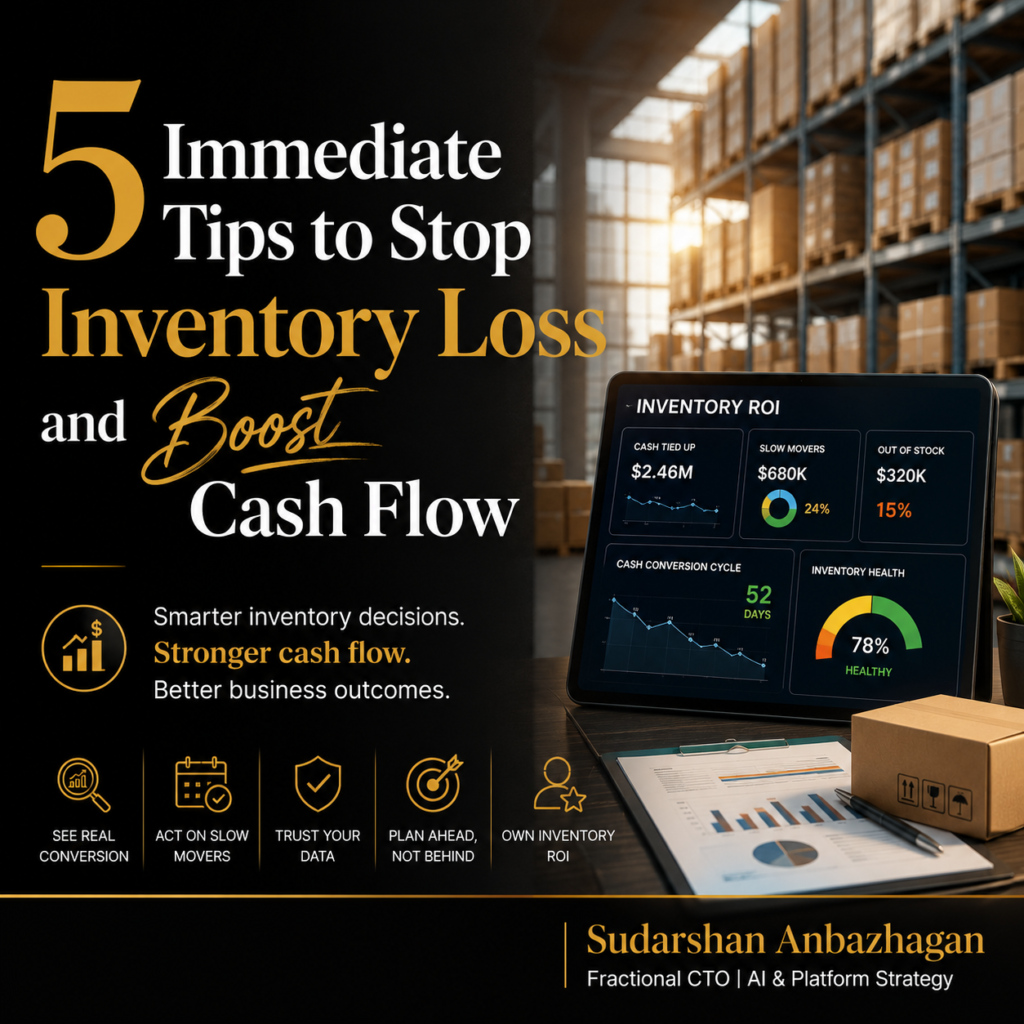

5 Immediate Tips to Stop Inventory Loss and Boost Cash Flow
The most expensive inventory problem I have ever seen did not look like a crisis. It looked like a warehouse that was always full and a team that was always busy. Shelves stocked. Staff working. Systems running. And underneath all of that, a quiet steady cash drain that nobody was measuring at the right level. It continued for months before anyone connected the dots between what was sitting on the shelves and what was missing from the working capital position.
Here is the myth that keeps this pattern alive in operations of every size: a full warehouse means a healthy operation. That belief is understandable, because visible stock feels like security. The reality is more precise. A full warehouse with the wrong stock at the wrong time is not operational strength. It is frozen cash arranged neatly on shelves. And the difference between those two framings is the difference between an operation that grows and one that perpetually defers the investments it needs to scale.
The shift that changes this pattern is not a system upgrade, a new platform, or a larger warehouse management team. It is five leadership decisions applied consistently. I have seen these five applied inside businesses ranging from mid-sized manufacturing operations to multi-site retail networks, and the results are consistent: inventory loss declines, cash flow improves, and the operation becomes measurably more predictable. Not because the technology changed, but because the leadership accountability around inventory decisions changed first. This connects directly to what I described in my earlier post on the real cost of inventory inaccuracythe numbers are almost always larger than leadership expects, and the fix almost always starts with a decision rather than a system.
Stop Inventory Loss With Weekly Cash-Conversion Reviews at SKU Level
The first decision is a review rhythm change. Run a weekly cash-conversion review at the SKU level, not at the category summary level. Category summaries create false confidence because they average out the performance of your strongest SKUs against your weakest ones, producing a number that looks acceptable while individual products quietly drain working capital. Granular visibility into which products are converting and which are degrading your cash position requires going one level deeper, and it requires someone owning that review with the authority to act on what they see.
The data to run this review exists in most inventory management systems today. What is almost always missing is the review rhythm itself and the named accountability that makes it happen every week without exception. In my experience, organisations that establish this rhythm within a quarter of doing so identify two to four SKU-level cash drains they were completely unaware of at the leadership level. The visibility was always available in the system. The practice of extracting and reviewing it consistently was the missing ingredient.
Define a Slow-Mover Threshold and Enforce a 30-Day Action Rule
The second decision is defining a slow-mover threshold and making the action that follows non-negotiable. After 45 days at or below minimum velocity, a defined action is required from a named owner. Discount. Bundle. Liquidate. Transfer. The specific action matters less than the discipline of making one at all. Delay is not a holding strategy. It is a cash cost that compounds daily.
Most operations do not have a formally defined slow-mover threshold. They have a general sense that something needs to happen with ageing stock, and they depend on experienced team members to raise it when it feels significant enough. That approach produces inconsistent outcomes because it relies on individual judgment under workload pressure rather than a system with clear triggers. The businesses that recover the most working capital from slow-moving inventory are the ones that have removed the judgment call from the initial decision and replaced it with a threshold and a timeline. The judgment sits in choosing which action to take. Not in whether to take one.
Fix System Trust Before Building Any New Process on Top of It
The third decision is a diagnostic one, and it is often the most revealing. If your team manually double-checks system counts before purchasing decisions, the system is not trusted. That is not a technology failure. It is an operational signal that the data layer beneath every downstream decision is considered unreliable by the people closest to it. Every process built on untrusted data inherits the inaccuracy. Every purchasing decision made with a mental caveat about system reliability introduces a margin of error that compounds across thousands of transactions per year.
Fixing system trust is not optional in a high-performing inventory operation. It requires identifying where the drift between system counts and physical actuals is occurring, assigning ownership for closing that gap, and establishing a cycle count cadence that keeps the two aligned rather than relying on annual audits to reveal a year’s worth of accumulated divergence. This is foundational work. No optimisation layer built above it will perform reliably until it is done.
Connect Reorder Decisions to Forward Demand, Not Backward Sales
The fourth decision is about the information model behind purchasing. In seasonal operations, volatile demand environments, and growth-stage businesses, replenishing on last month’s sales movement is one of the most reliable ways to create overstocks and stockouts running simultaneously. Historical data tells you what happened. It does not tell you what is about to happen, and in fast-moving operations those two things can diverge significantly within a single sales cycle.
Connecting reorder decisions to forward demand signals requires introducing inputs that account for velocity change, promotional cycles, and lead time variance before the purchase order is raised. In practice this means the buying conversation starts with the question of what is expected to happen, not what recently happened. Organisations that make this shift consistently reduce emergency procurement episodes and improve their inventory turnover ratio without increasing working capital deployment, because they are buying closer to what is actually needed rather than what was recently sold.
Name One Leader Accountable for Inventory ROI as a Business Outcome
The fifth decision is the structural one that makes all the others sustainable. Operations manages the process. Finance tracks the cost. In most businesses, nobody formally owns the intersection where inventory decisions produce cash outcomes. That gap is exactly where margin disappears and where it continues to disappear until someone is named accountable for the full picture. Accuracy is a metric. ROI is the outcome. When one named leader owns the cash impact of every inventory decision and reports on it at the same level as revenue and margin, the dynamics across every function involved in inventory shift measurably.
Forecasting tightens because inaccurate forecasting becomes visible as a cash outcome rather than an operational variance. Purchasing discipline improves because slow-mover creation is now someone’s accountability rather than an accepted cost of doing business. Slow-mover response time shortens because delay has a named cost and a named owner. This is not about adding a new role or creating a new committee. It is about ensuring that the financial outcome of inventory decisions is formally owned at the executive level with the same clarity as any other major P&L driver. The organisations that make this work, as I noted in my post on operational visibility and accountability, are the ones where leadership treats inventory ROI as a strategic responsibility rather than an operational detail.
If you implemented just one of these five decisions this quarter, which one would move your cash position fastest? In my experience, the answer is almost always the fifth one, because named executive accountability creates the internal pressure that makes the other four actually happen rather than remaining good intentions inside a busy operation.