
The Conversation That Needs to Shift
When a cross-geography team is not performing at the level expected, the first explanation that surfaces in leadership conversations is almost always about communication. Time zones get mentioned. Language differences get flagged. Cultural work styles come up. Occasionally, personality conflicts or team dynamics enter the discussion. These are real factors, and they deserve genuine attention and care. But in my experience stepping into organisations across 14 countries over 15 years, they are rarely the root cause of sustained execution gaps.
The teams that perform most consistently across geographies, the ones that deliver on time, maintain quality, and build long-term trust with their stakeholders, are not exceptional because of who is on the team. They are exceptional because of how the team is connected. The processes between them were designed deliberately, refined continuously, and respected consistently. And the teams that struggle most are almost always struggling not because of geography or culture, but because the structural connective tissue between them was never clearly built.
This matters for a very practical reason. When the diagnosis is culture or communication, the solutions tend to be interpersonal. Team-building activities get planned. Awareness training gets scheduled. Leaders invest in helping people understand each other better, which is genuinely valuable. But if the underlying process architecture is unclear, none of those investments will produce sustained improvement. The friction will keep returning because the structural cause was never addressed.
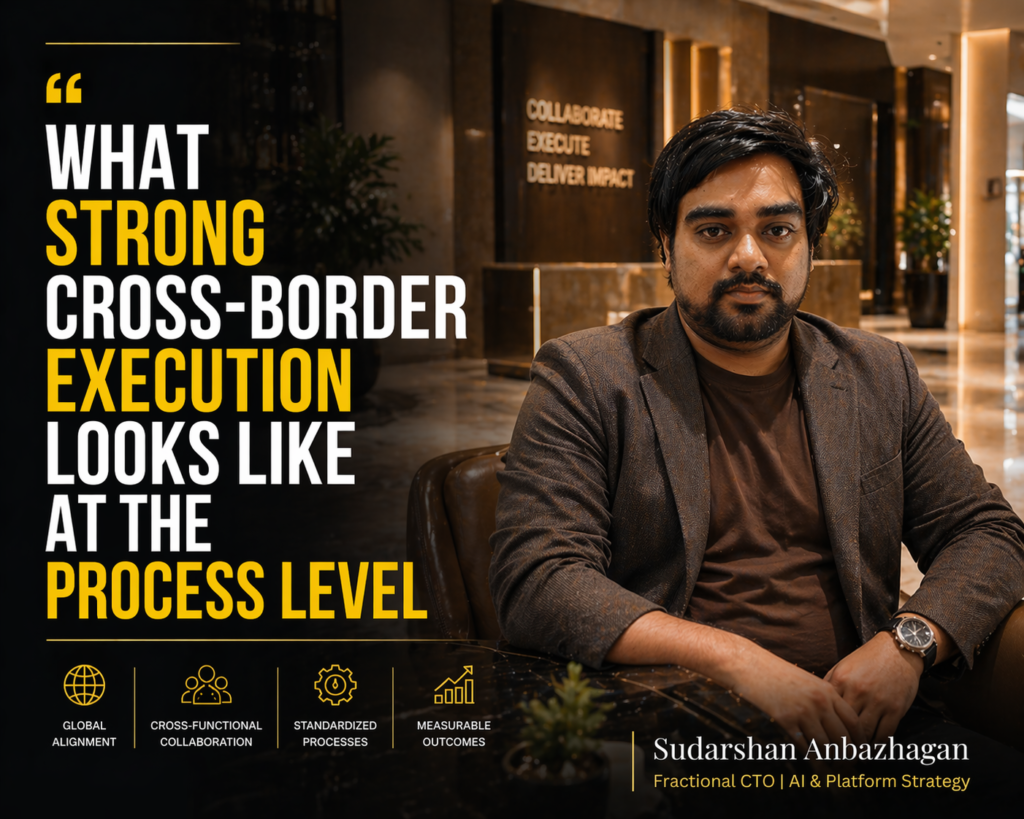
What I want to explore in this blog is what strong cross-border execution actually looks like when you examine it at the process level, not the interpersonal level. This is the layer where the most important decisions about cross-geography collaboration get made, and it is also the layer that is most often underdesigned relative to its importance.
Why Process Architecture Determines Execution Quality
There is a foundational principle that holds across every high-performing GCC engagement I have led. Execution quality is a downstream output of process clarity. When the processes connecting two teams are well-defined, execution is predictable. When they are not, execution depends on individual effort, goodwill, and the heroics of whoever is managing the relationship at any given moment. Heroics can sustain a project for a period of time. They cannot sustain a multi-year partnership across multiple teams and time zones.
The reason process architecture matters so much in cross-border contexts is that distance amplifies every ambiguity. In a co-located team, an unclear handoff can be resolved in a three-minute conversation at a whiteboard. The same ambiguity in a cross-geography team may not surface until the receiving team has been working from incorrect assumptions for an entire shift. By the time the gap is identified, hours of effort may need to be redirected. Multiply that across dozens of handoffs per week, and the cumulative productivity and quality cost becomes substantial.
What I have learned leading GCC teams and stepping in as Fractional CTO for organisations across the US, UK, Europe, and Asia is that the organisations which close this gap do so by treating process design as a strategic investment rather than an operational formality. They approach the architecture of how their teams connect with the same rigour and intentionality they would apply to product architecture or financial planning. And the returns on that investment compound over time in ways that are visible in delivery consistency, client trust, and team morale.
The key areas of focus that consistently determine whether cross-border process architecture is strong enough to support high performance are:
- Clarity of context: Does the receiving team understand not just what they are inheriting but why decisions were made the way they were, what constraints shaped the work, and what background information is essential to continuing it well?
- Clarity of expected outcomes: Is there shared agreement on what success looks like for each unit of work, defined in specific and measurable terms that both teams interpret the same way?
- Ownership of decisions: Is it clear at every stage who has the authority to make which decisions, who needs to be consulted, and who needs to be informed, so that decisions get made at the right level without unnecessary escalation or delay?
- Visibility of cross-team dependencies: Are the points where one team’s output becomes another team’s input clearly mapped, tracked, and communicated so that downstream teams can plan with confidence?
When all four of these elements are clearly defined and actively maintained, collaboration across geographies becomes significantly more effective. Not because the geography has changed, but because the process architecture is supporting the people within it rather than requiring them to compensate for what the architecture is missing.
Structured Handoffs: The Single Most Impactful Process Investment in Cross-Border Collaboration
If there is one area of cross-border process design that offers the highest return on investment for most organisations, it is the quality of handoffs between teams. Handoffs are the moments where context, ownership, and momentum transfer from one team to another. They are also the moments where gaps in process design are most likely to create visible problems.
High-performing cross-geography teams treat handoffs as a defined, structured process with consistent components. They are not informal exchanges that depend on the relationship between two individuals. They are repeatable mechanisms that any team member can execute reliably, regardless of who is involved on a given day. This distinction is the difference between a process that holds under pressure and a process that depends on the availability of specific people to function well.
In the GCC engagements I have led through SuperBotics, our cross-functional delivery pods, each comprising 40-plus specialists operating across multiple geographies simultaneously, operate with structured handoff protocols that are built into the rhythm of every project. These protocols are not bureaucratic overhead. They are the reason we have maintained a 98% on-time release rate across more than 500 projects delivered for clients in 14-plus countries. The consistency of delivery is structural, not exceptional.
A well-designed handoff protocol includes the following components, each of which serves a specific function in maintaining continuity:
Clearly Articulated Deliverables The receiving team needs to know precisely what they are inheriting, what state it is in, and what constitutes a complete and acceptable handoff. This means defining deliverables in specific, verifiable terms rather than descriptive ones. “API integration complete” is not a clearly articulated deliverable. “API integration tested against all documented use cases, edge case handling documented, error responses mapped to agreed status codes, and code reviewed and merged to the development branch” is a clearly articulated deliverable. The specificity that feels like overhead in the early stages of an engagement pays for itself many times over in reduced clarification cycles.
Contextual Information That Goes Beyond the Deliverable Every deliverable carries context that is not visible in the deliverable itself. The receiving team needs access to the reasoning behind key decisions, the constraints that shaped the approach, the alternatives that were considered and why they were set aside, and any relevant background about the work environment or stakeholder expectations. This context is what allows the receiving team to make good decisions when they encounter situations not covered by the original brief. Without it, they are navigating without a map. With it, they can adapt intelligently to whatever they find.
Visibility Into Open Items and Work in Progress A structured handoff includes a clear and honest account of everything that is unresolved, in progress, or dependent on decisions that have not yet been made. This is not a list of failures or problems. It is a planning tool that allows the receiving team to set priorities intelligently, allocate effort appropriately, and avoid investing time in areas where the ground may shift before they complete their work. Open items that are communicated clearly at handoff become manageable inputs to planning. Open items discovered mid-stream become disruptions.
Proactive Risk Awareness Risks that are identified and communicated at handoff can be planned for and often mitigated. Risks that are discovered after the receiving team has committed to an approach become escalations. High-performing handoffs include a clear, forward-looking account of the risks the receiving team should be aware of, ranked by likelihood and potential impact, with any relevant context that helps the team assess how to respond. This is not about creating anxiety. It is about giving the receiving team the information they need to make confident, informed decisions rather than reactive ones.
Named Owners for Every Open Action Every open item, dependency, or risk identified in the handoff should have a named owner and a clear expected resolution path. Unowned items tend to remain unresolved. When ownership is explicit, accountability is built into the process rather than depending on someone to volunteer it after the fact.
When all five of these components are consistently present in every handoff, continuity between teams becomes the default rather than the exception. Teams pick up exactly where the previous team left off. Momentum is maintained. And the energy that would otherwise go into reconstructing context is available for the work itself.
Using Overlapping Work Hours as a Strategic Resource
One of the clearest operational signals I observe when stepping into a cross-border team as a Fractional CTO is how overlapping work hours are being used. This is a surprisingly reliable indicator of execution maturity. In many organisations, overlap windows are treated as general availability time, filled with status updates, check-ins, routine reporting, and information sharing that could be handled asynchronously. This is one of the most significant and addressable productivity losses in cross-border operations.
Organisations that perform well across geographies make a deliberate and consistently maintained distinction between decisions and updates. Overlap time is protected for the conversations that genuinely require both teams to be present at the same moment. Everything that can be communicated asynchronously is moved out of the overlap window and handled through well-designed async workflows. This sounds like a simple operational preference, but the compounding impact on decision speed, blocker resolution, and team productivity is substantial.
The types of activities that belong in the overlap window include:
- Decision-making conversations: Strategic, architectural, or scope decisions that require input from both teams and cannot be resolved through asynchronous exchange without significant delay or risk of misalignment
- Dependency resolution: Working through the points where one team’s output connects to another team’s input, ensuring that both teams have the clarity they need to proceed with confidence
- Blocker clearance: Addressing the specific obstacles that are preventing one team from moving forward and require active involvement from the other team to resolve
- Alignment on priorities: Confirming that both teams’ near-term priorities are calibrated to the same goals and that any changes in direction are understood and accepted by everyone affected
- Relationship investment: The conversations that build trust, mutual understanding, and genuine connection between teams, which in turn make all of the above more effective and more resilient under pressure
The activities that belong in async workflows include status updates, documentation reviews, informational announcements, routine reporting, feedback on completed work that does not require immediate response, and any exchange that is primarily one-directional. These are all valuable and necessary. Moving them to async simply means they happen in the most efficient form possible, reserving synchronous time for the conversations where real-time exchange creates disproportionate value.
The leadership discipline required to maintain this distinction is real. In practice, the path of least resistance is to schedule a meeting. What high-performing cross-border leadership teams do instead is build a consistent habit of asking, before scheduling any synchronous touchpoint, whether the outcome requires real-time collaboration or whether it can be achieved more efficiently through async. Over time, this habit reshapes the entire operating rhythm of the cross-geography collaboration in ways that are visible in delivery speed and team satisfaction.
Building the Shared Norms That Make Process Design Stick
Designing good processes is necessary but not sufficient. The processes need to be understood, accepted, and genuinely followed by everyone on both sides of the collaboration. This is where many well-intentioned process improvement efforts fall short. The process gets documented. The documentation gets shared. And then the team continues operating largely as before, because the norms that shape daily behaviour were never actually updated.
What I have observed in the GCC engagements that achieve sustained process maturity is that the processes do not stay in the documentation. They become the natural way the team works. The team members on both sides do not consult a process guide before executing a handoff. They follow the handoff structure because it has become the expected and accepted way that handoffs are done here. This level of internalisation takes time and consistent reinforcement from leadership, but it is achievable and the difference in execution quality when it is achieved is significant.
Building shared norms across geographies requires attention to several specific dynamics:
Mutual Investment in Process Design Processes that are designed by one team and handed to another for compliance tend to produce compliance, not commitment. The teams that sustain high process maturity are the ones where both sides had genuine input into how the processes were designed. When a team has been part of designing how the work is structured, they understand the reasoning behind the structure and are far more likely to maintain it when the pressure to shortcut increases, as it inevitably does during high-demand periods.
Consistent Leadership Behaviour The norms of any team are shaped more by what leaders actually do than by what is written in a process document. When leaders on both sides of the collaboration consistently follow the handoff structure, consistently protect the overlap window for the right activities, and consistently model the behaviours they are asking from their teams, the expectation that these norms apply to everyone is established and reinforced. When leaders make exceptions for themselves or allow urgent delivery pressure to routinely override process discipline, the team observes this and calibrates their own behaviour accordingly.
A Culture of Constructive Process Improvement High-performing cross-border teams develop a shared expectation that process gaps will be surfaced and addressed constructively. When a team member identifies that the handoff structure is not capturing a particular type of context that the receiving team needs, or that the overlap window is being used in a way that is not producing the best outcomes, that observation is welcomed as useful information rather than treated as a criticism. This requires leaders who respond to process gap observations with genuine curiosity and a commitment to improvement rather than defensiveness. Teams that develop this culture find that their processes improve continuously over time, because the intelligence of the entire team is being applied to refining them.
The Compounding Value of Process Maturity Over Long Engagements
One of the most important things I want senior leaders considering cross-geography collaboration models to understand is that the returns on process investment compound over time. The effort required to design and establish good processes is front-loaded. The benefits accumulate across the full duration of the engagement.
In the early stages of a cross-geography team engagement, the process investment feels like it is adding time rather than saving it. Designing a handoff protocol takes longer than just starting work. Establishing shared norms requires conversations and iterations that a more informal approach would skip. Building alignment on how overlap time will be used involves agreeing on something that most teams have never discussed explicitly. All of this takes real effort in the early weeks.
What happens over the following months and years, for the organisations that make this investment, is that execution becomes increasingly reliable, increasingly efficient, and increasingly scalable. The time spent on reconstructing context at handoff decreases. The time spent in reactive coordination during overlap windows decreases. The number of escalations required to resolve misalignments decreases. And the trust between the teams, which is built through consistent and reliable process execution, creates a working relationship that is genuinely more than the sum of its parts.
What our clients who stay for an average of 6.8 years all have in common is not that they started with perfect processes. They started with a genuine commitment to building them carefully and refining them over time. The organisations that have been our partners longest are also the ones whose cross-geography teams are now operating with a level of process maturity that has become a genuine competitive capability, not just a delivery efficiency. They can scale faster, onboard new teams more smoothly, and absorb changes in scope or direction with less disruption than their peers who are still operating on informal coordination.
The key milestones that high-performing organisations typically reach in their cross-border process maturity journey look like this:
- Foundation stage (months one to three): Handoff protocols are designed and piloted. Overlap window norms are established. Both teams have participated in designing the processes and understand the reasoning behind them.
- Internalisation stage (months four to nine): Processes are becoming habitual. The team is following them without needing to consult documentation. Initial gaps are being identified and addressed. Trust between teams is building through consistent, reliable process execution.
- Optimisation stage (months ten to eighteen): Processes are being actively refined based on team feedback and delivery data. The team is identifying opportunities to improve efficiency and quality that would not have been visible without the foundation of consistent process execution.
- Maturity stage (eighteen months and beyond): Process maturity has become a structural capability. The team can absorb new members, new projects, and changes in scope without significant disruption. The processes are robust enough to hold under pressure and flexible enough to accommodate the complexity of real-world delivery.
What Process-Level Excellence Looks Like in Practice
The clearest sign that cross-border process design is working at an excellent level is that coordination becomes unremarkable. Not because nothing is happening behind the scenes, but because the mechanisms supporting coordination are functioning exactly as designed. Teams are not investing significant time in clarifying what was meant. Handoffs are completing without generating follow-up questions. Decisions are being made in the right windows by the right people with the right information. Blockers are visible and addressed before they become delays. And the teams on both sides feel genuinely supported by the processes around them rather than constrained by them.
This is the operating condition that senior technology and operations leaders should be building toward in every cross-geography team engagement. It is achievable. It requires intentional design, consistent leadership, and a genuine commitment to treating process quality as a strategic priority rather than an operational afterthought. But the organisations that achieve it find that they have built something genuinely valuable, a cross-geography team capability that delivers reliably, scales efficiently, and strengthens over time rather than requiring constant intervention to sustain.
The practical question worth reflecting on is whether the process architecture supporting your current cross-geography teams was designed with the same rigour and intentionality you would apply to any other significant strategic investment. If the honest answer is that it largely evolved informally, or that the handoff protocols are inconsistent, or that overlap time is regularly absorbed by updates rather than decisions, the opportunity to redesign deliberately is almost certainly larger than it initially appears.
Strong cross-border execution is a designed outcome. Every team and every organisation that achieves it did so by making a clear and deliberate choice to invest in the processes that make it possible. That choice, made early and maintained consistently, is what separates the cross-geography teams that become long-term strategic capabilities from the ones that remain a coordination challenge that leadership manages around.