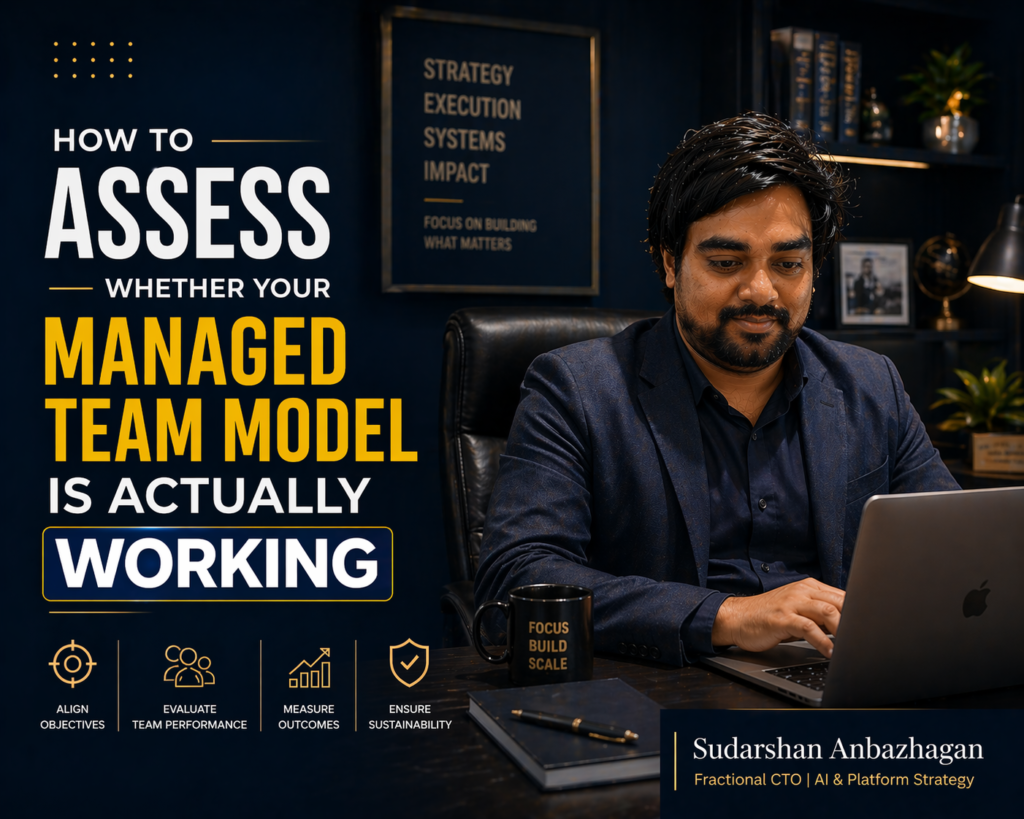

The Question Most Leaders Are Not Asking Often Enough
There is a specific moment I have seen in managed team engagements across the organisations I have worked with over the past 15 years. It typically arrives somewhere between 18 and 24 months into the engagement. The delivery numbers look solid. Releases are going out on time. The team is responsive. Stakeholders are reasonably satisfied. From the outside, and even from the inside, the arrangement appears to be functioning exactly as intended. And yet, something quiet and important is happening beneath the surface that no reporting dashboard or sprint velocity metric is designed to capture. The organisation has become comfortable handing decisions over to the external team rather than building the confidence and the capacity to make those decisions independently. The engagement is functioning, yes. But the deeper and more consequential question, the one that separates good engagements from genuinely excellent ones, is whether it is working in the fullest and most strategic sense of that word. That distinction is what this blog is about.
A well-structured managed team model should be accomplishing two things simultaneously and continuously throughout the life of the engagement. The first is execution, which means getting the right work done, at the right pace, with the right quality, and with the right level of communication and accountability. Most managed team evaluations begin and end here, and while execution standards matter enormously, they are only one half of the picture. The second is something more strategic and, in my experience, far more valuable over the long arc of a partnership: the active building of internal capability within the client organisation, so that the company grows progressively stronger, more confident, and more operationally independent as a direct result of the partnership. When both are happening together, the engagement creates sustained and compounding value. When only execution is present, the organisation is effectively renting capability without ever owning it, and that is a structural situation that will eventually surface as a risk, particularly at moments of transition, scaling, or strategic change.
What I have learned stepping into organisations across 14 countries, across industries as different as financial services, healthcare technology, e-commerce, and enterprise software, is that the gap between these two outcomes is rarely visible in the first six months of an engagement. Both types of partnerships look similar from the outside in the early phases. The differentiation emerges gradually over time, in the quality of the conversations between internal leaders and the managed team, in how knowledge moves through the system and whether it stays there, in the nature of the decisions that still require external input eighteen months or three years after the engagement began, and in the confidence with which internal leaders show up to strategic conversations. These are the signals worth learning to read clearly, and the framework I want to share in this blog is designed to help you do exactly that.
Why Execution Alone Is Not a Sufficient Measure of a Managed Team Model
The most common assessment of a managed team engagement goes something like this: review the delivery metrics, check the release cadence, look at the defect rate, evaluate team responsiveness and communication quality, and determine whether the service level agreements are being met. At SuperBotics, we take all of these standards seriously. Across our 500 plus projects and 150 plus enterprise launches spanning more than 14 countries, we maintain a 98 percent on-time release rate, and our cross-functional pods of 40 plus specialists are built specifically to sustain that quality across geographies and time zones. Delivery discipline is non-negotiable, and any managed team model that is falling short on execution does not yet have the foundation needed to provide anything else of value. That much is clear.
But here is what I have seen consistently across the longest and most productive engagements in our portfolio, including partnerships that have now been running for an average tenure of 6.8 years: the clients who get the most out of managed team models are not the ones who monitor delivery most closely. They are the ones who invest equally in measuring a second set of outcomes, outcomes that are harder to quantify but far more indicative of whether the partnership is creating lasting value. These outcomes include the growth of internal decision-making capability, the distribution and documentation of knowledge across the organisation, the gradual and natural shift in the nature of the organisation’s reliance on the managed team, and the quality of the human and intellectual relationship between internal and external team members. None of these appear on a standard delivery dashboard. All of them matter enormously when you take a three to five year view of what the engagement should have produced.
The organisations that are most vulnerable to discovering this gap are the ones that set up their managed team engagements as pure delivery arrangements from the start. The initial framing is efficient and pragmatic: the external team handles execution, the internal team handles strategy and stakeholder management, and the arrangement is evaluated on throughput. This model works well in the short term and often performs satisfactorily for longer periods than it should, because delivery metrics keep improving, satisfaction levels remain reasonable, and there is no immediate crisis to prompt a deeper review. The challenge surfaces gradually. Internal leaders find that their ability to make certain categories of technical and operational decisions has not grown at the pace it should have. Institutional knowledge that should reside within the organisation remains concentrated in the external team. Transitions, when they happen, are more disruptive than anticipated. And the organisation realises that despite years of productive engagement, a significant portion of its operating capability is still housed externally.
Assessment One: How Decision Ownership Is Evolving Over Time
The first and perhaps most telling dimension to assess in a managed team engagement is the evolution of decision-making ownership within the internal leadership team. This is not about whether the internal team is making decisions, because in most engagements they clearly are. It is about the quality, confidence, and independence with which those decisions are being made, and whether that quality is improving meaningfully over the life of the engagement.
In an engagement that is genuinely working, internal leaders become progressively more capable and more assured in the decisions that fall within their remit. They engage with the managed team on questions of strategy, architecture, and direction rather than waiting for external input on operational and execution questions they should own comfortably. They bring a clear point of view to conversations rather than presenting open-ended problems and waiting to be told what the right answer is. They challenge scope, question technical recommendations on informed grounds, and make calls with confidence even in domains that were unfamiliar to them at the start of the engagement. The shift in posture from “what should we do here” to “we are thinking this way and want to pressure-test it with you” is one of the most meaningful positive signals an engagement can produce.
When I step into an organisation as a Fractional CTO or when I am reviewing the health of a long-running managed team engagement, one of the first things I assess is the nature of the decisions that still flow exclusively through the external team. Not because external input is a problem, it is often genuinely valuable, but because the type of decisions that require external input tells you a great deal about how effectively capability has transferred. If the managed team is still being consulted to define priorities, frame tradeoffs, evaluate technical feasibility, or assess risk in areas where the organisation has now been operating for two or more years, that is a meaningful gap. It suggests that the engagement has been delivering outcomes for the client without simultaneously building the client’s own capacity to navigate those outcomes confidently and independently. The two should be happening in parallel, and when they are not, it is worth a direct and constructive conversation about how the engagement design can be adjusted.
The most effective way to address this is not to withdraw external input abruptly or to artificially force internal leaders into decisions they are not yet ready to make. It is to redesign the knowledge transfer dynamic within the engagement itself. This means ensuring that the managed team’s recommendations are accompanied by clear explanations of the reasoning behind them, so that internal leaders are learning the frameworks, not just receiving the outputs. It means creating regular forums where internal leaders engage with the managed team on strategic questions with a genuine expectation that they will bring their own perspective, not simply ratify external recommendations. And it means tracking, over time, whether the nature of the questions internal leaders are asking is becoming sharper and more strategic, because that trajectory is one of the clearest indicators that something genuinely valuable is being built.
Assessment Two: How Knowledge Is Managed, Distributed, and Retained
The second dimension worth examining carefully in any managed team engagement is the state of knowledge management across the system. This is an area that receives far less attention than delivery performance, and in my experience it is where the most consequential structural risks in long-running engagements are quietly accumulating.
In managed team models that are designed and operating well, knowledge is treated as an organisational asset that must be continuously documented, distributed, and made accessible to internal stakeholders as a standard operating discipline, not as a project to be completed when a transition is anticipated. This means that every significant process, decision framework, integration design, system architecture choice, and operational procedure is documented in a form that an internal leader could access, understand, and act on independently. It means that when a team member rotates, when a phase of work ends, or when an unforeseen transition becomes necessary, the change happens with minimal disruption because the knowledge lives in the system rather than in any individual. It means that the organisation can answer operational questions about its own technology, its own processes, and its own systems without needing to route those questions through the external team. This level of knowledge accessibility is not incidental to a well-functioning managed team engagement. It is structural to it.
The following are the specific knowledge management signals worth assessing in your current model:
- Process documentation: Are all operational processes clearly documented and stored in a location that internal stakeholders can access independently, without needing to request documentation from the managed team?
- System and architecture records: Is there a current and accurate record of the technical architecture, integration landscape, and system configuration that is maintained as a living document and not only as knowledge held by external team members?
- Decision logs: Are significant decisions, including the reasoning behind them and the alternatives that were considered, being recorded and accessible to internal leaders who may need to revisit, build on, or challenge those decisions in the future?
- Transition readiness: Has the organisation tested its ability to operate core functions during a hypothetical period of transition? The answer to this question is often revealing about where genuine knowledge gaps exist.
- Onboarding capability: Can the organisation bring a new internal team member up to speed on its technology, processes, and operating model using documentation that already exists, or does that onboarding still depend on the managed team providing context that is not written down anywhere?
When I conduct this kind of assessment within organisations across our client base, the findings are almost always more nuanced than leaders expect. There are usually areas where documentation is strong and transitions would be smooth, and there are usually other areas where institutional knowledge is concentrated in two or three individuals within the managed team and has never been formally transferred. The value of identifying these gaps early is that they can be addressed systematically and without disruption, through a structured knowledge distribution exercise that runs in parallel with delivery rather than interrupting it.
Assessment Three: The Trajectory of Operational Dependency
One of the most useful frameworks I use for evaluating the health of a managed team engagement is what I think of as the dependency trajectory. The core question is not whether the organisation depends on the managed team, because some level of reliance is entirely appropriate and expected, it is whether the nature of that dependency is evolving in a positive and strategic direction over time.
In a well-functioning engagement, the trajectory should look something like this. In the early phases, the organisation relies on the managed team broadly: for execution, for technical direction, for process design, for governance frameworks, and for operational judgment across a wide range of functions. This is appropriate and expected when the engagement is new, when internal capability in specific areas is still developing, and when the managed team is bringing specialist depth that the organisation has not yet needed to build internally. Over time, as the engagement matures, that broad reliance should naturally and organically narrow. The organisation should become progressively more capable of managing day-to-day execution with confidence, making its own technical and operational calls, and handling the governance of its own systems and processes. The managed team’s role should correspondingly evolve from broad operational support toward focused, high-value engagements in areas where external expertise genuinely adds something that would be disproportionately expensive or time-consuming to build internally. This is not about reducing the commercial value of the engagement. It is about the engagement producing the right kind of value as it matures.
What our clients who stay for an average of 6.8 years all have in common is precisely this trajectory. The nature of what they ask of us changes meaningfully between year one and year five. In the early years, they lean on us heavily across a broad front of execution and operational decisions. By the middle years, they are deeply capable in their core functions and are engaging us on specific, strategic, and architecturally complex challenges that genuinely benefit from external perspective. By the later years, we are functioning as a trusted strategic partner on specific high-value questions rather than as the primary operators of their technology function. This is exactly what a healthy managed team engagement should produce over time, and it is also what makes these partnerships sustainable and genuinely valuable to both sides for the long run.
The warning sign to look for is stagnation in this trajectory. If an organisation is in year three or year four of a managed team engagement and is still relying on the external team in the same way and for the same categories of decisions as it did in year one, the engagement design needs a direct and honest review. This does not mean the managed team is performing poorly. It often means the engagement was structured in a way that optimised for delivery continuity without building in a deliberate and structured pathway for capability transfer. Correcting this does not require disruption to ongoing delivery, but it does require a leadership decision to make capability building an explicit and measured objective of the engagement going forward.
Assessment Four: The Quality of Knowledge Transfer in Real Time
Beyond documentation and process, there is a more dynamic form of knowledge transfer that distinguishes the best managed team models from the merely functional ones. This is the quality of knowledge exchange that happens in the ordinary course of the work itself, in the conversations, reviews, standups, and strategic discussions that form the day-to-day texture of the engagement. When this dimension is working well, internal leaders are continuously learning from the managed team, not because there is a formal training programme in place, but because the way the managed team communicates, explains, and engages naturally builds the understanding and capability of everyone around them.
In practice, this looks like managed team members who explain the reasoning behind their technical recommendations rather than simply presenting conclusions. It looks like reviews where internal leaders are invited to engage with architectural decisions substantively rather than to simply approve them. It looks like retrospectives where the conversation includes not only what was delivered and what could be improved in delivery, but also what the internal team learned during the period that would enable them to make better or more independent decisions in similar situations in the future. It looks like a culture within the engagement where asking “why” and “how would we think about this ourselves next time” is not seen as inefficient or disruptive, but as a natural and valued part of how the work is done. This cultural dynamic does not happen by accident. It is the result of deliberate choices made by the managed team’s leadership about how they engage with client stakeholders, and it is one of the specific things I look for when I am assessing whether an engagement is performing at the level it should.
The organisations I have seen benefit most from managed team partnerships are invariably the ones where internal leaders are active participants in the intellectual life of the engagement rather than passive recipients of its outputs. They show up to the important technical conversations with informed perspectives. They ask questions that push the managed team to explain, justify, and pressure-test. They treat the partnership as an opportunity to accelerate their own organisational learning, not just to get work done. This posture from the internal side creates the conditions for the managed team to operate at its best, because it raises the quality of the conversations and creates an environment where genuine expertise is genuinely valued and engaged rather than simply consumed.
Assessment Five: The Human and Leadership Dimension That Frameworks Consistently Miss
Every formal assessment of a managed team model tends to focus on the quantitative dimensions: delivery velocity, defect density, on-time performance, resource utilisation, cost efficiency. These measures are important and should be tracked rigorously. But the dimension that most assessment frameworks consistently miss, and that I have come to believe is one of the strongest leading indicators of long-term partnership success, is the quality of the human and intellectual relationship between the internal leadership team and the managed team.
In managed team models that are truly working at the highest level, the relationship feels qualitatively different from a vendor engagement. There is a shared language that has developed over time, reflecting a genuine and mutual understanding of the organisation’s strategic context, its pressures, its constraints, and its ambitions. Internal leaders engage with the managed team as thinking partners rather than as service providers. When a managed team member raises a concern about strategic direction or technical approach, the internal team engages with the concern seriously and on its merits rather than treating it as scope creep or overstepping. When an internal leader challenges a technical recommendation, the managed team engages with the challenge thoughtfully rather than deferring immediately or defending the original position reflexively. This quality of intellectual exchange, where both sides are genuinely contributing to the quality of the outcome rather than simply playing their designated roles in a transactional arrangement, is one of the most reliable indicators that an engagement is producing something more than delivery.
Building this quality of relationship requires intentional leadership attention, particularly in the early phases of the engagement when norms and patterns are being established. The organisations I have seen develop the most productive long-term partnerships are the ones where the internal sponsor invests personally in shaping the quality of the collaboration from the start. They do not simply oversee the engagement from a distance and review its outputs. They participate in the important conversations. They model the kind of intellectual engagement they want to see from both sides. They create forums where managed team members feel genuinely invited to bring their full perspective and expertise to strategic questions, not just to execute what has already been decided. And they hold both sides accountable, not just to delivery standards, but to the quality of the relationship and the richness of the intellectual exchange. These are the engagements that compound in value over time, and they are the ones where both the client and the managed team genuinely feel that they are doing their best work.
A Practical Assessment Framework: Six Questions Worth Asking at Your Next Review
Rather than conducting a one-time audit of your managed team model, the most effective approach is to build a regular and structured assessment practice into the governance of the engagement itself. The following six questions are the ones I recommend to senior leaders who want to move beyond delivery metrics and assess the full value their managed team model is producing.
- Decision ownership: When you look at the categories of decisions that internal leaders are making independently today, compared to 12 months ago, is that set of decisions meaningfully broader and more confident? Are the decisions that still require managed team input becoming more strategic and less operational over time?
- Knowledge accessibility: If your managed team were unavailable for 30 days, how much of your organisation’s operational capability would be intact and how much would be dependent on knowledge that exists only within the external team? The answer to this question defines your knowledge risk profile.
- Dependency trajectory: Is the nature of what your organisation relies on the managed team for evolving in a positive direction, from broad operational reliance toward focused strategic engagement, or has the pattern of reliance remained largely static over the past 12 to 18 months?
- Documentation health: Is your process and system documentation current, comprehensive, and accessible to internal stakeholders without requiring assistance from the managed team to interpret or locate it?
- Intellectual engagement quality: Are internal leaders genuinely learning through their participation in this engagement, or are they primarily receiving outputs and approving decisions rather than developing their own understanding and capability?
- Relationship depth: Does the engagement feel like a genuine partnership where both sides are intellectually engaged and mutually invested in the quality of the outcome, or has it settled into a transactional rhythm where expectations are met but nothing more is produced?
These questions are designed to be asked honestly and in good faith, and the most productive place to ask them is in a direct conversation with the managed team’s leadership rather than as an internal exercise conducted separately. A managed team that is committed to producing genuine long-term value will welcome this kind of review. It is the conversations that arise from honest assessment that typically produce the most significant improvements in how a partnership is structured and how it evolves.
What a Genuinely High-Performing Managed Team Model Looks Like Over Time
The managed team models that I have seen produce the most sustained and compounding value share a set of characteristics that distinguish them clearly from engagements that deliver competently but do not build anything lasting. These are not characteristics that emerge by accident. They are the result of deliberate design choices made at the start of the engagement and reinforced continuously through the governance and leadership of the partnership.
The first characteristic is a shared and explicit understanding of what the engagement is supposed to produce beyond delivery. Both the client and the managed team can articulate clearly what internal capability should look like at the 12-month, 24-month, and 36-month marks of the engagement, and there is a shared accountability for producing those outcomes rather than treating them as a pleasant side effect that may or may not materialise. The second is a knowledge transfer discipline that is built into the operating model of the engagement from the outset rather than being scheduled as a project for the end of the contract. The third is a governance structure that creates regular and substantive opportunities for internal leaders and managed team leaders to review not just delivery performance but the health of the relationship, the quality of knowledge transfer, and the evolution of the dependency trajectory. The fourth is a culture of genuine intellectual partnership where both sides show up to the important conversations with their best thinking and hold each other to the highest standards, not just in what they produce but in how they engage.
After 15 years of building, leading, and evaluating managed team models across organisations on four continents, I am confident that these characteristics are learnable and achievable regardless of where a given engagement currently sits. The organisations that are furthest along this path today are not necessarily the ones that started with the best design. They are the ones that committed to asking honest questions early and often, and that were willing to have the direct conversations that those questions sometimes require. The managed team models that create the most enduring value are the ones built on that kind of mutual honesty and mutual investment, and the organisations that build that kind of partnership are the ones that find themselves, years later, genuinely stronger for having had it.
The most honest measure of a managed team engagement is not what it delivered. It is what the organisation became because of it.
Thinking about Managed Teams? Visit sudarshananbazhagan.com to explore how Sudarshan can help.