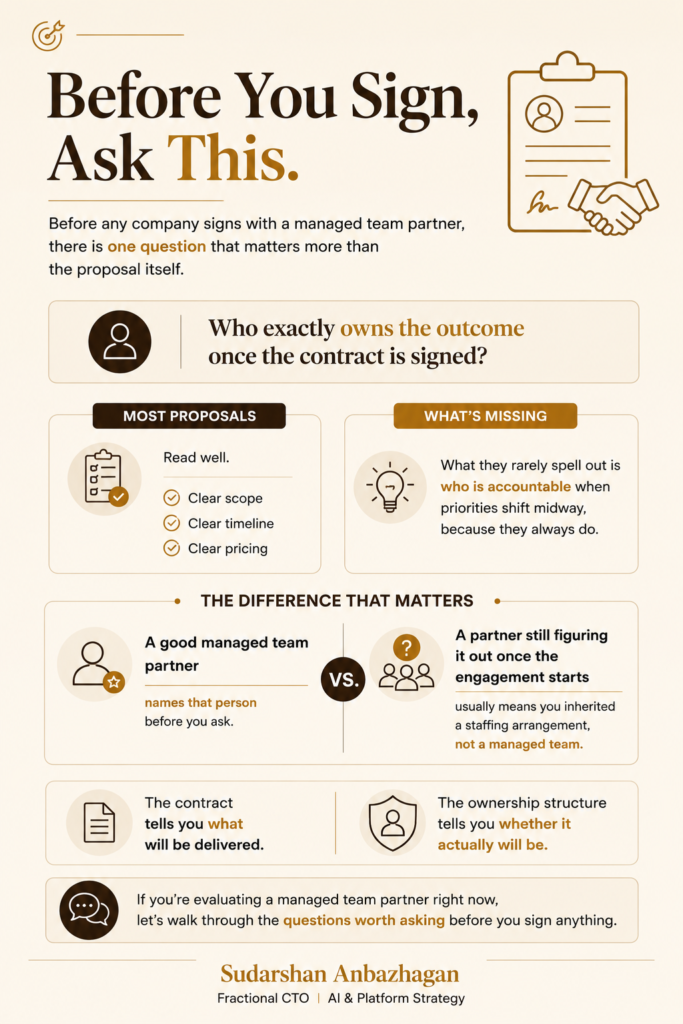

Before any company signs with a managed team partner, there is one question that matters more than the entire proposal document put in front of them. Who exactly owns the outcome once the contract is signed. Most proposals read exceptionally well on the page, with clear scope, a clean timeline, and pricing that has been carefully structured to look competitive against alternatives.
What most proposals rarely spell out with the same clarity is who is accountable when priorities shift midway through the engagement, because priorities always do shift at some point. A genuinely good managed team partner names that accountable person before you even have to ask the question. A partner still figuring out that answer once the engagement has already started usually means you have inherited a staffing arrangement dressed up as a managed team, rather than an actual managed team.
Why the Contract Rarely Tells You What You Need to Know
The contract governing a managed team partnership tells you what will be delivered, on what timeline, and at what cost. It rarely tells you whether it actually will be delivered as promised, because the contract cannot capture the internal ownership structure that determines whether commitments get honored when circumstances change. That ownership structure is what separates a reliable managed team partner from one that looks identical on paper but performs very differently once real work begins.
I have reviewed dozens of managed team proposals over the years on behalf of clients, and the strongest ones share a specific trait that weaker proposals almost always lack. They explicitly name a single accountable owner for the engagement’s outcome, not just a project manager responsible for reporting status, but someone with the authority to make tradeoff decisions when the original plan runs into an unexpected obstacle.
The Difference Between a Project Manager and an Outcome Owner
A project manager tracks whether the plan is being executed as written. An outcome owner is accountable for whether the business result the engagement was meant to produce actually materializes, even if that requires deviating from the original plan. Many managed team proposals include the former role prominently and leave the latter role undefined, which is precisely the gap that surfaces once priorities shift and nobody on the partner’s side has the standing to make a real decision about how to respond.
Questions That Reveal Whether a Partner Has Genuine Ownership Structure
When evaluating a managed team partner, I recommend asking directly who will make the call if the agreed scope needs to change three months into the engagement, and whether that person has the authority to make that call without escalating through several layers of approval on the partner’s side. A partner with genuine ownership structure will answer this question specifically and immediately. A partner still assembling that structure will answer more vaguely, often deflecting to a general commitment to communication and collaboration rather than naming an actual person and their actual authority.
A good managed team partner names the accountable owner before you ask. A partner still figuring it out once the engagement starts usually means you inherited a staffing arrangement, not a managed team.
It is also worth asking how the partner has handled a past engagement where the original scope needed to change significantly. A partner with real experience managing outcome ownership will have a concrete story, including what went wrong, how it was identified, and how the accountable owner adjusted the plan. A partner without that experience, or without genuine ownership structure, will often struggle to produce a specific example and will instead offer general reassurances about their process.
Governance Signals Worth Watching For
Beyond the direct questions, certain structural signals in the proposal itself indicate whether genuine ownership exists. A proposal that includes an explicit escalation path, naming specific roles and specific response timeframes for different categories of issues, suggests the partner has thought through accountability in advance. A proposal that only includes a general commitment to weekly status updates, without addressing what happens when those updates reveal a problem, suggests the ownership structure has not been fully worked out yet.
Why This Evaluation Matters More Than Price
Price comparisons between managed team partners are relatively easy to make and tend to dominate the early stages of a vendor evaluation process, simply because they are the most concrete numbers available for comparison. Ownership structure is harder to compare because it requires asking pointed questions and evaluating the quality of the answers rather than a number on a spreadsheet. But ownership structure, not price, is what determines whether the engagement actually delivers the outcome your business needs when circumstances inevitably deviate from the original plan.
If you are currently evaluating a managed team partner for an upcoming engagement, the single most valuable question to bring into that conversation is not about their rates or their team’s technical credentials, both of which are usually well documented already. It is the question of who, specifically, owns the outcome once the contract is signed, and what happens when the plan that outcome was built around needs to change.