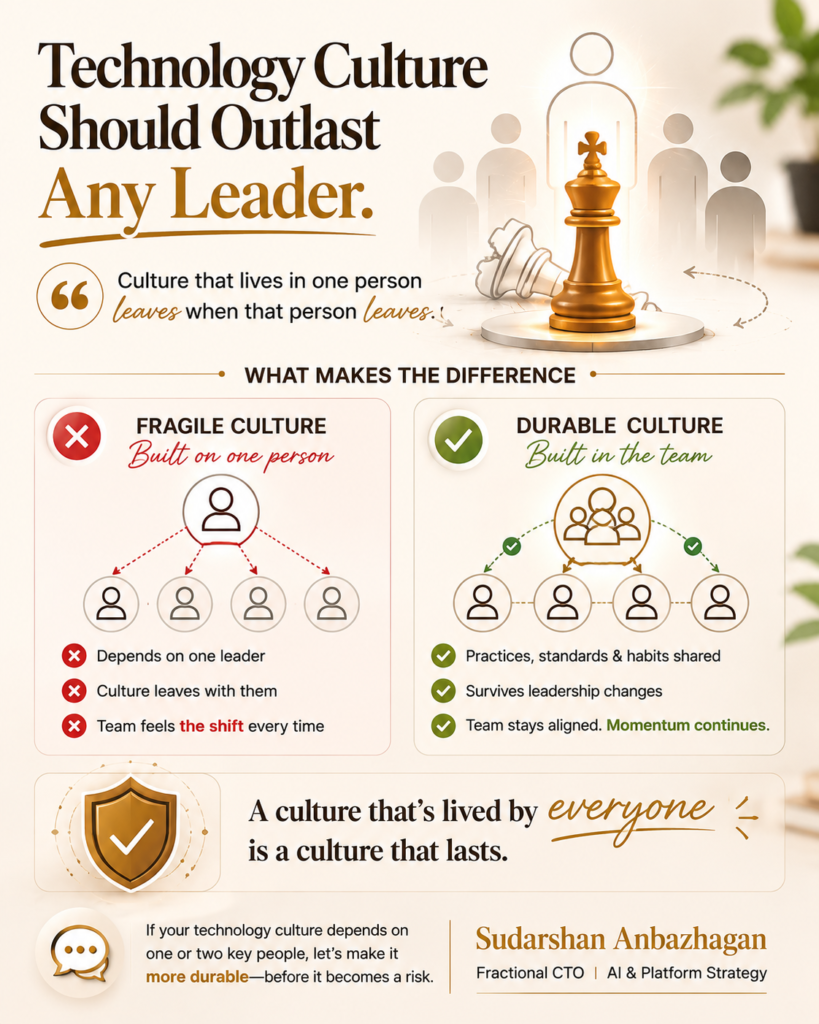

I have watched strong technology culture fall apart within months of a leadership change, even in situations where the new leader stepping in was genuinely talented and well regarded by the team. The culture in those cases was never actually built into the organization itself. It was built into one person, and when that person left, the culture left with them, regardless of how capable their replacement turned out to be.
This pattern is more common than most leadership teams like to admit, because a strong technology culture under a talented leader can look remarkably durable from the outside. Standards are high, decisions are consistent, and the team operates with a shared sense of what good work looks like. What is easy to miss is that all of this consistency may be flowing from one person’s judgment being applied consistently, rather than from a set of practices the whole team has genuinely internalized.
Why Personality-Dependent Culture Collapses So Quickly
A technology culture that depends on one individual holding it together is fragile in a specific and predictable way. The moment that individual leaves, whether through a planned transition or an unexpected departure, every standard that was previously enforced through their personal judgment suddenly has no clear mechanism keeping it in place. Team members who understood the standards intellectually may not have internalized the reasoning behind them deeply enough to maintain them without the original leader’s ongoing presence and reinforcement.
This is not a criticism of the departing leader, who may have been doing an excellent job of maintaining high standards throughout their tenure. It is a structural observation about how culture gets built. A culture maintained through one person’s consistent judgment, however excellent, is architecturally different from a culture that has been distributed across the practices, habits, and decision-making frameworks of the entire team.
The Warning Signs Before a Transition
Organizations can often identify whether their technology culture is personality-dependent before a leadership transition actually occurs, simply by asking how decisions get made when the current leader is unavailable. If a team defers major decisions until the leader returns from vacation rather than applying an internalized standard themselves, that is a meaningful signal that the culture has not yet been distributed beyond one individual, regardless of how well things appear to be running day to day.
What Makes a Technology Culture Genuinely Durable
A technology culture survives leadership changes when the practices, standards, and decision-making habits are lived by the whole team, not just modeled by whoever happens to be leading at any given time. The strongest technology cultures I have observed are the ones where a new leader can step into the role and the team barely notices a shift, because the culture was never dependent on any single individual holding it together in the first place.
The strongest technology cultures are the ones where a new leader can step in and the team barely notices a shift.
Building this kind of durability requires deliberate intention. It rarely happens by accident, because the natural tendency in any organization is for a strong leader’s personal judgment to become the de facto standard, simply because it is easier for a team to defer to a trusted individual than to codify and internalize the reasoning behind every decision that leader makes.
Practical Ways to Distribute Culture Beyond One Person
One approach that works well is requiring that significant technical decisions be documented with the reasoning behind them, not just the decision itself, so that the underlying logic becomes part of the team’s shared knowledge rather than residing only in one person’s head. Another is deliberately rotating who leads specific types of decisions across different team members, so that the judgment required to maintain standards gets practiced and internalized by more than one individual over time.
Regular retrospectives that explicitly discuss not just what was decided but why, and whether the team would make the same call again given what they now know, also help distribute the reasoning behind a culture’s standards beyond whoever happens to be in the room making the final call. These practices take more time upfront than simply trusting a strong leader’s instincts, but they produce a culture that survives well beyond that leader’s individual tenure.
Preparing for a Transition Before It Becomes Necessary
If your technology culture currently depends on one or two key people holding standards together through their personal judgment and presence, that dependency represents a real organizational risk, even if the current team is performing well and morale is high. The time to address this is before a transition becomes necessary, not during the scramble that follows an unexpected departure.
Building durability into a technology culture is ultimately a form of organizational insurance. It does not diminish the value of a strong current leader to distribute their standards more broadly across the team. It protects the organization’s ability to maintain those standards regardless of who occupies the leadership role in the future, which is precisely the kind of resilience every growing organization eventually needs, whether or not a transition is currently on the horizon.