
Every organization makes the same mistake when scaling season arrives. They assume growing faster is simply a matter of adding more people to the team, and this assumption shows up as often in well-funded US companies as it does in early-stage startups still finding their footing. Some of the fastest-scaling companies I have advised have demonstrated a very different pattern, one built around managed teams rather than headcount expansion alone.
These companies scale through managed teams built around clear outcomes, not by adding headcount and hoping that structure will catch up to the size of the team at some later point. The difference is not the size of the team involved. It is how quickly that team can move from a decision to actual delivery without extra coordination layers slowing the process down at every step.
Why Adding Headcount Alone Does Not Produce Speed
The instinct to solve a growth bottleneck by hiring more people is understandable, because headcount is a variable every leadership team can directly control, and it feels proportionate to the size of the ambition being pursued. But adding people to a structure that was not designed to move quickly usually just distributes the existing slowness across more individuals, rather than resolving it.
I have seen companies double the size of an engineering team while barely improving the rate at which features actually ship, because the new hires were absorbed into the same layered approval process that was slowing down the original team. More people were writing code. The same number of decisions were required before that code reached production. The net effect on speed was minimal, while the cost of the team increased substantially.
The Structural Choice Underneath Fast-Scaling Companies
A managed team built with speed in mind from the start looks structurally different from a team that grew organically through successive rounds of hiring. It is organized around a single point of ownership per outcome, with a deliberately small number of handoffs between the decision to pursue something and the delivery of that thing. This structure does not happen by accident. It requires an explicit decision at the outset to prioritize decision velocity over the comfort of distributed responsibility.
How Managed Teams Are Built for Speed From the Start
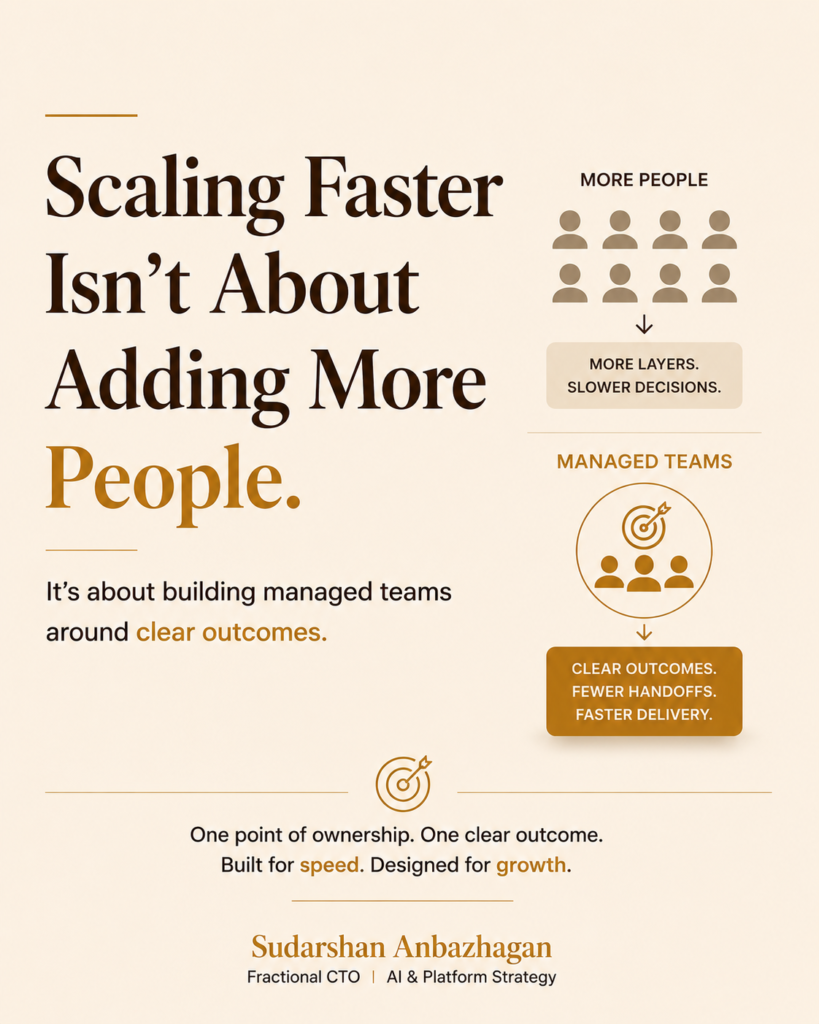
A managed team is built with speed in mind from the outset. One point of ownership, one clear outcome, fewer handoffs along the way. That structure is available to any company willing to build it this way, regardless of where they are scaling from geographically or what stage their current technology stack happens to be in. It is not exclusive to a particular size of company or a particular industry.
The advantage was never the size of the team. It has always been how quickly that team can move from a decision to delivery.
What makes this structure particularly effective for US companies working with managed teams based internationally is that the model forces clarity that might otherwise get postponed. Because a managed team is often engaged through a formal partnership rather than built through internal hiring, the outcome and the ownership structure need to be defined explicitly before the engagement begins. That upfront clarity, which some companies experience as an inconvenience during the contracting phase, turns out to be exactly the discipline that produces faster delivery once the engagement is underway.
Cross-Geography Structure as an Advantage, Not a Complication
Companies sometimes assume that working with a managed team across a significant time difference will inherently slow decisions down, given the reduced overlap in working hours. In practice, the companies that scale fastest through this model treat the time difference as a forcing function for clearer documentation and decision rights, rather than as an obstacle to work around. When a decision cannot be resolved through a quick hallway conversation because the relevant people are not in the same time zone, teams tend to write decisions down more precisely, which reduces the ambiguity that often causes delays even within teams working in the same office.
What Growth-Stage Companies Should Evaluate Before Scaling
If growth is genuinely on your roadmap for the remainder of this year, the most useful diagnostic is not how many people your current plan calls for hiring. It is whether your current team structure, at its present size, can move a typical decision from identification to delivery without passing through more people than the outcome actually requires. If that number already feels high before you have added a single new hire, adding more people through traditional headcount growth will likely make the problem larger rather than smaller.
A managed team approach offers an alternative path precisely because it requires that structural clarity to exist before the engagement even begins, rather than allowing it to emerge organically and often imperfectly over years of ad hoc hiring decisions. For companies serious about scaling this year, the question worth sitting with is not simply how many people you need. It is whether your current team structure can actually support the pace of growth you are planning for, regardless of how many additional people eventually join it.