
The Room Where Technology Strategy Either Gets Owned or Gets Tolerated
There is a moment in almost every technology engagement I step into that tells me more about the health of an organisation’s technology governance than any audit, architecture review, or delivery dashboard ever could. It is the moment a CTO walks into a board meeting, opens a roadmap presentation, and within five minutes, half the room has quietly reached for their phones. Not out of disrespect. Not because the board is disengaged from the business. Because the thread connecting what is on the screen to what the board is responsible for has been lost, and experienced leaders instinctively disengage when they cannot find their footing in a conversation that was supposed to anchor a major strategic decision.
I have been in those rooms across 14 countries, working alongside organisations from early-stage technology ventures to established multinationals with complex global operations, and the pattern I have observed is both consistent and consequential. The boards that disengage from a technology roadmap presentation do not disengage from the investment. They approve it, often unanimously, and the programme begins. What they carry into that approval, however, is not conviction. It is acquiescence. They trust the CTO. They respect the process. And they sign off on something they do not fully own. The distinction between conviction and acquiescence may not be visible on the day of approval, but it becomes acutely visible the first time something in the programme gets difficult and in every technology programme of meaningful scale, something will.
The organisations that get the most from their technology investments are not always the ones with the strongest engineering teams. They are the ones where the board understands what they approved, believes in the case for it, and is equipped to protect it when the environment changes. Building that quality of understanding is not a communication responsibility that sits alongside strategy. It is a strategy responsibility in its own right. This piece is about that responsibility: why it matters more than most technology leaders realise, how to discharge it with precision, and what it changes about the entire governance relationship between a CTO and the board they serve.
What a Board Is Actually Responsible For When They Approve a Technology Investment
To understand why most technology roadmaps fall short at the board level, it is worth being precise about what a board is actually doing when they approve a technology investment. They are not validating the architecture. They are not endorsing the sprint plan. They are not confirming the vendor selection, the cloud strategy, or the integration approach. What they are doing is taking fiduciary and strategic responsibility for the allocation of capital toward an outcome they believe serves the long-term interest of the organisation. That is a business act, not a technology act. And when a roadmap is presented to them in the language of technology rather than the language of business consequence, they are being asked to take responsibility for something they have not been given the tools to understand.
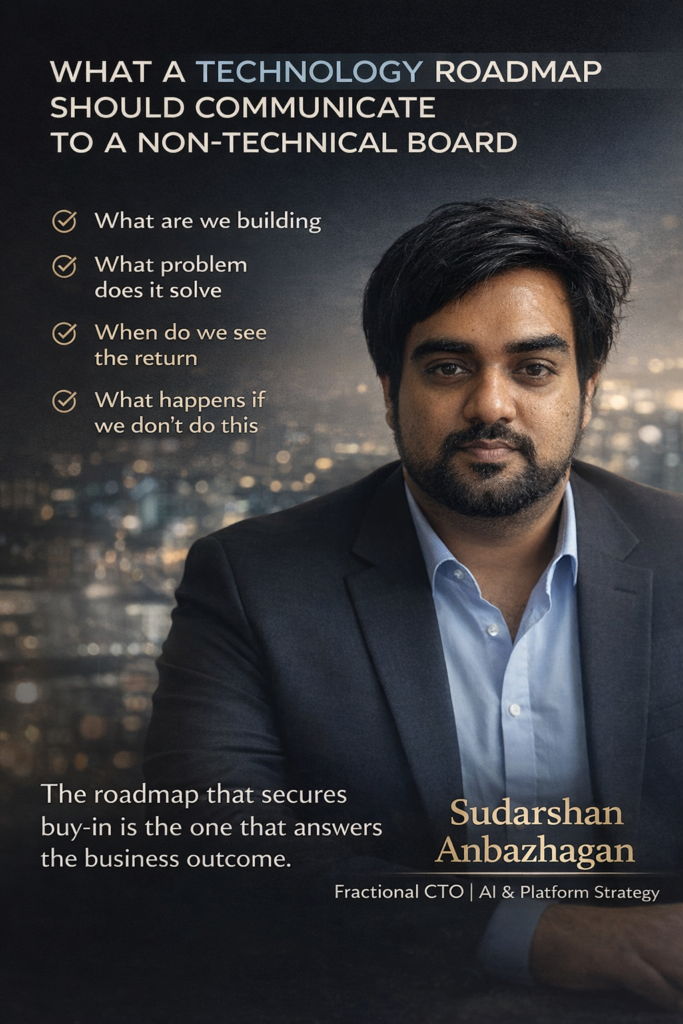
After 15 years of technology leadership work across more than 500 projects in the US, UK, Europe, and Asia, I have distilled what a board is genuinely trying to assess when they sit in front of a technology roadmap presentation. They are asking four foundational questions, often without articulating them explicitly, and the entire quality of the board relationship with the technology function depends on whether those questions are answered with clarity and honesty. Most roadmaps answer none of them directly. They answer questions the board was never asking, in a sequence that reflects how engineers think about building rather than how boards think about deciding, and the result is a presentation that is technically comprehensive and strategically opaque.
The four questions every board brings into a technology roadmap review:
- What are we building, and how does it connect to where the business needs to go? Not a feature list. Not a system architecture. A clear articulation of the strategic gap this investment addresses, why that gap matters now, and why addressing it serves the organisation’s direction rather than diverting from it.
- What problem does this solve that the business is actually experiencing? Boards understand operational pain, competitive pressure, customer attrition, margin compression, and regulatory exposure. They do not natively translate from technical debt or integration complexity to business consequence. That translation is the CTO’s responsibility, and doing it well requires the CTO to have engaged deeply with the business leaders who live with the problem every day.
- When does the organisation see a return, and in what form? A timeline of sprints and releases does not answer this question. What answers it is a clear mapping of when each phase of investment translates into a measurable business outcome: reduced operating cost, accelerated revenue recognition, improved customer retention, or a capability that the business currently lacks and currently compensates for in more expensive ways.
- What happens to the business if we do not do this? The consequence of inaction is almost never included in a technology roadmap presentation, and yet it is the most important question a board can be given an honest answer to. It reframes the investment from an opportunity into a strategic necessity, and organisations that understand necessity commit differently, more durably and more protectively, than organisations that are simply presented with an opportunity.
The Real Cost of a Board That Approves Without Understanding
The conventional assumption in technology organisations is that securing board approval is the goal. Once the budget is allocated, the work can begin, and the board can return to the governance agenda items they understand better. This assumption, widely held and rarely examined, is one of the most consequential misunderstandings in technology programme management. The cost of approval without understanding is not paid at approval. It is paid progressively throughout the life of the programme, and it compounds with every difficulty the programme encounters along the way.
When a board approves a technology investment without genuinely owning the strategy behind it, what follows is a programme that is structurally vulnerable at the governance level. The technology function has budget but not backing. It has a mandate but not the conviction of the people who granted it. And technology programmes of meaningful scale will always encounter moments that test that backing: a timeline that needs to extend, a scope that needs to be adjusted, a vendor that underdelivers against commitments, an external dependency that shifts unexpectedly, or a technical assumption that proves incorrect in practice. These are not signs of a programme in difficulty. They are the normal features of complex, ambitious delivery. But they become genuinely difficult when the board encounters them without the strategic context to understand why holding the investment is the right response, and without the ownership of the original decision that motivates them to protect the programme rather than question its foundations.
The boards that withdraw support from technology programmes mid-delivery are almost never withdrawing because the programme is failing. They are withdrawing because they never had the tools to distinguish between a programme that was in trouble and a programme that was progressing through difficulty with integrity. The strategy was never made legible enough for them to make that distinction with confidence, and in the absence of confidence, experienced leaders default to caution. The cost of that caution, when it manifests as a programme pause or a budget reduction at a critical delivery stage, is almost always larger than the investment the programme would have required to reach the next value milestone. And the damage to the relationship between the technology function and the board, the erosion of trust that follows from a pattern of approvals the board did not fully understand, takes significantly longer to repair than it took to cause.
There is a quieter dimension to this cost that is equally important for technology leaders to hold in view. When a CTO’s credibility with the board is built on the board’s willingness to trust rather than on the board’s genuine understanding, that credibility is inherently fragile. It holds in calm conditions and under pressure it shifts. The CTOs who build enduring authority at the board level are the ones who invest early and consistently in the quality of the board’s understanding, knowing that the returns on that investment are not immediately visible but are profound when the programme enters its most demanding phases.
The Two-Version Roadmap: A Governance Framework, Not a Presentation Technique
When I step into a Fractional CTO engagement, one of the first structural changes I introduce to the technology governance model is the two-version roadmap. The concept is straightforward to describe, but the discipline required to execute it well is substantive. The engineering version and the board version are not two presentations of the same information at different levels of technical detail. They are two distinct strategic documents, each designed to do a specific job for a specific audience, and each requiring a different order of strategic thinking to produce with integrity.
The engineering roadmap is the document that runs the programme. It is sequenced by technical dependency and maps every architecture decision that must be made before subsequent phases can proceed. It includes integration points, testing gates, rollback plans, risk assessments at a system level, sprint allocation by team, and the technical assumptions that underpin each phase of delivery. This document is owned entirely by the delivery team, reviewed in technical governance forums, and updated as the programme progresses. It is not designed for a boardroom, and presenting it in one is not a gesture of transparency. It is a signal that the translation work, which is a genuine strategic responsibility, has not yet been undertaken.
The board roadmap is the document that governs the investment. It is organised around business outcomes rather than technical milestones, and it is designed to answer the four foundational questions that every board brings into a technology review. In every Fractional CTO engagement I have led at SuperBotics, this document follows a consistent structure that I have refined through 150 enterprise launches and adjusted based on what the work across 14 countries has taught me about how senior leaders process and retain strategic information.
What a board-level technology roadmap must contain to earn genuine conviction:
- Strategic context section: A precise articulation of the business challenge or opportunity this investment addresses, written entirely in terms the board already understands from their strategic planning conversations. The board does not need to understand the technical context to govern the investment well. They need to understand the business context with complete clarity, and this section provides it.
- Phase-to-outcome mapping: Each phase of the programme mapped not to a release or a sprint milestone, but to a specific, verifiable business outcome. What does the organisation gain at the end of Phase 1 that it does not have today? What operational capability becomes available at the end of Phase 2 that was not possible before? What balance sheet risk is retired at the end of Phase 3 that currently sits as a liability in the business?
- Consequence of inaction analysis: For each phase, an honest and specific assessment of what the business absorbs if this investment is delayed by six months, by twelve months, or indefinitely. This element is not presented as a pressure mechanism. It is a service to the quality of the board’s decision. Leaders who understand the cost of both action and inaction make better decisions and hold those decisions with more confidence when conditions change.
- Investment protection conditions: The specific organisational behaviours, resourcing commitments, and external conditions that must hold for this programme to deliver its intended outcomes. This is not a risk register, which belongs in the engineering roadmap. It is a shared accountability document that makes explicit what the board is committing to, not just what the technology function is committing to.
- Value visibility timeline: A clear mapping of when business value becomes visible, and in what form, at each stage of the programme. This is different from a delivery timeline and must be presented as such. The board is not governing a project schedule. They are governing a value creation process, and this element makes that process visible to them.
- Decision points and adjustment gates: The specific moments in the programme where the board will be invited to review progress and make a decision, with advance clarity on what information will be presented at each gate and what decision is being requested. Boards that know what decisions are coming, and when, engage with programme governance more consistently than boards that receive updates without a clear decision mandate.
Building this document well requires that the CTO has completed the most demanding part of the strategy work before any presentation is scheduled: connecting every initiative on the roadmap to a verifiable business consequence, quantifying the value wherever that is genuinely possible, and being transparent about the assumptions that underpin the case. A roadmap that cannot be translated into this structure is not yet ready to be presented to a board. It is ready to be taken back into the strategy process for further development, and that development will make both the roadmap and the programme stronger.
Why Translation Is More Demanding and More Valuable Than Simplification
There is a distinction that every technology leader presenting to a board needs to internalise deeply, because it changes both the quality of the work and the nature of the board relationship over time. Simplifying a roadmap means taking the existing engineering document and reducing its technical complexity, leaving a thinner version of the same thinking. Translating a roadmap means rebuilding the document from the board’s frame of reference entirely, using the engineering document as the source of truth but organising the narrative around business consequence rather than technical sequence. These are fundamentally different acts, and the difference is felt in the boardroom even when it cannot be articulated.
When a CTO simplifies, something is always lost. The board receives a version of the roadmap that feels more accessible but lacks the strategic weight to earn genuine conviction. They sense, often without being able to name it precisely, that they are being given a curated summary rather than the complete thinking, and experienced board members carry a healthy wariness toward curated summaries. The professional careers of people who sit on significant boards have almost invariably included at least one occasion where a well-presented summary concealed a problem that emerged later at considerable cost. That experience does not make boards hostile. It makes them alert to the difference between a presentation designed to inform and a presentation designed to persuade, and they respond more fully to the former.
When a CTO translates, nothing of strategic substance is lost. The full complexity of the architecture, the full rigour of the dependency mapping, the complete honesty of the risk assessment all of it is preserved in the engineering document, which remains the governing document for the delivery team. What the board receives is that same quality of thinking expressed in the language of business consequence, and the credibility of the presentation rises because it does not carry the texture of having been edited for palatability. It carries the texture of having been thought through for them specifically, which is a very different thing and is received very differently.
Across more than 150 enterprise launches and client partnerships that average 6.8 years in duration, the board engagements that produce the most resilient programme outcomes are consistently the ones where the board leaves the presentation feeling that the full weight of the strategic thinking was made available to them in their own language. Those are the boards that champion the investment through difficult moments. Those are the boards that ask the right questions when a programme encounters unexpected conditions, questions oriented toward finding the best path forward rather than toward establishing accountability for what went wrong. And those are the board relationships that extend, naturally and without negotiation, into the next technology programme the organisation undertakes.
How the CTO’s Preparation Changes When Translation Is the Standard
The shift from simplification to translation changes not just the document that gets presented to the board. It changes the preparation discipline of the CTO in ways that strengthen the entire strategy, not just the communication of it. When a technology leader knows that the roadmap must be translatable into board-level language before it is ready to present, that standard becomes a quality test for the strategy itself. Initiatives that cannot be connected to a business consequence with specificity are initiatives whose strategic case needs further development. Phases whose value cannot be expressed in measurable business terms are phases where the investment thesis needs to be sharpened. The translation requirement, in this way, serves as a clarity filter for the entire roadmap, and programmes that have passed through that filter are structurally more coherent than programmes that have not.
This preparation discipline also changes how the CTO engages with the rest of the leadership team in the weeks before a board presentation. Building the board-version roadmap well requires the technology leader to have had substantive conversations with the CFO about where value will appear on the balance sheet and when. It requires conversations with the COO about the operational capabilities that each phase of the programme enables and how those capabilities connect to the operating model the business is building toward. It requires conversations with the CEO about how the technology investment positions the organisation relative to the competitive and regulatory environment it is navigating. These conversations are not preparation activities that sit alongside strategy. They are strategy. And the board-version roadmap is their output.
What the CTO’s preparation for a board roadmap presentation must include:
- A business consequence review with the CFO: A structured conversation that maps every phase of the programme to a financial outcome, identifies the assumptions that underpin that mapping, and agrees on how value will be measured and reported once each phase is delivered. This conversation also surfaces any financial sensitivities the board may bring to the discussion, allowing the CTO to address them proactively in the presentation rather than reactively in the Q&A.
- An operational alignment session with the COO: A review of how each phase of the programme changes what the operating teams can do, what it requires from them during delivery, and what organisational change management is needed to realise the operational value the programme is designed to create. Technology investments that are technically successful but operationally unabsorbed do not deliver their intended business outcomes, and this session ensures the roadmap accounts for the full change journey, not just the technical delivery.
- A strategic framing conversation with the CEO: A discussion of how this investment fits within the organisation’s broader strategic agenda, what it enables that would not otherwise be possible, and how the CEO would articulate the case for it to the board in their own language. The CEO’s frame is often the most direct proxy for the board’s frame, and understanding it in advance allows the CTO to build a presentation that resonates at the level of strategic intent rather than at the level of technical detail.
- A pre-briefing with the board chair or lead independent director: A one-to-one conversation before the formal board session. Not to preview the presentation. To understand what strategic questions the board chair is holding about the investment, what the political and relational dynamics of the board conversation are likely to be, and what the CTO needs to address directly to give the programme its best chance of receiving genuine support rather than performative approval.
Building Board Conviction as an Ongoing Programme Management Discipline
The most resilient technology programmes I have had the privilege of leading or advising across the US, UK, and European markets share a characteristic that is rarely discussed in technology delivery frameworks: the board is not just aware of the programme but genuinely invested in its success. Not invested in the sense of having approved the budget. Invested in the sense of understanding what the programme is building, believing in the strategic case for it, and feeling equipped to defend that case in a room where it might come under pressure. This level of board conviction does not emerge from a single compelling presentation. It is built progressively, through a consistent rhythm of communication that keeps the board connected to the strategy as it is executed, and that treats the board relationship as a governance asset worth tending to throughout the life of the programme.
The communication rhythm I have refined through engagements across 14 countries, and adjusted based on what the work has taught me about how senior leaders process and retain strategic information over time, follows a consistent five-stage structure. Each stage has a specific purpose, a specific audience configuration, and a specific standard for what it must contain to serve the board well.
The board communication rhythm that builds and sustains programme-level conviction:
- Pre-approval: The strategy briefing. Before the formal board presentation, a one-to-one or small group briefing with the board chair, CEO, or lead board sponsor. The purpose is not to preview the roadmap. It is to understand the board’s current strategic priorities, test the business case framing against those priorities, and identify the questions that will need the most thoughtful answering in the formal session. A board presentation should never contain a strategic surprise for the people whose sustained support the programme depends on.
- At approval: The board-version roadmap presentation. Structured around the six-element framework described above. Designed explicitly to produce a decision rather than to deliver information. The distinction is important: a presentation designed to inform gives the board information and leaves the decision implicit. A presentation designed to produce a decision gives the board the information they need to decide and makes the decision explicit, specific, and actionable. Boards respond to the latter with greater clarity and greater commitment.
- Quarterly: The outcome progress review. Not a status report and not a technical update. A business outcome review. Each quarter, the board receives an honest assessment of which business outcomes are on track, which have been delivered ahead of the programme timeline, and which have encountered conditions that warrant a conversation. The language is always business consequence. The frame is always the original investment thesis. Updates that drift toward technical progress reporting gradually erode the board’s sense of ownership of the investment, because they shift the conversation away from the business outcomes the board cares about.
- At decision gates: The adjustment briefing. When the programme reaches a significant decision point, whether a phase transition, a material scope adjustment, a vendor change, or a shift in the external conditions that informed the original business case, the board receives a structured briefing that presents the decision clearly, outlines the available options with their respective business consequences, and makes a specific recommendation with honest supporting rationale. The CTO’s role at these moments is to make the board’s decision as well-informed as possible, not to present a case for a predetermined outcome.
- At programme completion: The outcome realisation review. The final board communication is an honest comparison of the business outcomes that were promised in the original board-version roadmap against the business outcomes that were delivered. Where the programme delivered more than promised, the review documents the conditions that enabled that. Where it delivered differently than promised, the review explains what changed and what the organisation learned. This review is the most important investment in the credibility of the next technology programme the organisation undertakes, and the CTOs who take it seriously build a compounding reputation for strategic integrity that makes every subsequent engagement easier to govern.
What the Board Relationship Reveals About the Quality of Technology Strategy
There is a dimension to all of this that goes beyond governance frameworks and communication rhythms, and it is the dimension I find most important to address directly with the technology leaders I work with as a Fractional CTO. The quality of the relationship a CTO builds with a board is not a soft metric that sits alongside the harder measures of programme delivery. It is a direct and revealing reflection of the quality of the strategic thinking behind the technology programme. When a technology leader finds it genuinely difficult to translate their roadmap into board-level language, the source of that difficulty is almost never a communication limitation. It is a signal that the connection between the technology investment and the business outcome has not been made explicit enough in the strategy itself to survive the translation process. The discipline of building a board-version roadmap is, in practice, the discipline of completing the strategy.
I have worked with technology leaders who are exceptional architects, talented delivery managers, and deeply capable engineers who find the board communication dimension of their role the most challenging part of the work. When we have worked through the process of building a board-version roadmap together, the difficulty has consistently not been in finding the right words or the right level of language. It has been in making explicit a set of business consequence connections that the leader understood intuitively but had never been required to articulate with the precision that a board presentation demands. The board-version roadmap forces that articulation. And once it has been made explicit for the board, the entire delivery team benefits from the clarity, because the business case for every initiative is now documented in terms that everyone in the organisation can understand, connect their own work to, and take genuine ownership of.
The technology leaders who build the strongest board relationships over time are consistently the ones who treat the board not as a funding committee to be managed but as a strategic partner in a shared business outcome. They keep the board informed not just at scheduled governance milestones but whenever a development in the programme is material enough to affect the board’s understanding of the investment they approved. They bring complexity early, in business terms, with a clear perspective on how to respond. They bring progress with equal clarity, documenting the business value that has been delivered and connecting it explicitly back to the investment the board made. Over time, this pattern of communication builds something that has real organisational value: a board that does not just approve technology investments, but understands them, owns them, and champions them through the periods when the work is hardest and the returns are not yet fully visible.
The Strategic Discipline That Separates Funded Programmes from Finished Ones
There is a distinction that matters deeply in technology programme management, and it is one that only becomes fully visible once a programme has moved past its early stages into the sustained effort that determines whether the original investment thesis is realised. The distinction is between a programme that has been funded and a programme that will be finished. Funded programmes have board approval and budget. Finished programmes have board conviction and sustained organisational commitment through every phase of delivery, including the phases that are slower, more uncertain, and more demanding than the original roadmap indicated they would be.
The organisations that consistently build finished programmes rather than just funded ones are the ones where the technology leader has treated board conviction as a programme management discipline from the beginning. They have not waited for the board to ask better questions. They have given the board the tools to ask better questions by making the strategy legible from the first presentation. They have not hoped that the board would remain supportive through difficulty. They have built the quality of understanding that makes continued support a rational choice rather than an act of faith. And they have not treated the board communication work as something that happens after the real strategy work is done. They have understood, from experience, that it is an inseparable part of the real strategy work.
What I have carried from 15 years of leading technology programmes across more than 14 countries, from early-stage builds to large-scale enterprise transformations, is a deep conviction that the most valuable thing a technology leader can invest in before a programme begins is the quality of governance understanding at the board level. Not just the quality of the architecture. Not just the quality of the engineering team. The quality of the board’s ownership of the decision they made and their confidence in holding that decision when the programme needs them to. That quality of ownership is what turns a technology investment from a line item on a budget into a strategic priority that the whole organisation, from the board to the delivery team, is genuinely committed to making real.
The roadmap a board can follow is the roadmap that has been built with the board’s frame of reference held in mind from the first strategic conversation. It is the roadmap that has been honest about what the investment requires and what it delivers. It is the roadmap that treats the board as the strategic partners they are, rather than as the approval authority they technically represent. And it is the most important document a Fractional CTO produces in any engagement, not because of what it communicates in the boardroom, but because of the quality of completed strategic thinking it requires to exist. When the board can follow the roadmap, it is because the strategy is ready. When the strategy is ready, the programme can be protected. And when the programme can be protected by people who genuinely understand it, the business outcome the organisation invested in becomes something more than a plan. It becomes a commitment that the whole organisation is prepared to honour.
Thinking about Fractional CTO? Visit sudarshananbazhagan.com to explore how Sudarshan can help.