
ERP upgrades rarely fail outright. They reduce margin through performance drift, weak governance, and trust loss. Here’s how to manage the risk properly.
Why ERP Upgrades Quietly Erode Margin in Manufacturing and Retail
Most ERP upgrades do not fail. They go live. Transactions post. Reports generate. Leadership sends a note thanking the team. And then, over the next six to twelve months, margin tightens. Inventory creeps upward. Planning feels slower. Financial close extends. Store managers override system logic. Planners export data into spreadsheets “just to be safe.” Nothing broke. But something shifted.
In manufacturing and retail environments where contribution margin is thin and operational complexity is real, the danger is rarely a dramatic outage. The danger is slow performance drift that erodes trust and silently changes behavior. An ERP upgrade is not primarily a technical event. It is an operational risk event with financial consequences.
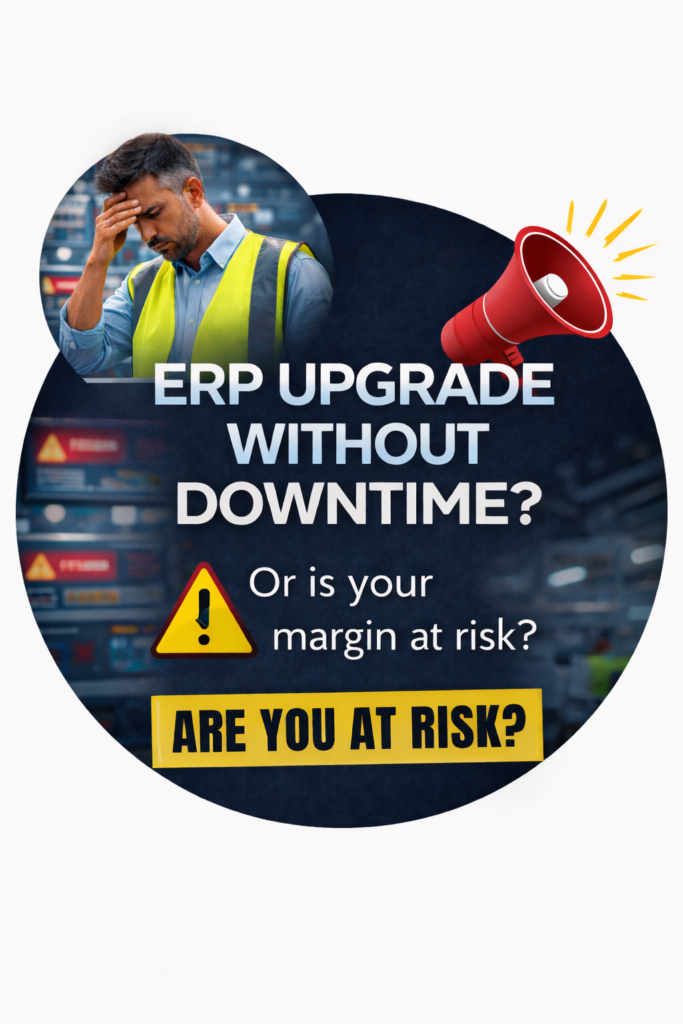
Downtime Is Not an IT Issue. It Is a Revenue Variable.
For a multi-site manufacturer, one hour of instability affects more than screens. It affects production sequencing, MRP regeneration, MES reporting, WMS picking waves, EDI transmissions, and shipment confirmations. Labor remains active even when information is delayed. Trucks still arrive. Customers still expect delivery.
For a retail network, POS latency does not just slow checkout. It triggers manual price overrides, reconciliation discrepancies, delayed settlement batches, and customer frustration at the counter.
Consider a conservative manufacturing example. If a plant generates $75,000 per hour at a 25 percent contribution margin, one hour of meaningful disruption places $18,750 of gross margin at risk. Four such hours per quarter exceed $75,000 annually, without including expediting fees or strained customer relationships. These numbers are not dramatic. They are normal.
Downtime is visible. Latency and performance degradation are not. Yet both alter revenue outcomes. When leadership frames uptime as a technical metric instead of a financial variable, risk is underestimated from the beginning.
The Real Damage Happens When Nothing Crashes
The more common failure pattern is subtle. Upgrades are often scheduled around vendor timelines, contract cycles, or fiscal windows. Testing passes in controlled environments. The assumption follows that production will behave similarly.
Manufacturing and retail operations rarely cooperate with controlled assumptions. Production priorities change mid-shift. Promotions increase POS load. Supplier delays alter inventory flow. BI dashboards pull heavier data during forecasting cycles. MRP regeneration spikes at month-end.
Without precise dependency mapping between ERP, MRP, WMS, MES, POS, EDI, and financial reporting layers, minor inefficiencies cascade. A longer MRP runtime delays purchase recommendations. Inventory synchronization lag creates uncertainty on the floor. Planners add safety stock. Buyers hedge. Store managers override. Finance questions data accuracy. The system is online. But confidence declines.
A $120 million, three-site manufacturer experienced exactly this pattern after a technically successful ERP upgrade. There was no outage. No crisis call. No public failure. Within months, MRP runtime had stretched significantly. Inventory synchronization lagged during peak shifts. Planners began manually adjusting purchase orders to protect service levels. Safety stock increased by 12 percent. Carrying costs rose and working capital tightened. The upgrade did not fail. Margin did.
After deliberate performance tuning and workflow correction, MRP runtime was reduced by 35 percent and excess inventory dropped by 8 percent within four months. The recovery was measurable. But it required focused leadership attention that had not been planned during the upgrade. The lesson was straightforward. Technical uptime is not the same as operational reliability. Trust, once eroded, is expensive to rebuild.
Zero Downtime Is Governance, Not a Vendor Capability
Many executives assume that downtime protection can be purchased through licensing tiers or infrastructure upgrades. In practice, zero downtime is an operating discipline that must be designed into the project. That discipline includes several non-negotiable elements:
- A rollback plan defined before go-live, with documented restore points and validation scripts
- Parallel validation under real production load, not just test scenarios
- Clear mapping of upstream and downstream system dependencies
- Explicit decision authority for go or no-go calls within a defined time window
Without these elements, teams default to optimism. They hope issues will be minor. They assume vendor testing was sufficient. They rely on technical sign-off instead of operational thresholds. Hope is not a mitigation strategy.
Parallel validation under peak load conditions is especially critical. MRP regeneration times, POS transaction latency, WMS queue processing, and financial posting cycles should be measured against predefined business thresholds. If those thresholds are exceeded, the organization must have both the authority and the discipline to pause or revert. Governance protects margin. Software alone does not.
The Tradeoffs That Must Be Acknowledged Up Front
Every ERP upgrade forces choices that leadership must confront directly. Accelerating deployment shortens project timelines but compresses validation windows and increases exposure. Expanding validation reduces operational risk but extends cost and internal fatigue. Standardizing processes across sites improves reporting consistency and forecasting clarity, yet it can reduce local flexibility in plant or store operations.
These tensions are not signs of poor planning. They are inherent to modernization. What distinguishes strong outcomes from weak ones is not the absence of tradeoffs. It is the clarity with which they are addressed. When executive teams articulate their risk tolerance explicitly, they make deliberate decisions. When they avoid the conversation, those decisions are made reactively during pressure moments. There is no perfect balance. There is only informed management of risk relative to margin.
A Practical Structure to Protect Financial Outcomes
Protecting margin during an upgrade does not require replacing your ERP. It requires disciplined structure around it.
The first step is comprehensive dependency mapping. Document how ERP transactions affect WMS wave planning, MES production reporting, POS transaction processing, EDI exchanges, forecasting models, and BI dashboards. This exercise often reveals fragile manual steps and undocumented integrations that create hidden exposure.
The second step is to define performance thresholds in business terms. Acceptable MRP runtime, maximum POS latency, allowable inventory synchronization delay, and financial posting windows should be quantified before go-live. These thresholds must connect directly to revenue, labor efficiency, and working capital.
The third step is rollback readiness. Restore points, validation scripts for inventory and open orders, and clearly assigned authority for activation must be established and rehearsed. Rollback planning does not signal pessimism. It signals maturity.
The fourth step is executive ownership. Cross-functional input is required, but a single accountable leader must own the final decision. Diffused authority creates hesitation. Hesitation increases exposure. This framework does not eliminate risk. It contains it.
A Conservative ROI Lens
Consider a ten-store retail operation generating $12,000 per hour per store with a 30 percent gross margin. If transaction latency reduces throughput by just 5 percent for two hours per month across all locations, monthly revenue impact equals $12,000 multiplied by ten stores multiplied by two hours multiplied by 5 percent. That results in $12,000 in lost revenue per month. Over a year, that equals $144,000 in revenue, or approximately $43,200 in gross margin.
If additional validation planning and performance stress testing cost $25,000 in time and internal resources, payback occurs well within twelve months. This excludes labor rework, reconciliation time, and potential customer dissatisfaction. Managing upgrade risk is not an IT expense. It is margin preservation.
What Modernization Will Not Fix
An ERP upgrade will not correct inconsistent master data. It will not repair weak cycle counting discipline. It will not automatically improve forecasting if assumptions remain flawed. It will not increase OEE if MES data is unreliable. Software amplifies operational habits. It does not replace them. Upgrades expose existing weaknesses more quickly. That visibility can be valuable, but only if leadership is prepared to act on what is revealed.
The Question That Determines Outcome
Before approving an ERP or POS upgrade, leadership should ask whether operational dependencies are fully understood, whether rollback procedures are tested under real conditions, whether performance thresholds are defined in financial terms, and whether a single accountable owner holds decision authority.
Most modernization efforts do not collapse because teams lack intelligence or effort. They underperform because operational risk is underestimated and ownership is diffused. In mid-market manufacturing and retail environments, where IT resources are lean and every hour of disruption affects revenue, upgrades require steady cross-functional leadership. When that leadership treats modernization as an operational commitment rather than a technical milestone, systems strengthen trust instead of slowly draining margin.
The difference is rarely the software. It is the discipline behind it.