
When Leadership and Capability Come Together, Value Grows
Every year, enterprise organizations around the world complete technology implementations that are, by every measurable standard, a genuine achievement. Systems go live smoothly, platforms perform with stability, integrations function as designed, and teams complete their onboarding with confidence. The organization moves forward with well-founded optimism that the investment will begin generating meaningful returns in the quarters ahead. What enterprise benchmarks increasingly confirm is that the organizations realizing the strongest, most sustained returns share something important beyond good systems. They share a governance discipline that treats frontline adoption as an ongoing leadership responsibility, one that deepens and matures well beyond the go-live milestone.
This distinction is one of the most consequential drivers of enterprise performance in the digital era. For senior executives navigating complex technology portfolios, expanding operational footprints, and growing expectations for strategic accountability, this represents a meaningful and well-timed opportunity. In most organizations, the technology is already in place. The leadership structure that unlocks its full and lasting value is where the most rewarding progress can be made, and where organizations that act with intention will consistently build stronger results than those that do not.
Bridging the Space Between Deployment and Full Value
There is a pattern that enterprise performance reviews observe with consistency and clarity. A technology program concludes its implementation phase on schedule, all planned capabilities are available and functioning well, the vendor has delivered with quality, the project team has performed with excellence, and the organization has met every go-live milestone. The business then moves into the performance phase with genuine confidence. Yet several quarters later, the operational improvements that informed the original investment case are developing more gradually than expected, or more variably across teams and locations than the model projected. The gap between deployed capability and fully realized value is not a reflection of technology quality. It is an invitation to strengthen the governance and adoption structures that convert available capability into consistent operational performance.
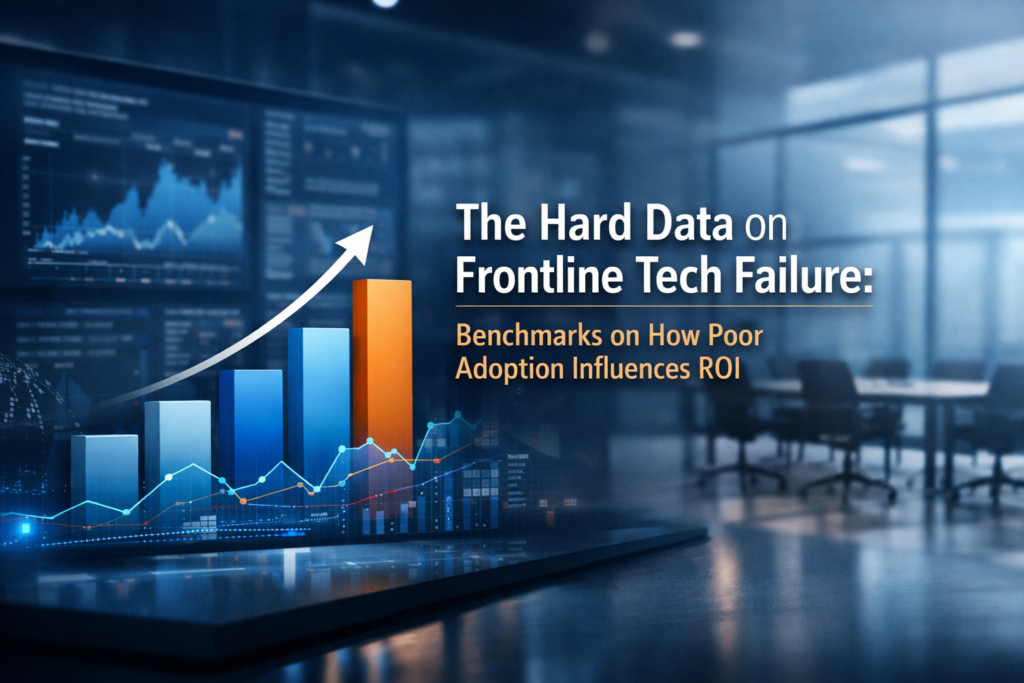
Enterprise benchmarks increasingly quantify this dynamic with valuable precision. Organizations that govern adoption as a leadership discipline, embedding utilization accountability into management routines and performance structures from go-live onward, report measurably stronger utilization at the twelve, eighteen, and twenty-four month marks. Utilization sustained over time is the primary mechanism through which digital investment converts into operational excellence, real-time visibility, and enterprise performance that compounds in a meaningful and lasting way. The structural practices most consistently observed in high-performing organizations include the following:
- Sustained executive sponsorship that remains active and visible well beyond the go-live date, reinforcing adoption as a strategic organizational priority through ongoing communication and visible leadership engagement.
- Frontline leadership accountability where managers and supervisors at the team level are responsible for embedding new systems into daily workflows, creating the operational conditions for consistent and confident usage.
- Utilization metrics integrated into performance scorecards alongside financial, productivity, and quality indicators, so that adoption is visible as a business performance dimension that receives the same attention as any other key result.
- Role-specific, scenario-based training that mirrors the actual operational environments of frontline teams, connecting system usage directly to the decisions and workflows of each specific role in a personally relevant way.
- Regular operational reviews that examine utilization patterns, identify opportunities to strengthen consistency across teams and locations, and create structured pathways for resolving adoption barriers at the right leadership level.
Together, these practices create the organizational conditions under which technology investments deliver consistent and growing returns. They are observable, repeatable disciplines that distinguish high-performing enterprises and that any organization can build with the right leadership commitment and governance structure.
Understanding What Drives Consistent and Lasting Adoption
Adoption is fundamentally a behavioral outcome. It reflects the daily decisions of individuals across an organization, each navigating their own workflows, professional rhythms, and evolving habits. What produces lasting adoption is a consistent organizational environment in which using the system well is the natural, expected, and genuinely supported path for frontline teams. Building that environment thoughtfully and deliberately requires attention to several interconnected factors that, when addressed together, create a self-reinforcing adoption dynamic that grows stronger over time.
The first factor is clarity of purpose. Frontline teams adopt technology more readily and more durably when they understand not only how to use a system but why it matters to their work, their team’s performance, and the organization’s broader direction. This understanding grows most effectively through ongoing, visible leadership reinforcement that connects daily usage to strategic outcomes in a way that is personally meaningful to the individuals engaged in the work.
The second factor is thoughtful workflow integration. Technology that is woven into existing processes as a natural operational element, rather than layered alongside them as an additional requirement, tends to be used consistently and with greater confidence. The organizations achieving the strongest adoption outcomes design workflows that incorporate technology as a core operational element, so that using the system is simply how the work gets done well. This integration reflects collaboration between operations, technology, and frontline leadership teams, ensuring that process design actively and thoughtfully supports consistent usage.
The third factor is frontline leadership behavior. The managers, supervisors, and team leaders who are closest to daily operations are the most influential and positive drivers of adoption at scale. The following behaviors, consistently practiced by frontline leaders, have the most measurable and constructive impact on team-level utilization:
- Actively using the system in their own daily work and decision-making, demonstrating through personal practice that consistent usage is both expected and genuinely valuable to how the team performs.
- Referencing system data and outputs in team conversations, performance discussions, and operational planning, naturally embedding the technology into the rhythm of everyday leadership.
- Supporting team members in building competence and confidence over time, creating a team culture where questions are welcomed, learning is ongoing, and adoption is something people grow into together.
- Holding consistent usage as a professional standard within the team, treating it as a dimension of quality and operational care rather than a separate technology expectation.
These three factors, purpose clarity, workflow integration, and frontline leadership behavior, reinforce one another in organizations that achieve strong and durable adoption. Addressing all three together produces outcomes that focusing on any single element in isolation simply cannot replicate.
The Executive Sponsorship Dimension
One of the most consistently affirmed findings in enterprise adoption research is the positive influence of sustained executive sponsorship on long-term utilization outcomes. Sustained sponsorship means that senior leaders continue to visibly and constructively engage with the technology program in the months and years following deployment, maintaining a clear organizational signal that adoption remains a meaningful strategic priority worth ongoing leadership attention and energy.
In practice, sustained executive sponsorship involves a set of specific and repeatable behaviors that communicate organizational commitment at the highest level. These include referencing the system in strategic communications and business reviews, demonstrating through language and consistent attention that utilization is part of how the organization defines performance excellence. It includes ensuring that adoption progress is visible on executive dashboards alongside financial and operational metrics, so that performance conversations naturally encompass how consistently and confidently the organization is using its digital tools. It also includes expressing genuine interest in adoption during site visits and regional leadership conversations, signaling that this dimension of performance is valued and supported from the top of the organization.
The effect of this sustained executive engagement on frontline behavior is well supported across enterprise performance studies. When the organizational signal from senior leadership is consistent, warm, and visible, the following outcomes tend to develop and strengthen over time:
- Middle managers and frontline supervisors develop a clear and settled understanding that adoption is a permanent and valued dimension of operational performance, one that receives ongoing leadership attention and support rather than fading after launch.
- Teams at every level experience a consistent organizational message that using enterprise systems well is part of professional excellence, and that the leadership team genuinely values their engagement and progress.
- Regional and business unit leaders are more likely and more motivated to incorporate adoption into their own leadership rhythms, creating a productive cascade of accountability and encouragement that reaches every part of the organization.
- The organization develops a self-reinforcing adoption culture over time, where strong utilization becomes the shared expectation and standard, supported by visible leadership and experienced as a natural part of how excellent teams operate.
Senior leaders who sustain their engagement with adoption outcomes are making one of the highest-return leadership investments available to them, because the constructive ripple effects of that engagement reach far deeper into the organization than any individual program or initiative can on its own.
Operational Performance Reviews as a Governance Instrument
One of the most practical and high-impact governance decisions an organization can make in support of adoption is integrating utilization metrics into its existing operational performance review structures. This structural choice does more to embed adoption accountability than almost any other governance action, because it changes the organizational context in which adoption is discussed, celebrated, and continuously improved.
When adoption and utilization data appear in monthly operational reviews alongside productivity, quality, customer experience, and financial indicators, the organizational message is both clear and enduring. Consistent usage of enterprise systems is part of how the organization defines and measures performance excellence. Managers who see their utilization rates alongside their other performance metrics understand this as a dimension of their professional accountability, and they engage with it accordingly and constructively. The performance review structure also creates a natural and well-supported escalation pathway when utilization patterns reveal opportunities for improvement across teams, locations, or operational cycles, allowing leadership to examine root causes and design thoughtful responses at the right level and with the right participants.
The most effective operational review frameworks for adoption governance share several common and productive characteristics:
- Regular cadence with consistent metrics, ensuring that adoption data is reviewed with the same frequency and care as other operational performance indicators, typically monthly at the operational level and quarterly at the executive level.
- Comparative visibility across teams and locations, allowing leaders to recognize where adoption is thriving, identify where it is still developing, and direct support and attention appropriately.
- Root cause orientation, moving beyond the numbers to understand the factors shaping utilization patterns and designing responses that address those factors with precision and care.
- Clear action ownership, ensuring that every adoption opportunity identified in a review is connected to a named leader who is both accountable and empowered to make meaningful progress within a defined timeframe.
- Progress tracking across review cycles, creating genuine accountability for follow-through and allowing the organization to observe and celebrate the results of its interventions over time.
Organizations that build this governance structure early find that adoption becomes increasingly self-reinforcing as leaders grow accustomed to managing utilization as a valued performance dimension and as frontline teams experience the consistency and support of that expectation across all leadership levels.
Training That Reflects Real Operational Reality
The quality and relevance of training provided to frontline teams is a significant and positive determinant of adoption outcomes. The most effective training programs share a defining characteristic. They are grounded in the actual operational scenarios that frontline teams navigate every day, making the connection between system usage and daily work immediately clear, personally relevant, and genuinely useful to the individuals receiving it. When training is designed around the real decisions, real workflows, and real performance expectations of specific roles, it builds both competence and confidence, which together produce the behavioral consistency that drives lasting adoption.
Role-specific, scenario-based training bridges the gap between technical capability and operational application by designing learning experiences around the actual work of each function and level within the organization. A warehouse supervisor works through inventory management scenarios, shift handover workflows, and exception handling situations that mirror their daily reality. A regional sales manager engages with customer data analysis, pipeline management, and forecasting scenarios that reflect their genuine professional context. A customer service representative builds skills through customer interaction simulations, case management workflows, and escalation processes that prepare them for real situations with real confidence.
Beyond the design of training content, the timing and cadence of training matter significantly for long-term adoption success. The most effective organizations approach training as a continuous enablement program that grows with the organization, with the following elements thoughtfully built into their enablement architecture:
- Onboarding training designed with care for new team members at any point in the system’s lifecycle, ensuring that organizational growth and natural workforce transitions do not create adoption gaps over time.
- Refresher programs aligned to system updates, workflow enhancements, or process evolutions that invite teams to develop new competencies and refresh their confidence in using available tools well.
- Leadership-specific enablement that equips managers and supervisors with the knowledge and confidence to support their teams’ adoption journeys actively and enthusiastically.
- Advanced capability training for experienced users who are ready to leverage more sophisticated system features that can further strengthen their team’s operational performance and outcomes.
- Just-in-time learning resources that allow frontline team members to access relevant guidance in the moment of need, reducing friction and supporting the development of positive habits in real operational situations.
This continuous enablement approach sustains the behavioral consistency that drives long-term value, ensures that the organization’s investment in training continues to grow in impact over time, and builds a learning culture that is well positioned to adapt with confidence as technology continues to evolve.
Cross-Functional Alignment as a Value Multiplier
Enterprise technology investments deliver their most significant and lasting returns when adoption is strong and consistent across functions rather than concentrated in isolated areas of high performance. The most meaningful operational and financial outcomes tend to emerge from the integration of data, workflows, and decision-making across functions, connecting finance and operations, commercial and supply chain, human resources and business performance in ways that create organizational visibility and coordination that no single function can achieve on its own.
When different functions use the same enterprise system consistently and with shared standards, the data generated reflects a complete and accurate picture of organizational performance. Leaders at every level can trust the information they are working with, collaborate with greater confidence across functional boundaries, and make strategic decisions grounded in a shared understanding of operational reality. Senior leaders play an important and direct role in building this cross-functional alignment, through governance structures that create shared accountability and regular cross-functional review of adoption patterns, opportunities, and progress.
The benefits of strong cross-functional adoption alignment extend across several dimensions of enterprise performance in ways that create compounding value over time:
- Data integrity and reliability improve meaningfully when all functions use the system consistently, producing complete and accurate data sets that support high-quality analytics and well-informed decision-making at every level.
- Process standardization across functions becomes achievable and sustainable, enabling the organization to establish consistent operating standards that can be replicated with confidence as the business grows and evolves.
- Collaborative problem-solving accelerates and deepens when adoption opportunities in one function can be surfaced in cross-functional governance forums, allowing other functions to contribute valuable perspective and participate constructively in designing solutions.
- Strategic reporting becomes more meaningful and more actionable when leaders at every level can trust that the data before them reflects the full operational picture of the organization rather than a partial or function-specific view.
- Technology investment value compounds as integration between functions deepens, unlocking capabilities that require consistent and collaborative usage across multiple parts of the organization to deliver their full and intended potential.
Cross-functional alignment around adoption is the result of deliberate governance, sustained leadership engagement, and a shared organizational commitment to realizing the complete value of enterprise capabilities together.
Business Scalability and the Adoption Foundation
There is a strategic dimension of adoption governance that extends well beyond the performance of any individual technology program, and it is one that deserves a prominent place in executive conversations about long-term organizational strategy. Organizations that develop strong adoption disciplines are building something genuinely valuable that transcends any single system. They are building the organizational infrastructure for confident and sustainable business scalability, and that infrastructure becomes more valuable with every growth initiative, market expansion, or integration the organization undertakes in the years ahead.
Scalability in the operational sense requires that performance standards can be replicated reliably as an organization grows and evolves. Whether growth comes through entering new geographies, expanding service lines, integrating acquired businesses, or growing teams within existing markets, the ability to replicate operational excellence depends on consistency of process, consistency of data, and consistency of technology usage. Organizations with mature adoption governance carry these assets into every growth scenario with confidence. When they expand, they bring with them established and proven approaches to embedding technology into operational workflows, clear and tested structures for assigning adoption accountability, and an organizational culture that treats consistent utilization as a professional standard.
The compounding nature of adoption governance as a strategic asset becomes particularly evident and valuable in the following growth scenarios:
- Geographic expansion, where new markets can be brought online using proven adoption frameworks rather than building programs from the beginning, meaningfully reducing the time and resource required to achieve strong operational performance in new locations.
- Acquisition integration, where the organization can apply structured adoption governance to the integration process, accelerating the standardization of processes and systems across the combined entity with confidence and care.
- Workforce growth, where new team members join an organization with a healthy and established adoption culture, making onboarding faster, more consistent, and more productive from day one.
- New capability deployment, where an organization with mature adoption governance is significantly and demonstrably better positioned to realize full value from additional technology investments, because the structural disciplines required are already part of how the organization operates and grows.
Senior leaders who recognize adoption governance as a strategic growth asset are making a decision that strengthens their organization’s capacity for performance and sustainable expansion simultaneously, building compounding value that serves the organization well across every horizon.
A Governance Framework Built for the Long Term
The structural practices that produce strong adoption outcomes can be organized into a governance framework that is both practical and thoughtfully adaptable to the specific scale, structure, and culture of each organization. This framework is not a rigid set of procedures but rather a set of leadership disciplines that, applied with consistency and adapted with care, create the conditions under which technology investments deliver durable and growing returns. The following principles represent the strong and positive foundation of that framework.
Leadership ownership at every level of the organization is the starting point, with adoption accountability defined clearly and assigned to named and empowered owners at the executive, operational, and frontline management levels. Each owner has a clear understanding of their scope, their performance expectations, and the collaborative pathways available when opportunities require cross-functional attention and resolution. Adoption metrics integrated into performance scorecards ensure that utilization remains visible and valued as a business performance dimension, reviewed at regular intervals as part of existing leadership rhythms. Continuous enablement programs replace one-time training with ongoing learning that grows alongside the system, the business, and the people within it. The following governance disciplines form the practical and positive core of a high-performing adoption framework:
- Define adoption as a performance outcome, establishing clear and meaningful metrics for utilization, workflow adherence, and data completeness that are included in operational scorecards and reviewed with genuine interest and care from go-live forward.
- Assign ownership at the operational leadership level, ensuring that each business unit or function has a named and supported leader accountable for adoption within their scope and fully empowered to address opportunities within their authority.
- Integrate adoption reviews into existing leadership cadences, embedding utilization discussions into monthly operational reviews and quarterly leadership forums in a way that feels natural, valued, and productive rather than as a separate or supplementary agenda item.
- Invest in continuous enablement, building a training architecture that evolves thoughtfully with the system and the workforce, sustaining competence, confidence, and engagement over time.
- Create structured feedback channels, enabling frontline teams to share their operational experience in a way that reaches the right decision makers with speed and receives visible, genuine follow-through that reinforces trust.
- Recognize and celebrate strong adoption performance, acknowledging teams and leaders who demonstrate consistent utilization as a visible and sincere expression of organizational values and appreciation for excellent work.
These disciplines, applied with consistency and sustained leadership attention, create a self-reinforcing adoption environment where consistent usage becomes the organizational standard and where the returns from technology investment continue to grow in a compounding and lasting way.
The Strategic Value of Real-Time Visibility
Among the most significant and practical benefits of strong enterprise adoption is the quality of real-time visibility it creates across the organization. When frontline teams use enterprise systems consistently and thoughtfully, the data generated by those systems accurately and fully reflects operational reality. Leaders at every level can base decisions on current, reliable information, enabling faster responses, greater precision, and stronger alignment between operational reality and strategic direction. This shift from lagging to leading information is one of the most practically impactful and rewarding outcomes of strong adoption governance.
The connection between adoption and data quality is direct and quantifiable in a positive direction. Higher utilization rates produce more complete data sets, more complete data sets support more reliable analytics, more reliable analytics enable better decisions, and better decisions made consistently across an organization produce stronger and more durable enterprise performance over time. For senior executives who have invested in analytics capabilities, business intelligence platforms, or AI-powered decision-support tools, this connection is particularly significant. The value of those downstream capabilities is directly proportional to the quality of the data flowing into them, and data quality is directly proportional to the consistency and care of frontline system usage.
Strong real-time visibility enabled by consistent adoption delivers measurable and meaningful value across several strategic dimensions:
- Operational performance management improves as leaders gain accurate, timely, and comprehensive visibility into performance patterns, emerging opportunities, and areas where additional support or resource can be directed proactively and effectively.
- Financial decision-making becomes more confident and precise when financial leaders have access to current operational data that reflects actual activity and supports well-grounded resource allocation and investment decisions.
- Customer experience management is strengthened meaningfully when commercial and service teams can see accurate, real-time data about customer interactions, case status, and service performance, enabling more responsive and personalized engagement that builds lasting relationships.
- Supply chain and inventory management benefits from the operational transparency that consistent system usage creates, enabling more accurate forecasting, faster exception management, and more effective collaboration with supply partners.
- Strategic planning becomes more grounded and credible when the data informing long-range plans reflects the true and current operational baseline of the organization, supporting plans that are realistic, achievable, and compelling to boards and stakeholders.
Real-time visibility is an outcome that leadership makes possible by governing adoption with the rigor, care, and sustained attention that this dimension of enterprise performance genuinely deserves and rewards.
Looking Forward: The Leadership Opportunity Ahead
The pace of digital capability development continues to accelerate in ways that create genuine and expanding opportunity for enterprise organizations across every industry. Artificial intelligence, intelligent automation, advanced analytics, and connected operational platforms are expanding what organizations can achieve with meaningful and growing speed. For senior leaders, this creates both an exciting opportunity and a clear responsibility to ensure that the organizations they lead are positioned to capture the value these capabilities offer, not merely to deploy them, but to realize their full and lasting potential in everyday operations.
That positioning is not primarily a technology challenge. The more consequential differentiator is the governance discipline, leadership accountability, and adoption culture that allows technology to deliver consistent and compounding returns in practice. Organizations that invest thoughtfully in building this culture are not simply protecting their current technology investments. They are building the organizational infrastructure that will allow them to capitalize on the next generation of digital capabilities with greater speed, confidence, and effectiveness than organizations still working to fully realize the value of investments already made.
The executives who recognize adoption governance as a strategic priority are positioning their organizations for several durable and meaningful advantages:
- Faster value realization from future technology investments, because the structural disciplines required to achieve strong adoption are already embedded in the organization’s operating model and leadership culture.
- Stronger competitive positioning grounded in operational excellence, data integrity, and real-time visibility that grows more valuable over time as a differentiator in markets where performance precision and decision speed determine outcomes.
- Greater organizational resilience, because an enterprise with consistent processes, reliable data, and strong cross-functional alignment is well equipped to adapt to market changes and navigate uncertainty with confidence and clarity.
- Enhanced leadership credibility with boards, investors, and stakeholders who evaluate executive teams on their ability to realize value from strategic investments and build organizations that perform with consistency and purpose.
- A stronger foundation for innovation, because organizations with operational excellence and trusted data are well positioned to explore, experiment with, and scale new capabilities as the technology landscape continues to evolve in exciting directions.
Technology expands what an organization can do. Leadership determines how reliably and how fully those expanded capabilities become everyday results that serve customers, strengthen teams, and build lasting organizational value.
A Final Reflection for Senior Leaders
The opportunity presented by adoption governance is grounded in clear evidence, supported by enterprise benchmarks, and confirmed by the consistent and inspiring experience of high-performing organizations across industries and geographies. It does not require a new technology investment or a new strategic initiative. It calls for a thoughtful and honest assessment of whether the leadership structures, governance disciplines, and accountability frameworks currently in place are working as well as they can to realize the full value of the digital capabilities the organization has already built.
For most organizations, this represents a significant and genuinely exciting opportunity. The technology is present. The capability is available and ready. What follows is a leadership choice to govern adoption with the same care, visibility, and sustained attention that any other important dimension of enterprise performance deserves and benefits from. That choice, made with clarity and genuine organizational commitment, is what transforms technology investment into operational excellence, and operational excellence into the kind of strategic growth that creates meaningful and lasting organizational value. The organizations that will lead most effectively in the years ahead will be those whose leadership teams understood that the full value of technology is realized through people, through governance, through culture, and through the sustained and purposeful leadership work of making adoption a permanent, visible, and celebrated organizational priority.