
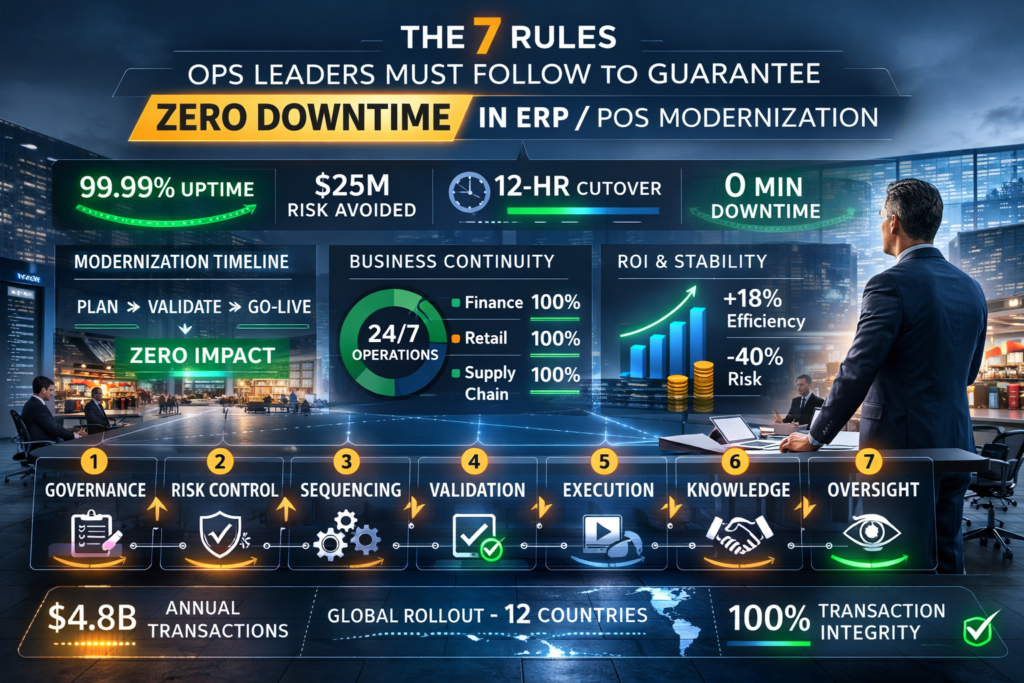
ERP and POS Modernization as a Strategic Enterprise Performance Imperative
ERP and POS modernization should be evaluated not as a routine technology upgrade, but as a structural enterprise performance decision that reshapes how the organization governs growth, manages risk, and sustains operational excellence. These systems form the digital backbone of finance, supply chain, commercial operations, compliance reporting, and customer engagement. When modernized with discipline, they enhance transparency, strengthen capital allocation accuracy, and improve long-term business scalability. When approached narrowly as an IT initiative, however, they can introduce avoidable exposure across revenue streams and operational workflows.
Across mature markets in North America and Europe, leadership teams are increasingly assessed on their ability to modernize digital infrastructure while preserving enterprise stability. Predictability has become a core performance indicator. Investors and boards examine not only growth trajectories, but also governance maturity, risk containment, and valuation resilience. Digital transformation that introduces volatility undermines confidence. In contrast, modernization that strengthens operational continuity reinforces strategic credibility.
ERP and POS platforms influence nearly every dimension of enterprise performance. Their impact extends across:
- Revenue recognition accuracy and financial reporting integrity
- Supply chain synchronization and inventory optimization
- Working capital management and liquidity visibility
- Regulatory compliance and audit transparency
- Customer transaction consistency and service continuity
- Real-time visibility across functional leadership teams
Because these systems are deeply embedded in enterprise operations, modernization decisions carry financial, reputational, and structural implications. Even temporary instability can affect margin performance, reporting confidence, and stakeholder perception.
Organizations that execute successful ERP modernization strategies recognize that system capability alone does not guarantee continuity. Sustainable transformation depends on leadership structure, cross-functional alignment, disciplined sequencing, and integrated enterprise risk management. Continuity during digital transformation is not accidental; it is the outcome of deliberate executive design, supported by a well-defined governance framework.
The sections that follow outline seven governance principles that protect operational stability while advancing strategic growth, reinforcing enterprise resilience, and positioning the organization for long-term competitive strength.
1. Anchor Modernization in Clear Executive Accountability
Large-scale ERP and POS modernization initiatives typically span operations, finance, technology, supply chain, and commercial leadership. In such environments, decision rights can easily become diffused if authority is not deliberately structured at the outset. When accountability is fragmented, escalation slows, priorities compete, and governance clarity weakens at precisely the moments when decisiveness is required. For modernization to reinforce operational excellence and enterprise performance, responsibility must be explicitly defined and visibly owned at the executive level.
A clearly designated accountable sponsor with authority across both operational and technological domains is essential. This leader ensures that system architecture decisions remain aligned with broader business objectives, capital allocation priorities, and enterprise risk management principles. Modernization, in this context, is not treated as a systems deployment exercise but as a structured performance initiative with measurable financial and operational implications.
Clear executive accountability strengthens modernization outcomes by enabling:
- Rapid, informed decision-making during critical transition phases
- Alignment between deployment strategy and enterprise risk appetite
- Disciplined capital allocation and budget oversight
- Consistent cross-functional communication and expectation management
- Transparent reporting to board oversight and audit structures
Collaboration across functions remains vital; however, shared accountability without defined authority introduces ambiguity. When responsibility is visible, structured, and reinforced by governance discipline, organizational confidence increases. Teams operate with clarity, stakeholders observe stability, and operational continuity is preserved.
Executive accountability ultimately signals that modernization is directly tied to enterprise performance, valuation resilience, and long-term strategic positioning.
2. Establish a Governance Framework Before Execution Begins
Operational disruption during ERP and POS modernization rarely originates from system limitations alone; it more often emerges from insufficient governance structure at the outset. When configuration decisions are made without clearly defined escalation pathways, approval thresholds, or risk ownership boundaries, the organization introduces exposure that could have been prevented through disciplined planning. Modernization affects enterprise performance across finance, supply chain, compliance, and commercial operations, and therefore requires a governance framework that is both formalized and visible before implementation begins.
A mature governance framework defines how authority is allocated, how risks are identified and mitigated, and how cross-functional alignment is maintained throughout the transition. It establishes decision clarity and reinforces enterprise risk management principles, ensuring that modernization strengthens operational excellence rather than testing it. By articulating governance standards early, leadership reduces ambiguity and protects continuity across critical business functions.
Core elements of an effective governance framework typically include:
- Clearly defined decision rights across finance, operations, and technology leadership
- Escalation pathways supported by time-bound response standards
- Formal change management controls that regulate scope and configuration adjustments
- Structured risk classification and mitigation protocols
- Financial oversight mechanisms, including budget variance monitoring and capital discipline review
- A defined communication cadence across executive and operational layers
High-performing organizations frequently adopt a three-tier governance structure to maintain clarity and objectivity. This structure includes:
- A Strategic Oversight Committee that maintains alignment with enterprise strategy, monitors risk exposure, and safeguards capital allocation discipline
- A Transformation Office that coordinates execution, tracks milestones, manages cross-functional alignment, and reports performance indicators
- Dedicated Operational Workstreams that execute configuration, testing, data migration, and validation within clearly controlled parameters
Such layered governance enhances transparency, strengthens accountability, and supports disciplined execution. Governance in this context is not procedural formality; it is the structural mechanism that protects operational stability, preserves financial integrity, and sustains enterprise performance during structural transformation.
3. Align Deployment Strategy With Enterprise Risk Management Principles
ERP and POS modernization strategies must be designed in alignment with the organization’s broader enterprise risk management framework. Deployment decisions, including whether to pursue a phased rollout, regional sequencing, or a consolidated transition, are not merely operational preferences; they are strategic judgments that directly influence financial stability, regulatory exposure, and operational resilience. When modernization is approached through the lens of enterprise risk management, it reinforces predictability and strengthens long-term enterprise performance.
Leadership teams should conduct a structured risk evaluation before finalizing deployment sequencing. This assessment ensures that modernization supports operational excellence while minimizing unnecessary exposure across high-impact areas of the business. Key considerations typically include:
- Revenue concentration risk across geographic regions and core product lines
- Seasonal demand cycles and peak transaction volumes that amplify operational sensitivity
- Supply chain interdependencies that could magnify disruption across distribution networks
- Regulatory and compliance reporting timelines that require data integrity and audit readiness
- Customer service continuity requirements, particularly in high-volume or service-intensive environments
- Financial close schedules, audit cycles, and reporting obligations that depend on system stability
These variables shape sequencing decisions, contingency investments, validation thresholds, and executive resource allocation. For example, organizations with high seasonal revenue concentration may sequence modernization during lower-volume periods to protect working capital efficiency and customer continuity. Enterprises operating within tightly regulated environments may require extended parallel validation to safeguard compliance integrity and reporting accuracy.
When deployment strategy aligns with enterprise risk appetite, modernization enhances predictability rather than introducing volatility. Structured risk alignment also reflects governance maturity to investors and board oversight bodies. It demonstrates that digital transformation initiatives are integrated into the organization’s capital discipline and strategic growth agenda, rather than pursued independently of financial and operational realities.
Modernization that is grounded in enterprise risk management principles strengthens confidence across stakeholders. It positions the organization to evolve its digital infrastructure while preserving operational continuity, regulatory integrity, and valuation stability.
4. Sequence Implementation According to Business Criticality
The sequencing of ERP and POS modernization reflects leadership judgment and strategic discipline. Implementation timelines should not be driven by convenience, vendor schedules, or internal momentum alone. Instead, they must align with business criticality and enterprise performance priorities. Thoughtful sequencing protects operational continuity, reinforces risk management discipline, and ensures that modernization strengthens rather than destabilizes the organization.
A structured business impact mapping exercise provides a rigorous foundation for prioritization. This approach evaluates the operational and financial sensitivity of each business segment before determining rollout order. Key dimensions typically include:
- Transaction intensity and overall revenue sensitivity across business units
- Margin concentration within specific product lines or geographic regions
- Geographic operational complexity, including multi-currency or multi-regulatory exposure
- Customer dependency levels and service continuity expectations
- Working capital implications tied to inventory cycles and receivables management
- Operational load variability, particularly during seasonal peaks or promotional cycles
By assessing these factors systematically, leadership can sequence modernization in a manner that reduces exposure during high-risk periods. Lower-risk environments or smaller operational units can serve as structured pilots, allowing teams to refine workflows, validate data integrity, calibrate reporting accuracy, and enhance real-time visibility before extending deployment into larger, revenue-critical segments. This measured progression improves confidence and strengthens enterprise resilience.
Sequencing aligned with enterprise performance priorities protects valuation stability and supports disciplined capital allocation. It signals to stakeholders that transformation is governed by financial prudence and operational awareness. Modernization should reinforce the organization’s capacity for sustainable strategic growth, not introduce unnecessary volatility.
Business scalability ultimately depends on structured progression. When implementation reflects careful prioritization and governance maturity, ERP and POS modernization becomes a reinforcing mechanism for long-term enterprise strength.
5. Embed Parallel Validation to Protect Data Integrity and Financial Accuracy
Operational continuity during ERP and POS modernization is fundamentally dependent on data reliability. Financial reporting accuracy, transactional integrity, inventory visibility, and working capital precision must remain stable throughout the transition. Because these systems directly influence enterprise performance, even minor inconsistencies can create disproportionate financial, operational, or compliance implications. For this reason, disciplined validation is not an administrative safeguard; it is a strategic risk management requirement.
Parallel validation mechanisms should be embedded as formal components of the modernization strategy rather than treated as discretionary controls. These mechanisms create structured transparency during system transition and allow leadership to evaluate performance against measurable standards before legacy platforms are decommissioned. Typical validation disciplines include:
- Dual reporting structures that compare outputs between legacy and newly implemented systems
- Transaction-level reconciliation frameworks to ensure accuracy across revenue, procurement, and payment cycles
- Inventory variance monitoring to detect discrepancies in supply chain synchronization
- Independent audit checkpoints to verify compliance integrity and financial reporting consistency
- Financial close benchmarking to confirm that reporting timelines and accuracy remain within predefined thresholds
Leadership teams should establish clearly defined success criteria before retiring legacy systems. These criteria may include variance tolerance levels, reconciliation accuracy targets, reporting consistency benchmarks, and working capital alignment thresholds. By formalizing measurable standards, the organization reduces reliance on subjective confidence and strengthens governance discipline.
Parallel validation enhances real-time visibility across finance and operations while reducing enterprise risk exposure. It protects regulatory compliance, supports audit transparency, and reinforces confidence among stakeholders. Disciplined validation ultimately safeguards enterprise performance, investor trust, and long-term valuation stability. Modernization becomes sustainable when data integrity is preserved with precision throughout the transition.
6. Preserve Institutional Knowledge to Safeguard Operational Continuity
ERP and POS modernization should expand enterprise capability, not unintentionally weaken it. While new systems introduce improved automation, real-time visibility, and reporting precision, the underlying operational judgment that sustains enterprise performance often resides within experienced operators across finance, supply chain, retail, and commercial functions. These individuals understand exception patterns, customer service nuances, regional regulatory variations, and informal process adaptations that may not be fully documented within existing system logic.
Institutional knowledge represents a strategic asset. When modernization efforts rely excessively on external system integrators without structured internal engagement, organizations risk creating dependency gaps and eroding operational resilience. Protecting enterprise continuity therefore requires deliberate knowledge preservation embedded within the transformation strategy.
Structured knowledge retention practices typically include:
- Pairing internal functional leaders with external system integrators throughout design and configuration phases
- Documenting existing workflows, including exception handling processes, prior to redesign
- Establishing formal knowledge transfer milestones tied to implementation phases
- Retaining clear process ownership within business units rather than transferring accountability to technical teams
- Incorporating capability preservation metrics into modernization KPIs and executive reporting
These disciplines ensure that system configuration reflects operational realities rather than abstract technical models. They also support cross-functional alignment by integrating experiential knowledge into digital architecture decisions.
When operational expertise remains embedded within the enterprise, modernization strengthens long-term resilience and reduces dependency risk. It supports sustained operational excellence by combining structured digital infrastructure with informed human oversight. Digital transformation achieves its full value when technology enhancement and institutional judgment evolve together in a coordinated, disciplined manner.
7. Separate Oversight From Delivery to Maintain Objectivity
Sustained operational continuity during ERP and POS modernization requires governance structures that preserve objectivity. While delivery teams are responsible for execution, configuration, and milestone achievement, oversight must remain structurally independent to ensure balanced evaluation of performance, risk exposure, and enterprise impact. When implementation teams assess their own progress without external or executive-level scrutiny, transparency can narrow and optimism bias may influence reporting.
Separating oversight from delivery strengthens governance credibility and reinforces disciplined risk management. Independent supervision ensures that modernization progress is evaluated against enterprise performance standards rather than internal project momentum. It also provides boards and senior leadership with clear visibility into risk indicators, financial implications, and operational continuity metrics.
An effective separation model may include:
- Independent steering committees with authority to review risk posture and strategic alignment
- Executive dashboards focused specifically on enterprise continuity metrics, including financial accuracy and system stability
- Risk reporting channels that operate outside delivery hierarchies to preserve transparency
- Periodic third-party validation assessments to confirm compliance integrity and performance reliability
This structured approach reinforces accountability while protecting objectivity. It ensures that modernization decisions remain aligned with capital discipline, regulatory expectations, and long-term strategic growth priorities. By maintaining independent oversight, the organization reduces exposure to escalation delays and reporting blind spots.
Ultimately, oversight safeguards the primary objective of ERP modernization: sustained enterprise stability. Implementation speed may be important, but operational excellence, data integrity, and valuation resilience remain the defining success metrics.
The Strategic Value of Disciplined Modernization
When governed with precision and executive alignment, ERP and POS modernization becomes far more than a systems upgrade; it becomes a structural enhancement of enterprise architecture. Disciplined modernization strengthens the digital backbone that supports finance, supply chain orchestration, commercial operations, compliance reporting, and performance analytics. In doing so, it reinforces operational excellence while enabling sustainable strategic growth. The value does not emerge solely from new functionality, but from the clarity, integration, and governance maturity embedded in the transformation process.
Organizations that approach modernization through a structured governance framework frequently observe measurable enterprise-level benefits. These advantages extend beyond technical efficiency and directly influence financial stability and competitive positioning. Common outcomes include:
- Improved real-time visibility across finance, operations, and commercial leadership
- Enhanced cross-functional alignment through integrated data environments
- Greater forecasting accuracy supported by consistent reporting structures
- Stronger working capital management driven by synchronized inventory and receivables data
- Increased regulatory transparency and audit readiness
- Elevated investor confidence grounded in predictability and disciplined execution
Operational excellence emerges from structure rather than acceleration. When governance maturity guides modernization, enterprise performance improves not only because systems are updated, but because decision-making becomes more informed and aligned. Integrated platforms support clearer capital allocation decisions, more reliable margin analysis, and faster response to market shifts.
Disciplined modernization also positions the organization for future scalability initiatives, including acquisitions, geographic expansion, and advanced analytics integration. A well-governed ERP modernization strategy creates a stable foundation upon which strategic growth can occur with confidence. In this context, modernization becomes a reinforcing mechanism for enterprise resilience, strengthening valuation stability and long-term competitiveness rather than introducing disruption.
A Leadership Imperative for the Next Decade
Digital infrastructure will continue to shape competitive positioning across global markets over the coming decade. As enterprises expand into new regions, integrate advanced analytics, and navigate increasingly complex regulatory environments, the stability of core systems will directly influence enterprise performance and valuation resilience. Progress remains essential; however, progress without governance discipline introduces volatility that can erode stakeholder confidence. Organizations that sustain long-term valuation strength and institutional trust will be those that modernize with measured precision, aligning digital transformation with structured enterprise risk management and capital discipline.
ERP and POS transformation has therefore become a visible measure of leadership maturity. It reflects whether an organization can pursue innovation while safeguarding financial integrity, operational continuity, compliance transparency, and real-time visibility across functions. Mature leadership teams recognize that modernization is not defined by implementation speed alone, but by the strength of the governance framework that supports it. Sustainable digital transformation requires balance between ambition and control, between technological advancement and operational resilience.
Sustained enterprise performance in this environment depends on several interdependent disciplines working in coordination:
- Clear executive accountability that reinforces ownership and strategic alignment
- Defined governance frameworks that preserve decision clarity and transparency
- Disciplined alignment with enterprise risk management principles
- Structured sequencing based on business criticality and financial sensitivity
- Embedded validation controls that protect data integrity and reporting accuracy
- Institutional knowledge preservation to sustain operational expertise
- Independent oversight mechanisms that maintain objectivity and accountability
When these principles are embedded into the modernization strategy, transformation strengthens stability rather than testing it. It enhances business scalability, supports acquisition readiness, improves regulatory posture, and reinforces long-term strategic positioning.
Operational continuity is not a function of acceleration or short-term momentum. It is the result of deliberate design, disciplined execution, and governance maturity. In complex global markets, the quality of that design reflects leadership itself.