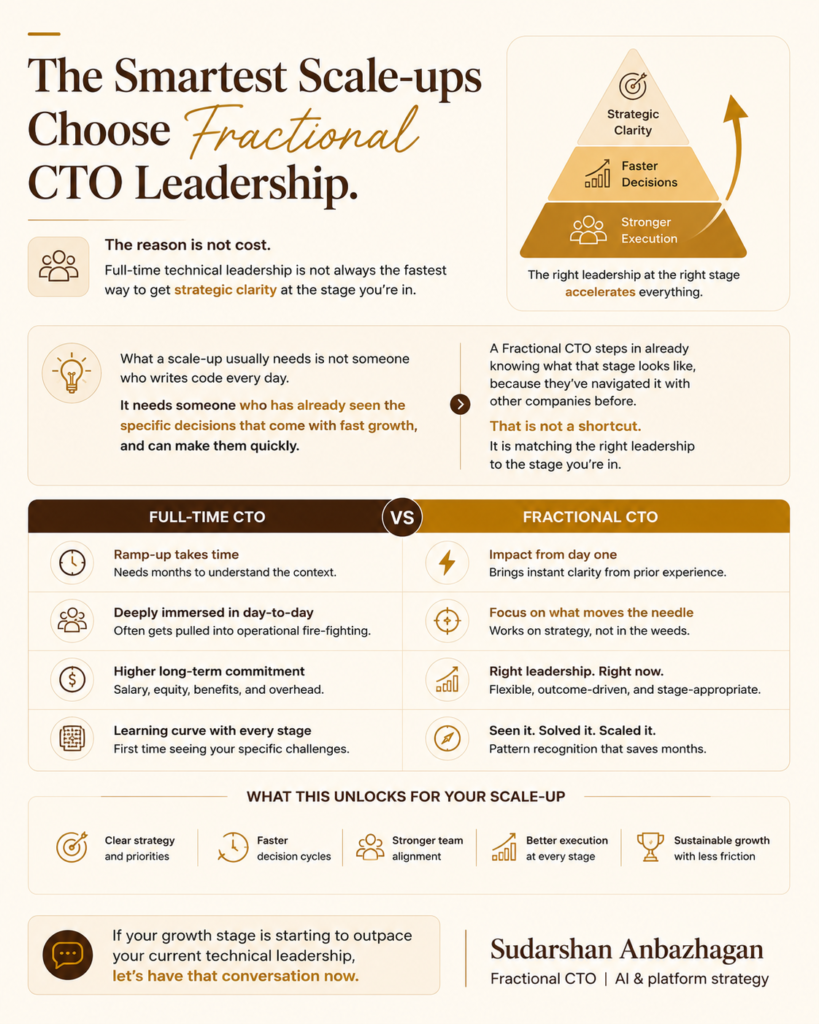

Scale-ups across the United States have been moving toward the fractional CTO model faster than most people in the industry expected this year, and the reason has surprisingly little to do with cost. Full-time technical leadership is not always the fastest way to get strategic clarity at the specific stage a scale-up actually finds itself in, and more founders are recognizing that gap earlier than they used to.
What a scale-up usually needs is not someone who writes production code every day. It needs someone who has already navigated the specific decisions that come with fast growth and can make similar decisions quickly, without spending the first six months learning the company’s context from scratch. A fractional CTO steps into that role already understanding what this particular stage of growth looks like, because they have walked through it with other companies before this one.
What the Fractional CTO Model Actually Solves for a Scale-Up
The core problem a fractional CTO solves is not a staffing gap. It is a judgment gap that opens up the moment a company grows past the point where its founding technical decisions were made with enough foresight. Early architecture choices that worked perfectly well for ten customers start creaking at two hundred customers, and the person who made those original choices is often too close to them to see clearly what needs to change.
A fractional CTO brings an outside vantage point paired with direct pattern recognition from having guided other companies through the same transition. That combination is difficult to replicate with a full-time hire, because a full-time hire, however talented, is learning your specific company’s history for the first time. A fractional CTO has usually already seen a dozen versions of the same story play out elsewhere, which means they recognize the warning signs faster and recommend the fix with more confidence.
Matching Leadership to the Actual Stage of the Company
This is not a shortcut around hiring a full-time technical leader eventually. It is simply matching the type of leadership to the stage a company is actually in right now. A scale-up in its early growth phase often does not have enough complexity to justify a full-time executive salary, but it has more than enough complexity to genuinely need senior judgment on architecture, vendor selection, and team structure. The fractional CTO model exists precisely for that gap between not needing full-time leadership and desperately needing experienced leadership.
Why Cost Was Never the Real Driver
It would be easy to assume that scale-ups choose the fractional CTO model purely to save money compared to a full-time executive hire, and while the cost difference is real, it consistently ranks lower than speed and judgment when founders explain their actual decision. What they describe wanting is someone who can walk into a leadership meeting in week one and ask the right questions, rather than someone who needs three months of onboarding before their input carries real weight.
Speed of context is the underappreciated value here. A fractional CTO engaged through a firm like SuperBotics MultiTech typically arrives having already worked across multiple industries and company sizes, which means the first strategic recommendation lands faster and with more precision than it would from someone building organizational context from zero.
The fractional CTO model is not a smaller version of a full-time hire. It is a different kind of hire, built for a different kind of need.
The Questions a Fractional CTO Brings to the Table
The value a fractional CTO adds does not show up primarily in technical questions. It shows up in business questions that happen to have technical consequences. Is the architecture being built today still the right one for where the company expects to be in eighteen months. Is the team building for the current stage, or quietly over-engineering for a scale that does not exist yet. Are the technology decisions being made this quarter creating future options for the business, or are they quietly closing doors that leadership has not noticed yet.
These are not questions a full-time engineer buried in delivery work has the vantage point to ask consistently, because they are focused on shipping the next feature, not on whether the underlying direction still makes sense. A fractional CTO’s entire value proposition rests on being positioned to ask exactly these questions, on a regular cadence, without the day to day pressure of also being the one writing every line of the code.
Recognizing the Signal Before It Becomes a Crisis
Most companies that eventually bring in a fractional CTO do so about six months after the signal first appeared, not because they were careless, but because the signal is genuinely easy to miss from inside the situation. The moment it becomes necessary rarely looks like a crisis. It looks like a leadership meeting where a technical question comes up and everyone in the room quietly defers to whichever engineer happens to be present, without anyone in the room actually being able to evaluate whether the answer given was the right one.
That pattern, repeated across enough meetings, means technology decisions are effectively being made on trust rather than on understanding, and it is precisely the pattern a fractional CTO is brought in to correct. The right time to make this change is not after a product failure or after an investor starts asking hard questions about technical debt during a fundraising round. The right time is when growth is creating decisions that require senior technical judgment, and that judgment is not consistently available inside the business yet.
If your growth stage is starting to outpace your current technical leadership capacity, that gap tends to widen quietly before it becomes visible loudly. Scale-ups that move fastest on this decision are rarely reacting to a crisis. They are the ones who recognized, from a position of relative calm, that the judgment their next stage of growth requires was not yet consistently present in the room.