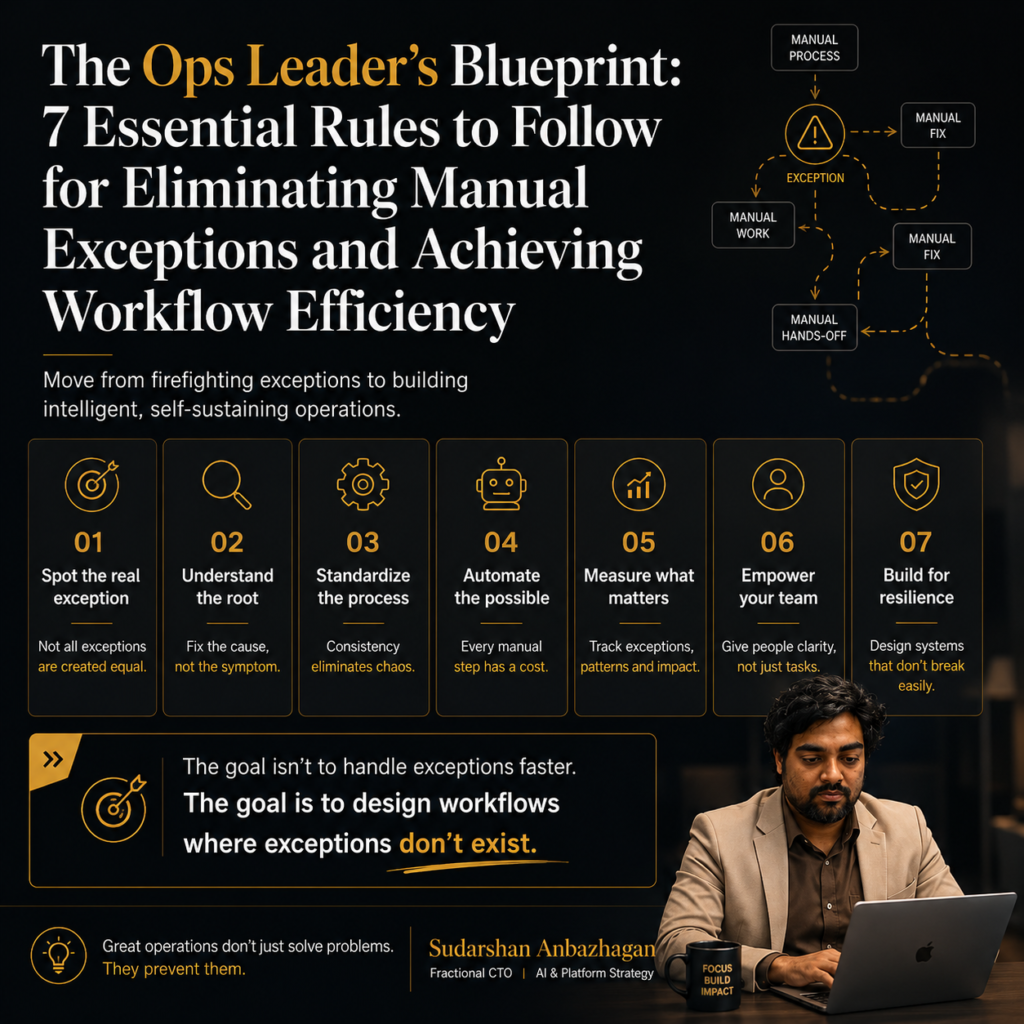

Why a Blueprint Matters More Than Willpower in Operations
I remember standing in a room where an operations director had just walked her leadership team through the most detailed process map I had ever seen. Every workflow was documented. Every exception path was drawn. Every escalation route was labelled and colour-coded. The room was impressed, and I was too, for a moment. Then I asked her one question: when was the last time this map had changed because of what an exception revealed? She looked at the map, then looked at me, and said: it has not changed. That is the difference between documenting operations and actually improving them. A well-organised status quo is not the same as a well-designed operation. The operations leaders who genuinely eliminate manual exceptions and achieve sustainable workflow efficiency are not the ones with the best documentation. They are the ones who treat every exception as a question their process design has not yet answered correctly, and they build the authority, the structure, and the rhythm to keep answering it. The blueprint below is built from what I have consistently seen work across a decade and a half of enterprise operations engagements on four continents.
Before offering the rules, it is worth being clear about what they are and are not. They are not a checklist for a transformation programme. They are not a set of one-time interventions that produce a new operational state and then no longer require attention. They are structural principles for how an operations organisation needs to be configured, led, and measured if it is to make genuine, compounding progress on exception elimination and workflow efficiency over time. The organisations that apply them most successfully do not apply them all at once as a programme. They begin with the two or three that are most absent from their current operating model, build those into normal practice, and then add the others as the organisation’s capacity for improvement work grows. The sequence matters less than the commitment. And the commitment, as always, must begin with leadership rather than with the team.
Rule One: Start With Ownership, Not Analysis
The first and most consistently overlooked principle in exception elimination work is ownership. Most organisations have more data about their operational exceptions than they know what to do with. They have exception logs, root cause analyses, trend reports, and escalation histories. What they almost universally lack is one named person who is accountable for reducing the frequency of each significant exception category, not just for managing the instances as they occur. This distinction between instance management accountability and frequency reduction accountability is structural and it is consequential. When accountability is defined at the instance level, the most rational and rewarded behaviour is fast resolution. When accountability is defined at the frequency level, the most rational and rewarded behaviour is root cause identification and process redesign. The first produces a better-managed exception log. The second produces a shorter one. Assigning frequency reduction ownership does not require a large team or a significant investment. It requires a leadership decision to define success differently and to build that different definition of success into the accountability structure of the operations organisation.
Rule Two: Simplify Before You Automate
Every time a business automates a complex manual exception process without simplifying it first, the result is a faster version of the same problem. This is one of the most expensive mistakes in enterprise operations, and it is one of the most predictable. The appeal of automation is entirely understandable. The exception process is consuming significant team capacity, the technology investment is approved, and the pressure to show ROI is real. But complexity embedded in an automated system is significantly harder to identify and correct than complexity in a manual workflow. In a manual workflow, an experienced team member can see the awkward steps and knows intuitively that a simpler path would produce the same outcome with less friction. In an automated system, that same complexity is invisible until it produces an exception that the system cannot handle, at which point it produces a manual intervention that was supposed to have been eliminated and that now sits inside a technology layer that was not designed to accommodate it. The sequence is non-negotiable: simplify the workflow until it is the most logical version of itself, then automate that version. The planning investment in simplification is consistently recovered many times over in automation reliability, adoption quality, and the absence of expensive post-go-live rework.
Rule Three: Protect Improvement Time and Measure What Disappears
Teams spending all available capacity on exception resolution have no time to improve the process that produces those exceptions. This is not a time management problem. It is a structural problem, and the solution is structural. Deliberate improvement time must be protected by leadership before it can be used by the team. The standard pattern in exception-driven operations is that improvement work is always scheduled and almost never completed, because every week that was planned for process redesign becomes a week consumed by the exceptions that the existing process keeps producing. Breaking this cycle requires a leadership commitment that is specific, visible, and consistently held. The commitment is this: two to four hours per person per week are designated for process improvement work and are not available for exception resolution regardless of the exception volume that week. This protection does not make exception resolution slower in the short term. It makes exception production slower in the medium term, which produces far more cumulative time than was invested in the protection. Alongside this, the measurement framework must evolve to track what disappears rather than what gets resolved. Tracking exception recurrence rates monthly, by category and by root cause, is the single measurement change that most reliably drives improvement behaviour at the team level. What gets measured is what gets managed. What gets managed is what changes.
Rule Four: Build a Real Channel for Frontline Insight and Redefine Success at Every Level
The people who handle exceptions every day almost always know exactly why those exceptions keep happening. They have seen the same patterns repeat. They have developed informal workarounds that compensate for the process gaps that produce the exceptions. They have opinions about what would need to change for the exceptions to stop occurring. This knowledge is extraordinarily valuable. In most operations organisations, it is also systematically inaccessible to the people with the authority to act on it. The exception resolution process routes insight downward, toward the resolution of individual instances, rather than upward, toward the redesign of the process that keeps producing them. Creating a direct, respected, and consistently followed channel for frontline insight to reach process owners and senior leaders is not a cultural initiative. It is a structural one. It requires defining a specific mechanism, whether a weekly observation log, a monthly pattern review, or a structured escalation path for systemic observations, and it requires demonstrated follow-through by leadership that makes the investment of sharing insight worthwhile for team members. A survey is not a channel. An anonymous feedback form is not a channel. A channel is a mechanism that has a defined receiver, a defined process, and a demonstrated history of producing action. When that channel exists and functions, the intelligence available to the operations improvement effort multiplies dramatically, because the team closest to the work becomes a genuine asset in the improvement process rather than a resource consumed by it. Redefining team-level success metrics to include recurrence reduction alongside resolution speed is the structural change that makes this channel sustainable, because it creates a rational incentive for team members to invest in the improvement work rather than to remain optimised exclusively for the resolution work that the current measurement system rewards.
Rule Five: Lead the Patience That Stable Operations Require
The results of genuine exception elimination work are not dramatic in the first weeks. They are quiet and compounding. Fewer recurring exceptions each month. Cleaner data flowing through systems that were previously compensated for by manual intervention. Faster operational decisions because the information supporting those decisions is more reliable. A team that gradually recovers hours and energy that were previously consumed by firefighting and begins to redirect that capacity toward improvement and toward higher-value work. None of these outcomes produce a headline. None of them create a moment that leadership can point to as the day the operation changed. They accumulate quietly over six to twelve months until the organisation looks back and realises that the exception log is genuinely shorter, the escalation frequency is genuinely lower, and the team is genuinely operating at a higher level than it was before the work began. The leaders who build self-stabilising operations are the ones who stay committed through that early quiet period, who hold the measurement standard even when the results are not yet visible, and who resist the pressure to declare the problem solved and return to firefighting because the organisation’s natural homeostasis always pulls toward the familiar pattern. Patience in operations leadership is not passive. It is the active decision, made consistently week after week, to protect the improvement work, hold the measurement standard, and trust the compounding effect of better process design to produce the outcomes that effort alone cannot.
Predictable workflow efficiency is available to every operations team that applies these seven rules with sufficient consistency and leadership patience. It does not require a transformation programme, a technology replacement, or a team restructure. It requires a set of structural decisions that change what gets measured, what gets protected, what gets rewarded, and what question gets asked first when an exception appears. If you are working through this transition and want a practical perspective on how to sequence these principles for your specific operational context, connect with me on LinkedIn or visit sudarshananbazhagan.com. The blueprint exists. The question is which rule your operation most needs to apply first. Also explore the practical frameworks I have shared on eliminating manual data entry and building real-time operational visibility for complementary approaches to the same challenge.