
The Most Expensive Misunderstanding in Technology Delivery
I was three weeks into an engagement when I asked the managed team one question. When was the last time the client had asked for their opinion on something, not just their output? One of the senior engineers thought carefully before answering. Then he said that he did not think the client ever had. The team had been delivering well for fourteen months. On time, within scope, with consistently clean work. They were trusted to execute. But in fourteen months, not one conversation had included what the team was noticing. Not one question had been asked about what they would improve. Not one moment had occurred where their perspective was treated as professionally valuable rather than technically necessary. That is not a delivery problem. It is a model problem. And it is the most common and most expensive misunderstanding I encounter in the way organisations structure managed team engagements. The managed teams model, when properly understood, is one of the most powerful tools available for scaling technology capability without scaling overhead. When misunderstood, it produces technically competent work that consistently underperforms its actual potential.
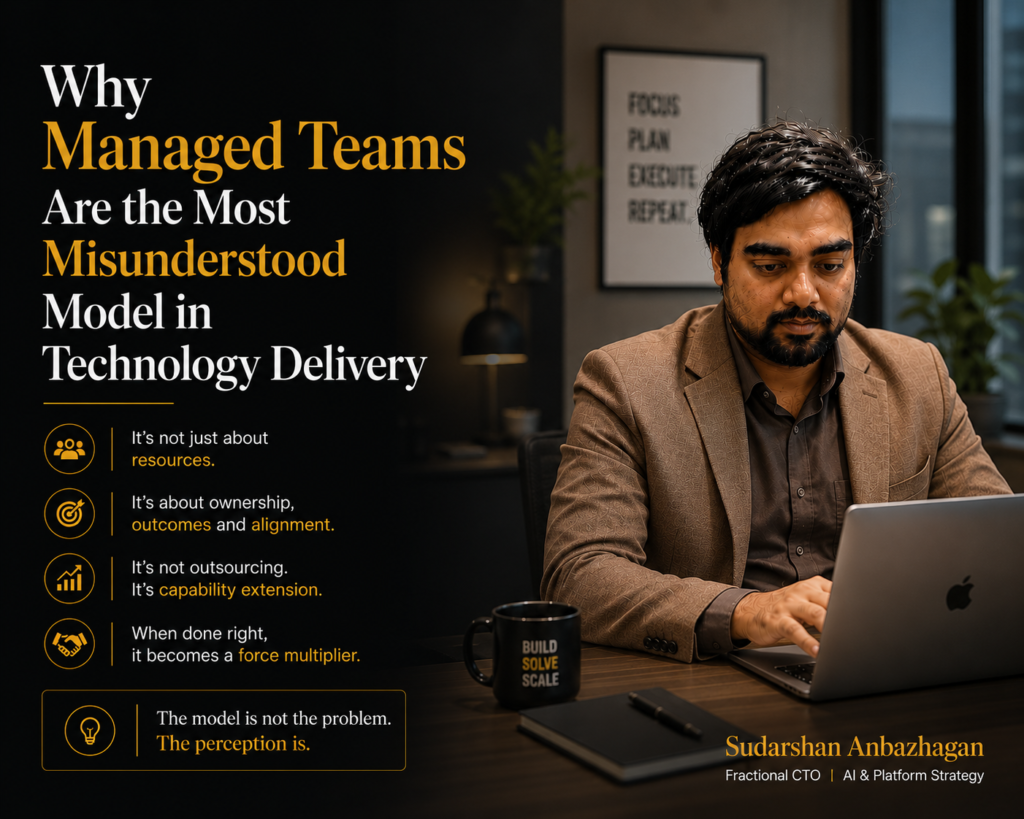
The most expensive misunderstanding about managed teams is this: they are treated as a staffing solution with a delivery wrapper. That framing shapes everything about how the engagement is structured, how work gets briefed, how success gets measured, and how much context the team ever receives. When the team is framed as an execution resource, the client naturally structures the relationship to maximise execution efficiency. Briefs become task lists. Review conversations become status updates. Performance measurement focuses on delivery metrics. And the accumulated intelligence that the team develops through months of deep work with the client’s systems, customers, and operational context remains permanently locked inside the team rather than feeding back into the client’s strategic thinking. The value that could compound does not compound. The relationship plateaus at a level of delivery quality that is genuinely impressive but permanently beneath the level of contribution the team is capable of making. This is not a team capability problem. It is a model configuration problem. And it is the client’s responsibility to solve it.
What a Managed Team Actually Is When the Model Is Right
The correct framing for a managed team is not staffing. It is not vendor. It is a capability model. This distinction matters more than it might initially appear to. A staffing solution provides people. A capability model provides a compounding asset. The difference is structural and it is consequential. People are static. Capability compounds. A team with outcome ownership, real business context, and a relationship that consistently invites their perspective will improve how the work is done over time, not just how fast it gets done. They will identify opportunities for process improvement that the client’s internal team has stopped seeing because proximity creates blind spots. They will surface risks that the project plan does not account for because they have been close enough to the operational detail to see what the architecture decisions will actually produce at the implementation level. They will bring a perspective on technology choices that combines external experience with deep client-specific context in a way that neither a purely internal team nor a purely external consultant can replicate. That combination is what makes a well-structured managed team engagement genuinely valuable over a multi-year relationship.
Capability compounds when the conditions for compounding are present. Those conditions are specific and they are the client’s responsibility to create. The first condition is outcome ownership at the team level. The team must be accountable not just for completing the tasks assigned to them but for the quality of the outcome those tasks are designed to produce. That accountability changes how the team approaches the work. It changes what questions they ask before beginning a sprint. It changes what they raise when they encounter an obstacle that threatens the intended outcome rather than just the delivery timeline. The second condition is real business context. The team needs to understand why the work matters, what business problem it is solving, what a successful outcome looks like from the client’s commercial perspective, and what constraints and priorities are shaping the decisions being made around them. Without that context, the team is executing against requirements. With it, they are contributing to outcomes. The difference in the quality of work produced is consistently significant and consistently underestimated by clients who have never experienced a managed team operating with full business context.
What Separates the Engagements That Compound in Value From the Ones That Plateau
The managed team engagements I have seen compound most significantly in value share a set of structural characteristics that are entirely within the client’s control to implement. The first is how work is briefed. In transactional engagements, the client provides detailed specifications and expects the team to execute against them precisely. In high-value engagements, the client shares the business problem first, the constraints and context that shape it, and then invites the team’s perspective on how best to approach it before specifications are finalised. This is not a slower process. It is a higher-quality process. The specifications that emerge from this kind of briefing are better because they have been informed by the team’s technical perspective before being locked, which means they are more likely to achieve the intended outcome without the expensive mid-sprint revisions that specification-first briefing consistently produces. It is also a relationship-building process. Teams that are invited into the problem-definition phase develop a different relationship to the outcome than teams that are handed requirements to execute.
The second characteristic is how review conversations are structured. In transactional engagements, the review asks what was completed and whether it meets the acceptance criteria. In high-value engagements, the review asks what was completed, what the team noticed during the work that is worth considering, and what they would approach differently next time. That second and third question creates a feedback loop that continuously improves both the work product and the working relationship. It signals to the team that their perspective is valued beyond their technical output. It surfaces observations and insights that would otherwise remain invisible to the client. And it creates a culture of continuous improvement within the engagement that is unavailable to teams who know their observations will not be heard because there is no structural mechanism for them to be raised. This simple change in review rhythm is one of the highest-leverage improvements available to any client managing a long-term technology team engagement. The compounding effect on engagement quality over six to twelve months is consistently significant and consistently underestimated.
The Human Dimension That the Model Requires to Work
There is a human dimension to the managed team model that no contract, SLA, or governance framework can substitute for. Teams deliver their best work for clients who treat them as thinking professionals rather than executing resources. This is not a sentiment. It is a structural reality of high-performance technology work. The most valuable contribution a senior engineer or architect can make to a client engagement is their judgement, not their execution speed. When a client structures the relationship in a way that signals that execution is what is being bought and judgement is not what is being sought, the team rationally optimises for execution. They stop offering unsolicited perspectives because those perspectives have consistently been received as scope creep or over-reach. They stop raising concerns about technical decisions they believe are wrong because the relationship does not create a safe channel for that kind of contribution. They become better and better at delivering exactly what they are asked to deliver, and the engagement steadily loses the quality that makes a technology team genuinely valuable: the ability to contribute perspective that the client does not already have.
Rebuilding this dimension in a managed team engagement that has plateaued into a purely transactional mode requires deliberate action from the client. It requires a direct conversation with the team about what is expected of them at the perspective and contribution level, not just the delivery level. It requires a structural change in how the engagement is reviewed and how the team’s observations are solicited and acted upon. And it requires enough consistency in these changes that the team genuinely believes the new invitation is real before they begin to take it up. Trust in a professional relationship is rebuilt slowly. But the investment is worthwhile. The teams I have seen transition from a transactional mode to a genuine capability partnership consistently produce outcomes in the subsequent twelve months that would not have been achievable under the old model, at the same cost and with the same team. The difference is entirely in how the relationship was structured and what the client made clear they were genuinely interested in receiving. Read more about building trust in technology leadership and how it applies to these partnerships.
If you manage a managed team engagement and want to explore what it would take to move it from delivery excellence to genuine capability partnership, connect with me on LinkedIn or visit sudarshananbazhagan.com. The value is already in the room. The question is whether the model is configured to release it.