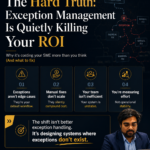

When Resolving Fast Is Not the Same as Winning
There is a meeting I think about often. An operations lead sat across from me, genuinely proud of her exception report. It was colour-coded, every owner clearly named, every closure date diligently tracked. She told me with confidence that her team resolved 94% of exceptions within 48 hours. That number was real. The effort behind it was real. And yet when I asked how many of those same exceptions had appeared the month before, she paused for a long time before quietly saying, “Most of them.” That silence is where the real story lives. Resolving fast feels like winning. It looks like control. But if the same exceptions keep returning week after week, the operation is not improving. It is simply running faster on the same treadmill. This distinction, between resolution speed and recurrence rate, is the most important mindset shift an operations leader can make to unlock genuine ROI and build a predictable, self-stabilising workflow.
Across 15 years of working with operations teams across 14 countries, I have seen this pattern repeat with striking consistency. Organisations invest in capable teams, strong platforms, and detailed process documentation. And yet the exception log remains steady, sometimes growing, quarter after quarter. The leadership team is not failing from lack of effort. They are failing because the measure of success has been calibrated to the wrong outcome. Speed of resolution is a performance metric. Reduction in recurrence is a design metric. Performance metrics reward individuals. Design metrics build systems. The organisations that achieve genuinely predictable operational efficiency understand this difference at a structural level, and they build their leadership habits, their measurement frameworks, and their team accountability models around it. Everything else flows from that foundational shift in how success is defined and how it is measured consistently over time.
The Real ROI of Operations Does Not Live in Your Exception Report
Most operations dashboards tell the same story in the same format. Exceptions logged, exceptions resolved, average resolution time, aging items. These are useful data points. But taken together, they describe a team that is managing a problem, not a team that is solving it. The real ROI of operations lives not in how efficiently your team handles exceptions but in how consistently those exceptions fail to reappear. When a recurring exception is treated as a design failure rather than a performance failure, the entire conversation changes. The question moves from who handled it to what in the process keeps producing it. That reframe changes what gets measured, what gets resourced, and what gets the deliberate attention of senior leadership. Without that reframe, even the most capable operations teams find themselves locked in a cycle they can see clearly but cannot seem to break. They are not lacking effort or talent. They are lacking a system that rewards the right outcome at the right level of the organisation.
Operationally mature leaders approach the exception log not as a daily management tool but as a diagnostic instrument. When they see a recurring exception, they do not ask how quickly it can be closed. They ask what in the current process design makes that exception possible, and they pursue that answer with the same urgency most leaders reserve for individual resolution. This is not theoretical. I have seen organisations reduce their exception volume by 40% within two quarters simply by shifting the weekly operations review from a status update to a root cause conversation. The technology did not change. The team did not change. The question being asked changed. And that question, asked consistently by leadership week after week, is what fundamentally alters how an operations team thinks about its own work and its own measure of success. It creates a culture where prevention is valued, not just speed.
Where Improvement Time Goes and Why It Never Comes Back
There is a structural irony at the heart of exception-driven operations. The teams most capable of improving the process are the ones most consumed by managing the current state of it. When every available hour is spent closing exceptions, diagnosing patterns, and escalating the most urgent items, there is no time left to redesign the conditions that keep producing those exceptions in the first place. This is not a resource problem. It is a priority problem. And it will not solve itself because the incentive structure of a reactive operation actively discourages the work of prevention. Every hour spent on process redesign is an hour not spent on exception resolution. In the short term, that trade-off feels irresponsible. In the long term, it is the only trade-off that actually works. The leaders who build self-stabilising operations do not find time for improvement. They protect it. They carve it out deliberately, treat it as non-negotiable, and defend it when the next crisis tries to reclaim it. That protection is a leadership decision, and it is one of the most consequential decisions an operations leader can make.
What I consistently observe in organisations that make this transition successfully is that leadership changes how improvement time is treated before the process changes. They do not wait until operations are stable to begin investing in stability. They create the conditions for stability by investing in it first. This means committing two to four hours per week, per team, to structured improvement work. It means protecting that time even when a high-priority exception hits. It means accepting that in the short term, some exceptions may take slightly longer to resolve so that the team can do the work that makes future exceptions less likely. This is counterintuitive in a reactive culture. But it is the only path to an operation that genuinely improves quarter over quarter rather than simply managing the same challenges with greater efficiency.
What Operationally Mature Leaders Protect That Most Leaders Do Not
The leaders who build genuinely predictable operations share a set of habits that distinguish them clearly from leaders still caught in the firefighting cycle. The most important of these habits is not a process framework or a measurement system. It is a decision about what kind of question gets asked first. When an exception surfaces, the reactive leader asks how it can be closed quickly. The mature leader asks whether this exception has appeared before. If the answer is yes, the next question is not about resolution. It is about root cause. And that question is not asked once. It is asked every time, consistently, by leadership, until the answer changes because the process has been redesigned to prevent recurrence. This consistency is what builds a culture where prevention is as visible, as valued, and as rewarded as resolution. Without that consistency from leadership, the culture always drifts back toward firefighting because firefighting is visible, immediate, and measurable in ways that prevention is not.
The second habit is precision in measurement. Operationally mature leaders track two numbers that most leaders do not. The first is exception recurrence rate, measured monthly, by category. The second is the percentage of leadership time spent on recurring versus novel exceptions. When recurring exceptions consume more than 60% of leadership attention in any given month, that is a structural signal. It means the process is not improving. It means the exception management capability of the team is strong, but the process design capability is underdeveloped. Both capabilities matter. But they are not interchangeable. An organisation that can resolve 95% of exceptions in 24 hours but sees 80% of those same exceptions return next month has a process design problem that no amount of resolution efficiency will solve. The measurement system must reflect both dimensions if the organisation is going to move toward genuinely predictable operational ROI.
The Compounding Value of a Shorter Exception Log
One of the most powerful and least visible outcomes of this mindset shift is what happens to the energy of the operations team over time. Teams that spend their days managing recurring exceptions develop a particular kind of exhaustion that goes beyond workload. It is the exhaustion of competent people applying real effort to a problem that never changes. It erodes confidence, retention, and the discretionary effort that separates a good team from an exceptional one. When an organisation begins to reduce recurring exceptions deliberately and consistently, something changes in the team that cannot be captured in a dashboard. People begin to feel that their work is actually moving something forward. The problems they solve today do not reappear next week in the same form. The improvements they make accumulate into a genuinely better operation rather than a temporarily managed one. This compounding effect on team energy is one of the most significant and sustainable sources of operational improvement available to any leadership team. It is also one of the most undervalued.
The organisations I have seen make this shift most successfully do not announce a transformation programme. They change one question in the weekly operations review. They start asking, every week without exception, how many of this week’s exceptions also appeared last week and the week before. That question, asked consistently, begins to redirect the attention of the entire team from resolution to prevention. It creates a new standard of success. It makes recurrence visible in a way it was not before. And over six to twelve months, it builds an operation that looks fundamentally different from what it was. Not because the team worked harder, but because leadership asked a better question and held the standard for long enough that the process had to change to meet it. That is what the ROI mindset shift in operations actually looks like in practice.
Building the Conditions Where Good Solutions Have Room to Work
The final insight I want to share is one that took me several years of field experience to fully appreciate. The reason most operational improvement initiatives fail is not that the solution is wrong. It is that the solution never gets enough room to stabilise before the next crisis pulls everyone back into firefighting mode. I have seen this pattern across industries and geographies. Leadership identifies the problem. A better process is designed. Early results look encouraging. Then a high-priority exception hits, improvement work pauses, and three months later the same team is dealing with the same problems, slightly more tired and slightly less convinced that real change is possible. The shift to predictable efficiency is not about finding a better solution. It is about building the conditions where a good solution actually has room to work. That means protecting improvement time. It means measuring recurrence, not just resolution. It means giving frontline insight a real channel to reach the people with authority to act on it. And above all, it means leadership staying committed through the early quiet period when results are not yet dramatic but the foundation of a genuinely better operation is being built, one avoided recurrence at a time.
Predictable operational efficiency is not a transformation programme. It is a leadership decision, made consistently, over time. The organisations that build it are not the ones that worked hardest inside the existing system. They are the ones where leadership decided that the current recurrence rate was no longer acceptable and built the structure, the measurement, and the culture to change it. That decision is available to every operations team, regardless of size, industry, or technology stack. It requires no new platform and no additional headcount. It requires a shift in what gets measured, what gets protected, and what question gets asked first when an exception appears. When you look at your operations this quarter, ask yourself honestly: is your team getting better at managing exceptions, or are they building the conditions where exceptions stop recurring? The answer to that question will tell you more about your operational future than any dashboard metric currently visible to your leadership team.
If you are navigating the shift from exception-driven operations to a genuinely predictable model and want a practical perspective on where to start, I am happy to share what has worked across the engagements I have led. Connect with me on LinkedIn or explore more frameworks at sudarshananbazhagan.com. Real operational improvement starts with one better question, asked consistently.