
The Convergence of Digital Integrity and Physical Throughput: A Strategic Mandate
In the contemporary global industrial landscape, the traditional boundary separating a corporation’s digital infrastructure from its physical output has not merely blurred , it has effectively vanished. For the seasoned Chief Operating Officer (COO), Executive Vice President (EVP), and Managing Director, the integration of core enterprise systems such as Enterprise Resource Planning (ERP), Customer Relationship Management (CRM), and Supply Chain Management (SCM) can no longer be relegated to the status of a “back-office” IT initiative. Instead, these integrations represent the central nervous system of the modern organization, dictating the speed, accuracy, and reliability of every physical action the company takes.
When these integrated systems falter, the repercussions are rarely confined to the digital realm. We are no longer dealing with simple “software glitches” or temporary IT outages; we are facing systemic failures that manifest as tangible financial hemorrhages. For a leader overseeing a multinational footprint, a single integration gap can lead to stalled production lines in Germany, bottlenecked logistics hubs in the United States, or cascading reconciliation errors that complicate quarterly earnings calls. The modern mandate for leadership is clear: operational stability is no longer a byproduct of technology, it is the result of disciplined, structural governance.
The Evolution from Connectivity to Continuity
Historically, system integration was viewed through the lens of connectivity, simply ensuring that System A could pass a data packet to System B. In today’s high-velocity markets, mere connectivity is insufficient. The priority has shifted to Continuity. Continuity implies that the flow of information is as resilient and reliable as the flow of capital or raw materials.
- The Cost of Invisible Fragility: Many organizations suffer from “hidden fragility” integrations that appear functional during normal operations but collapse under the stress of peak demand or geopolitical disruption.
- The Central Nervous System Analogy: Just as a biological nervous system coordinates muscular movement, your integration layer coordinates your global supply chain. If the signal is delayed or corrupted, the physical response will be clumsy, inefficient, and potentially catastrophic.
- Fiduciary Responsibility: Senior executives must view integration health as a core component of risk management. A failure in data synchronization is, fundamentally, a failure in corporate oversight.
Bridging the Global Execution Gap
The challenge for executives in the US and Europe is managing the “Execution Gap” the space between a strategic decision made in the boardroom and its actual implementation on the factory floor or in the distribution center. When systems are poorly integrated, this gap widens, leading to “dark data” and operational blind spots.
- Operational Transparency: Seamless integration provides the real-time visibility required to make agile decisions in a volatile market. Without it, leaders are managing by looking in the rearview mirror.
- Cross-Border Synchronization: In a globalized economy, an integration must account for varying regulatory environments (such as GDPR in the EU) and localized operational nuances without sacrificing the integrity of the global data set.
- Predictive Resilience: Modern operations require moving from reactive troubleshooting to predictive resilience. This is only possible when the integration architecture is designed to provide clean, high-fidelity data at every touchpoint.
Redefining the Leadership Perspective on Modernization
To “bulletproof” an organization, leadership must pivot their perspective. Modernization is not about chasing the latest technological trend; it is about reinforcing the foundation of the business to ensure long-term viability and scalability. This requires a transition from seeing IT as a cost center to seeing Integration Governance as a value-protection engine.
- Strategic Governance over Technical Implementation: While the “how” of integration is technical, the “why” and “what” are purely operational. Leadership must define the business rules that govern how data moves.
- Mitigating Human Intervention: Every time an integration fails, a human must intervene. This introduces manual error, slows down the cycle time, and increases the “cost per transaction.” High-level governance aims to eliminate these manual workarounds.
- Building for the 99th Percentile: Executive leadership must demand systems that are tested not for the average day, but for the most stressful day of the year.
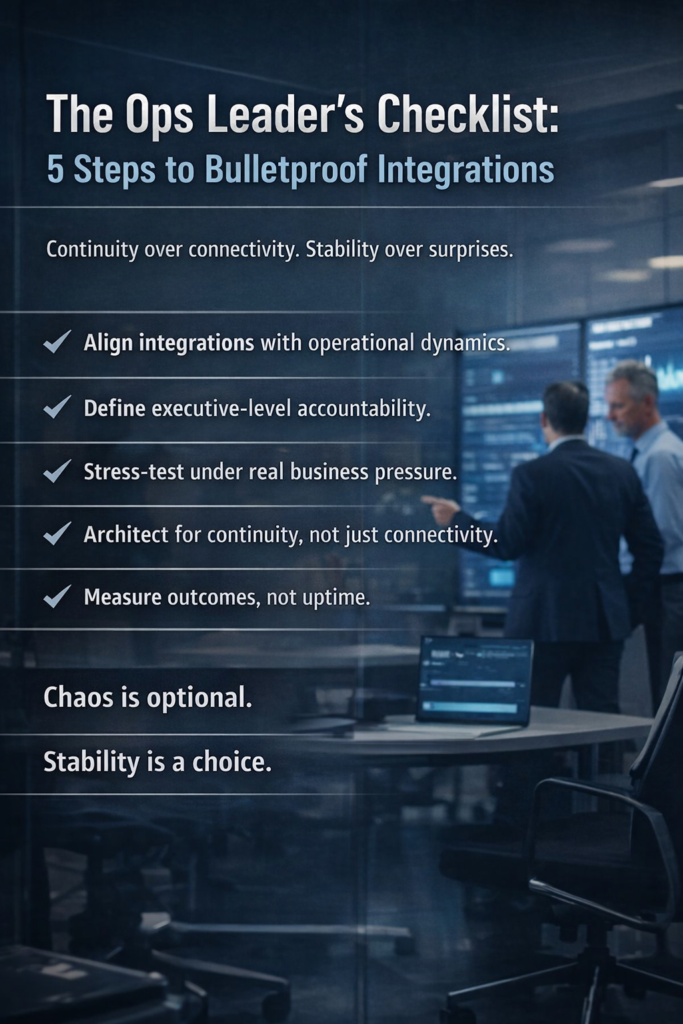
1. Synchronizing Integration Architecture with Global Operational Reality
Design strategies must transcend the idealized workflows often presented in initial project charters. True operational excellence requires that integrations be built to withstand the messy, non-linear reality of global commerce. This involves accounting for high-volume peak cycles such as the holiday surge, end-of-quarter pushes, or sudden geopolitical shifts , where system latency can translate directly into lost revenue. Senior leaders must ensure that digital bridges account for cross-border complexities, including fluctuating regulatory requirements like GDPR in Europe or evolving customs protocols in North America. A robust integration is one that acknowledges these “edge cases” not as exceptions, but as fundamental components of the daily business rhythm.
- Macro-Environmental Alignment: Map every data touchpoint against the physical movement of goods to ensure the digital twin matches the physical reality in real-time.
- Legacy Interoperability: Develop a tiered strategy for aging infrastructure, ensuring that modernization efforts do not create bottlenecks when interfacing with older, yet stable, core systems.
- Global Standardization Protocols: Implement unified data languages that allow for regional flexibility while maintaining a single, “golden” source of truth for global reporting and fiscal audits.
- Peak Load Resilience: Architect systems specifically for the 95th percentile of traffic rather than average daily volumes to prevent collapse during market volatility.
2. Implementing Executive Accountability and Ownership Frameworks
A recurring theme in integration failures is the “governance vacuum,” where technical teams manage the code but no one manages the business outcome. For an integration to be truly bulletproof, accountability must reside at the executive level. This means moving away from a “shared responsibility” model, which frequently results in finger-pointing during a crisis, toward a model of defined Business Process Ownership (BPO). When a CXO takes ownership of an integration’s health, the focus shifts from “is the API calling?” to “is the customer receiving their order on time?” This shift ensures that technical roadmaps are always subservient to strategic business objectives and shareholder value.
- Designated Executive Sponsorship: Assign a specific C-suite member to every high-impact integration to oversee both the implementation phase and long-term performance.
- Cross-Functional Steering Committees: Establish a governance body that bridges the gap between Operations, Finance, and IT to ensure holistic oversight of data flow.
- Defined Decision Rights: Clearly establish who has the authority to “stop the line” if an integration failure threatens the integrity of the broader business ecosystem.
- Fiduciary Oversight: Integrate system health reports into quarterly business reviews, treating data integrity with the same gravity as cash flow.
3. Stress-Testing Resilience Under High-Fidelity Conditions
The traditional “sandbox” environment is a controlled laboratory that rarely reflects the chaos of a live production environment. For senior leadership, the mandate must be rigorous validation under simulated stress. This involves “Chaos Engineering” for the supply chain, intentionally simulating upstream data failures, sudden spikes in transaction volume, and total outages of third-party APIs. By understanding the “breaking point” of an integration before it goes live, an organization can move from a reactive posture to one of proactive resilience. The goal is to validate not just the success path, but the Recovery Time Objectives (RTO) that keep the business solvent during a disruption.
- Volume and Velocity Simulation: Mandate testing at 150% of projected peak capacity to ensure the architecture can handle unexpected market surges.
- Upstream Failure Drills: Conduct regular exercises to observe how systems behave when a secondary partner (like a regional carrier or payment gateway) goes offline.
- Post-Deployment Performance Audits: Shift from a “one-and-done” testing mindset to a continuous validation cycle that monitors for performance degradation over time.
- End-to-End Latency Mapping: Identify the cumulative delay across multiple integration hops to ensure the total response time meets customer expectations.
4. Engineering Structural Redundancy and Failover Protocols
In a high-stakes operational environment, redundancy is not a luxury; it is an insurance policy against catastrophic failure. Structural resilience must be baked into the design phase, incorporating automated failovers and “graceful degradation” protocols. This means that if a primary integration path fails, the system should automatically pivot to a secondary route or, at the very least, preserve data integrity in an offline state until connectivity is restored. Leaders must view these technical safeguards as essential continuity assets that protect the brand’s reputation and the company’s bottom line from the inherent fragility of modern interconnected networks.
- Intelligent Failover Routing: Invest in smart logic that detects latency and switches to backup pathways without requiring manual intervention or downtime.
- Asynchronous Data Buffering: Implement robust queuing mechanisms that prevent data loss during periods of system downtime, ensuring all transactions are processed once services resume.
- Isolation of Failure Points: Utilize software “circuit breakers” to isolate failing components, preventing a single point of failure from cascading through the entire enterprise.
- Disaster Recovery Synchronization: Ensure that failover systems are updated in real-time so that switching to a backup does not result in stale or corrupted data sets.
5. Transitioning from System Uptime to Business Impact Metrics
The most dangerous metric in operations is the “Green Dashboard” that masks a failing business process. While IT teams may report 99.9% system uptime, the operations floor may be struggling with data mismatches that halt fulfillment. Executive leadership must demand a new class of Key Performance Indicators (KPIs) that measure the flow of value, not just the flow of packets. Metrics should focus on transaction accuracy, the speed of cross-system reconciliation, and the reduction of manual workarounds. By measuring what truly matters the stability of the downstream workflow leaders can ensure that their technology investments are delivering tangible operational dividends.
- Transaction Throughput Accuracy: Measure the percentage of orders or units that flow from inception to completion without requiring manual human intervention.
- Cycle Time Variability: Track the consistency of data movement across the integration landscape, identifying bottlenecks that slow down decision-making.
- Cost of Downtime Quantification: Focus on the “Cost of Failure” as a KPI, quantifying the financial impact of every hour of system-related operational delay.
- Data Fidelity Scores: Monitor the delta between different systems to ensure that inventory levels and financial records remain perfectly synchronized.
6. Managing the Human Element in Technical Transitions
Operational stability is as much about people as it is about protocols. For the experienced executive, modernization involves managing the “change curve” within the workforce. When systems are integrated, roles often shift from data entry to exception management. Leadership must ensure that the teams on the ground are equipped to handle the new digital reality. This involves upskilling staff to interpret integration errors and empowering them to act when the system flags a discrepancy. A bulletproof integration requires a workforce that trusts the data they are seeing and knows how to intervene when the automation hits a limit.
- Upskilling for Exception Management: Transition staff from manual processing to oversight roles, focusing on resolving the complex errors that automation cannot solve.
- Transparent Communication Channels: Ensure that frontline managers have a direct line to the technical team to report real-world friction before it scales.
- Cultural Alignment on Data Integrity: Foster an organizational culture where data accuracy is viewed as a shared responsibility across all departments.
- Feedback Loops for Continuous Improvement: Use frontline insights to refine integration logic, ensuring the technology evolves alongside the operational needs.
7. Strategic Vendor and Partner Governance: Extending the Enterprise Perimeter
In the modern hyper-connected economy, a company’s operational boundary no longer stops at its own firewall. Global enterprises rely on an intricate web of third-party SaaS providers, cloud infrastructure, and external logistics partners (3PLs) to maintain their competitive edge. However, this reliance introduces a significant governance challenge: a failure in a partner’s integration is, for all intents and purposes, a failure of your own system. For the executive in the US or Europe, vendor governance must evolve from a procurement exercise into a core operational discipline. Senior leadership must apply the same rigorous standards to external integrations as they do to internal mission-critical systems, ensuring that every link in the digital supply chain is as resilient as the core enterprise.
- Third-Party Resilience Mapping: Leadership should maintain a comprehensive map of all external dependencies, identifying “critical nodes” where multiple internal processes rely on a single third-party provider. By diversifying these nodes or building local redundancies, organizations can insulate themselves from the cascading effects of a major SaaS outage. This proactive mapping allows executives to visualize the “hidden” risks within their partner ecosystem and allocate resources to the areas of highest vulnerability.
- Performance-Based Service Level Agreements (SLAs): Modern SLAs must move beyond simple “uptime” percentages, which often mask significant operational friction. Executive-grade contracts should include specific clauses for data fidelity, payload latency, and error-resolution windows. If a logistics partner’s API is active but returning corrupted manifest data, they are not meeting the operational requirement. Governance frameworks should include clear financial penalties or service credits linked directly to these quality metrics to ensure vendor interests remain aligned with your operational stability.
- Continuous Security and Compliance Audits: In an era of escalating cyber threats and stringent regulatory frameworks like Europe’s GDPR or the US’s SOC2 standards, a partner’s security posture is a direct reflection of your own risk profile. Governance must extend past the initial “onboarding” phase to include recurring, automated security audits and vulnerability assessments. This ensures that the data pipes connecting your enterprise to third parties do not become conduits for ransomware or unauthorized data exfiltration, protecting both your intellectual property and your brand reputation.
- Interoperability and Exit Strategies: Financial and operational stewardship requires avoiding “vendor lock-in,” which can create a single point of failure for the entire organization. Strategic governance involves ensuring that all third-party integrations utilize standardized, open protocols rather than proprietary “black box” systems. Furthermore, leadership should mandate the development of “exit architectures” pre-defined plans to migrate critical data and workflows to an alternative provider if a primary vendor’s performance degrades or their fiscal stability falters.
- Collaborative Incident Response Protocols: When a cross-system failure occurs, the “mean time to recovery” (MTTR) is often delayed by jurisdictional disputes between internal IT teams and external vendor support. Bulletproof governance establishes “Joint Command” protocols pre-defined communication channels and shared troubleshooting dashboards that allow for real-time collaboration during a crisis. By breaking down the silos between your operations team and your vendor’s engineering team, you ensure that resolution is prioritized over finger-pointing.
8. Financial Stewardship and the ROI of Resilience
In the high-stakes environment of global operations, the ultimate objective of “bulletproof” integrations is the uncompromising protection of the firm’s capital. For the Chief Financial Officer (CFO) and Chief Operating Officer (COO), every integration project must be viewed strictly through the lens of Return on Investment (ROI) and Total Cost of Ownership (TCO). True financial stewardship recognizes that proactive governance is not a discretionary expense; it is a strategic investment in the long-term viability and scalability of the enterprise. By investing in resilience during the design phase, organizations effectively avoid the astronomical “technical debt” and emergency remediation costs that inevitably follow a systemic integration failure.
- Total Cost of Ownership (TCO) Analysis: Move beyond initial implementation fees to factor in the long-term costs of maintenance, API versioning, and security patches. A sophisticated TCO identifies the “fragility tax” the hidden cost of outages and manual workarounds and seeks to eliminate it through better structural design.
- Strategic Technical Debt Reduction: Allocate a dedicated portion of the operational budget to refining and simplifying existing integrations. Reducing technical debt is akin to managing a corporate bond; it prevents the “interest” paid in system friction and ensures the organization remains agile enough to pivot in volatile markets.
- Capital Allocation for Continuity: Treat redundancy and failover systems as essential capital investments rather than redundant “waste.” Investing in high-availability architecture safeguards the organization’s revenue-generating assets and acts as a hedge against catastrophic operational downtime.
- Value Realization Tracking: Establish a rigorous audit framework to periodically verify that integrations are delivering the business value promised in the original project charter. This ensures that technology continues to serve the bottom line and identifies underperforming assets before they become liabilities.
- Risk-Adjusted ROI: Evaluate all modernization efforts by adjusting projected returns against the “Cost of Failure.” In the US and European markets, where market share is hard-won, the financial value of an integration is defined as much by its stability as its speed.