
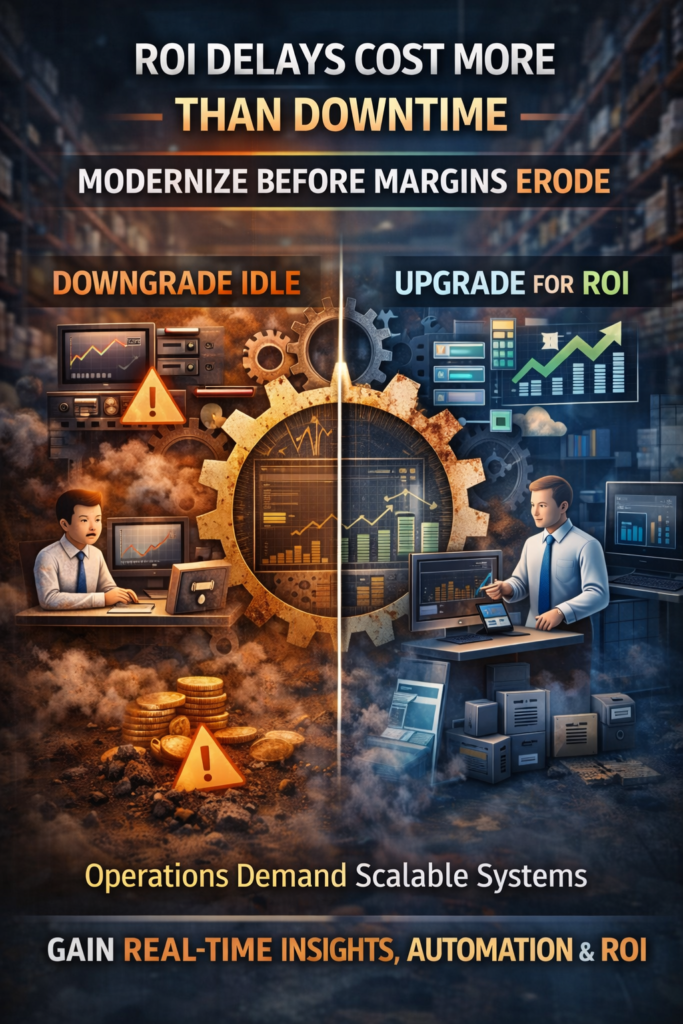
For many mid-market manufacturers and multi-site retailers, the ERP and POS systems currently in place are technically functioning as designed. Orders are processed accurately, invoices are generated on schedule, inventory is moving through warehouses and storefronts, and production lines continue to operate without obvious system failure. From the surface, stability appears intact. However, in organizations generating between $10 million and $500 million in annual revenue, the real constraint is rarely visible breakdown. It is accumulated operational friction. Manual reconciliations between ERP and POS systems, spreadsheet-based adjustments to MRP outputs, delayed synchronization between WMS and inventory records, and fragmented BI reporting workflows gradually introduce decision latency. Each workaround consumes time from finance, operations, and IT teams, quietly increasing labor costs and reducing confidence in data accuracy. Over time, these incremental inefficiencies compound into margin compression, working capital inefficiency, slower forecasting cycles, and executive fatigue caused by debating numbers instead of acting on them.
Modernization as a Strategic Control Initiative
When viewed through an operational lens rather than a technical one, ERP and POS modernization becomes less about replacing software and more about strengthening business control systems. For manufacturing and retail executives in the United States and Europe, modernization should be understood as a structured initiative to reduce downtime risk, improve data integrity across ERP, WMS, MES, and POS environments, and provide leadership with reliable, real-time visibility into performance metrics such as inventory accuracy, OEE, gross margin, and cash flow exposure. A disciplined modernization strategy does not disrupt daily operations; it stabilizes them by removing hidden friction points, aligning system governance with financial accountability, and ensuring that operational data supports faster, more confident capital allocation decisions.
The Operational Reality Facing Mid-Market Executives
Manufacturing and retail leaders in the United States and Europe are operating in an environment defined by volatility. Supply chain variability, tariff exposure, labor shortages, multi-state tax complexity, GDPR and CCPA compliance requirements, and increasing customer expectations have elevated the importance of system reliability.
In this context, ERP, POS, WMS, MES, EDI integrations, and BI dashboards are not support tools. They are the control framework of the business.
When these systems are loosely integrated or heavily dependent on manual intervention, several predictable patterns emerge:
- Inventory cycle counting uncovers recurring discrepancies between physical and ERP records.
- MRP recommendations are frequently overridden because planners lack confidence in system data.
- POS deposits require manual reconciliation against ERP financial postings.
- OEE reporting from MES lags production by 24–48 hours.
- Forecasting models rely on exported spreadsheets rather than integrated data streams.
None of these issues typically trigger a crisis. Instead, they slow decision-making and increase hidden labor costs.
Operational stability without scalability becomes a constraint.
Downtime Risk Is Often Data Risk
Many executives evaluate ERP and POS modernization primarily through the lens of implementation downtime. The concern is understandable. Revenue loss during transition is unacceptable.
However, in most mid-market environments, the greater exposure comes from ongoing data inaccuracy rather than system outages. When production schedules are misaligned with real demand, when store-level inventory is unreliable, or when financial reporting requires extensive manual adjustment, the business experiences micro-disruptions daily.
These micro-disruptions include:
- Expedited freight due to inaccurate inventory positions.
- Overtime labor caused by planning misalignment.
- Margin erosion from incorrect promotional pricing across POS systems.
- Delayed executive decisions due to reporting uncertainty.
Modernization reduces these risks when structured around integration accuracy and governance discipline rather than feature expansion.
Reframing Modernization as Risk Reduction
The most effective executive teams do not pursue ERP modernization for innovation. They pursue it to reduce operational exposure.
A practical decision rule is straightforward:
If the annual cost of inefficiency, manual reconciliation, data inaccuracy, and unplanned downtime exceeds the controlled cost of integration and system improvement, modernization becomes financially rational.
This shift in perspective moves the discussion away from “upgrading software” and toward strengthening operational resilience.
In mid-market manufacturing and retail organizations, modernization typically delivers value in three areas:
- Improved data integrity across ERP, POS, WMS, and MES environments.
- Reduced reconciliation time within finance and operations.
- Greater forecasting accuracy for working capital and production planning.
These improvements compound over time.
A Practical Framework for Controlled ERP and POS Modernization
Effective modernization programs follow a structured, phased approach that protects continuity while improving performance.
1. Establish a Measurable Operational Baseline
Before altering systems, quantify existing friction. Executives should require clarity on:
- Hours spent monthly on manual ERP and POS reconciliation.
- Frequency of inventory adjustments discovered through cycle counting.
- Downtime hours attributable to planning or data errors.
- Financial close duration and number of manual journal entries.
- Percentage of MRP overrides due to data distrust.
One mid-market manufacturer reduced monthly close time by 25 percent within six months after integrating shop floor MES data directly into ERP, eliminating redundant manual entries.
Measurement creates alignment and prevents assumptions from driving investment.
2. Prioritize Integration Before Replacement
Full rip-and-replace ERP programs are rarely required in the early stages. In many cases, the highest ROI comes from strengthening integration layers and data synchronization.
Examples include:
- Real-time POS to ERP financial posting.
- API-based synchronization between ERP and WMS to reduce inventory drift.
- Direct MES data feeds into OEE dashboards to eliminate reporting delays.
- Automated EDI reconciliation with suppliers to reduce manual oversight.
These targeted improvements frequently produce 10–30 percent efficiency gains without disrupting core operations.
This approach does not solve every architectural limitation. It does, however, stabilize performance and reduce risk before larger structural changes are considered.
3. Execute Phased Rollouts with Parallel Validation
Downtime risk is minimized through controlled sequencing and disciplined testing.
Best practices include:
- Running legacy and new modules in parallel during initial transition phases.
- Performing staged data migrations with reconciliation checkpoints.
- Scheduling POS cutovers during historically low transaction periods.
- Maintaining rollback plans during go-live windows.
In well-governed modernization programs, revenue disruption is not an acceptable tradeoff. Structured validation preserves continuity while building long-term reliability.
4. Embed Governance, Security, and Data Ownership
Modern ERP and POS environments introduce automation and broader system access. Governance must evolve accordingly.
Critical safeguards include:
- Clearly defined data ownership across finance, operations, and IT.
- Role-based access controls within ERP and POS systems.
- Multi-factor authentication and audit logging.
- Segmented network architecture for manufacturing environments with SCADA or MES integration.
- Vendor risk assessments for cloud-hosted platforms.
Security is not merely an IT responsibility. It is an executive-level risk management function.
A Conservative ROI Model for Downtime and Inefficiency
Consider a mid-market manufacturing example grounded in realistic numbers:
- Average production downtime cost: $4,500 per hour.
- Downtime attributable to planning inaccuracies or system latency: 6 hours per month.
- Annual exposure: $4,500 × 6 × 12 = $324,000.
If improved ERP integration and MRP parameter governance reduce downtime by 30 percent, annual savings reach approximately $97,200.
If the integration investment totals $120,000, the payback period approaches 15 months.
This model excludes secondary financial benefits such as:
- Reduced expediting fees.
- Lower overtime labor.
- Improved customer fulfillment performance.
- Reduced inventory carrying costs.
In retail environments, similar calculations apply to checkout inefficiency, inventory shrinkage, and reconciliation discrepancies between POS and ERP.
Conservative math frequently justifies disciplined action.
Addressing Tradeoffs Directly
No ERP or POS modernization strategy is free of tradeoffs. Experienced executives understand that clarity, not optimism, drives successful execution.
Speed must be balanced against control. Rapid deployment compresses testing and training windows. Excessive caution prolongs inefficiencies that impact margin and decision speed.
Centralizing ERP governance across multi-site operations strengthens consistency and financial oversight. However, it may initially limit perceived autonomy among plant managers or store leaders.
Automation reduces manual workload, improves inventory accuracy, and enhances forecasting precision. Yet experienced staff may feel a reduction in hands-on oversight during transition.
These dynamics should be addressed explicitly through structured communication, training, and defined accountability models. Modernization improves performance when governance structures mature alongside system capability.
What ERP and POS Modernization Does Not Solve
It is important to maintain realistic expectations. Modernization will not:
- Replace disciplined inventory cycle counting practices.
- Correct weak supplier performance management.
- Eliminate the need for accurate demand forecasting discipline.
- Compensate for unclear executive decision rights.
Systems enhance operational rigor. They do not substitute for it.
Before and After: A Practical Scenario
Before structured ERP and POS integration:
- Inventory accuracy at 92 percent.
- Monthly financial close taking 12 business days.
- OEE visibility delayed by 48 hours.
- Manual exports required for BI dashboard updates.
- Weekly POS reconciliation discrepancies requiring finance intervention.
After phased integration and governance refinement:
- Inventory accuracy improved to 97 percent within nine months.
- Financial close reduced to 8 business days.
- OEE dashboards updated hourly.
- BI reporting automated with validated data feeds.
- POS reconciliation automated daily.
Operations continued throughout the transition without revenue interruption. The improvement resulted from structured sequencing, executive ownership, and disciplined validation.
The Strategic Impact on Leadership Decision-Making
When ERP, POS, WMS, MES, and forecasting systems operate with synchronized data integrity, executive conversations shift from questioning numbers to evaluating strategy. Working capital allocation becomes more precise, production capacity planning aligns more closely with real demand, and store-level profitability analysis strengthens pricing and promotion decisions. The cumulative effect is not merely operational efficiency, but leadership confidence grounded in reliable, unified data.