
Why Scaling Engineering Headcount Without Technical Direction Compounds the Wrong Outcome Faster
I once watched a team double in size and ship in exactly the same wrong direction, only faster. It was not a failure of talent. Every engineer on that team was capable, several were genuinely excellent, and the sprint velocity numbers looked healthy on every dashboard leadership reviewed. What nobody measured was whether the direction itself was still correct, and by the time anyone asked, two quarters of committed engineering hours had reinforced a roadmap nobody had actually validated in months.
This is one of the more counterintuitive lessons from 15 years of building and scaling cross-geography technology teams. More engineers does not create more progress by default. It creates more commitment to whatever direction was already set, correct or not, and the larger the team, the more expensive that commitment becomes to reverse.
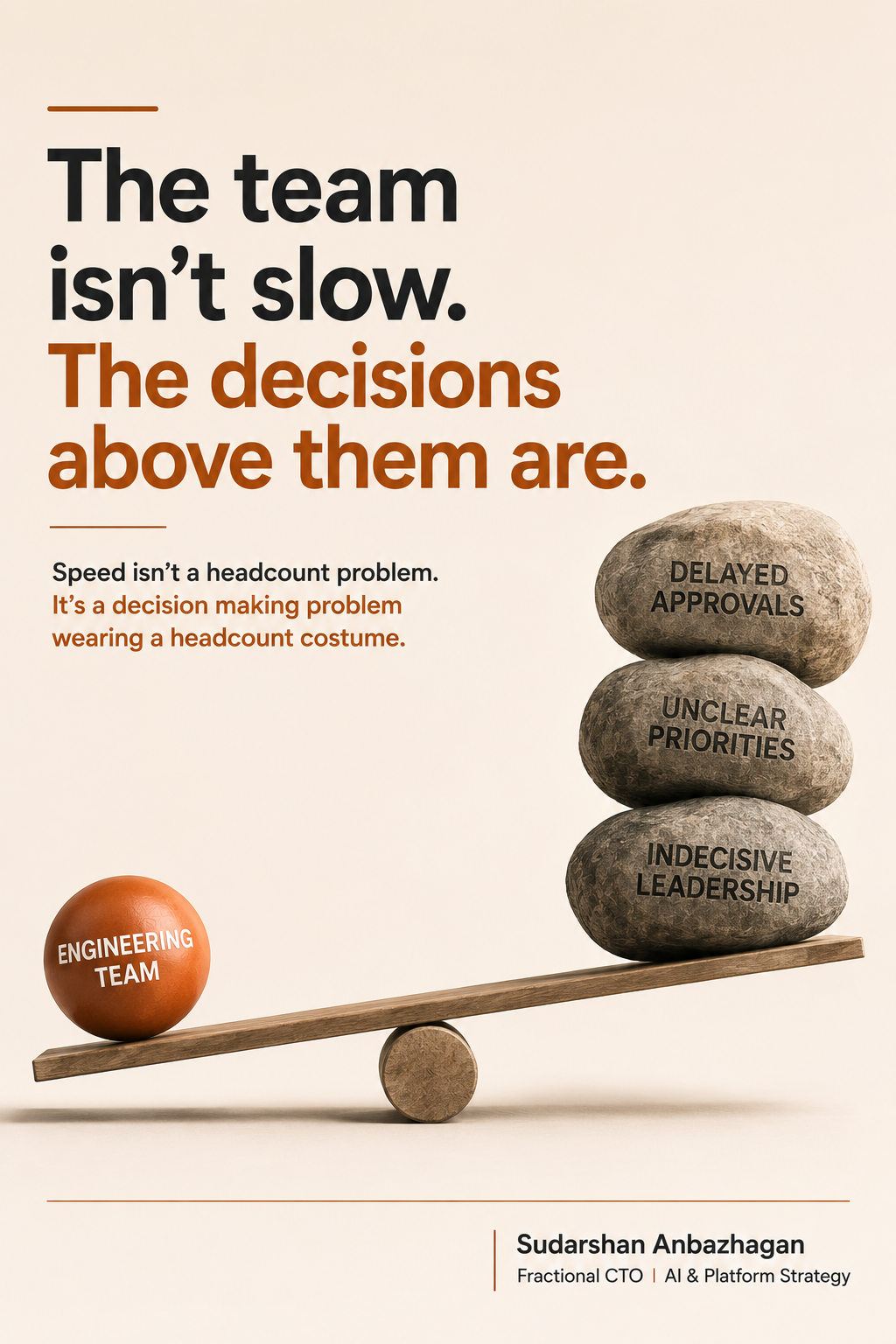
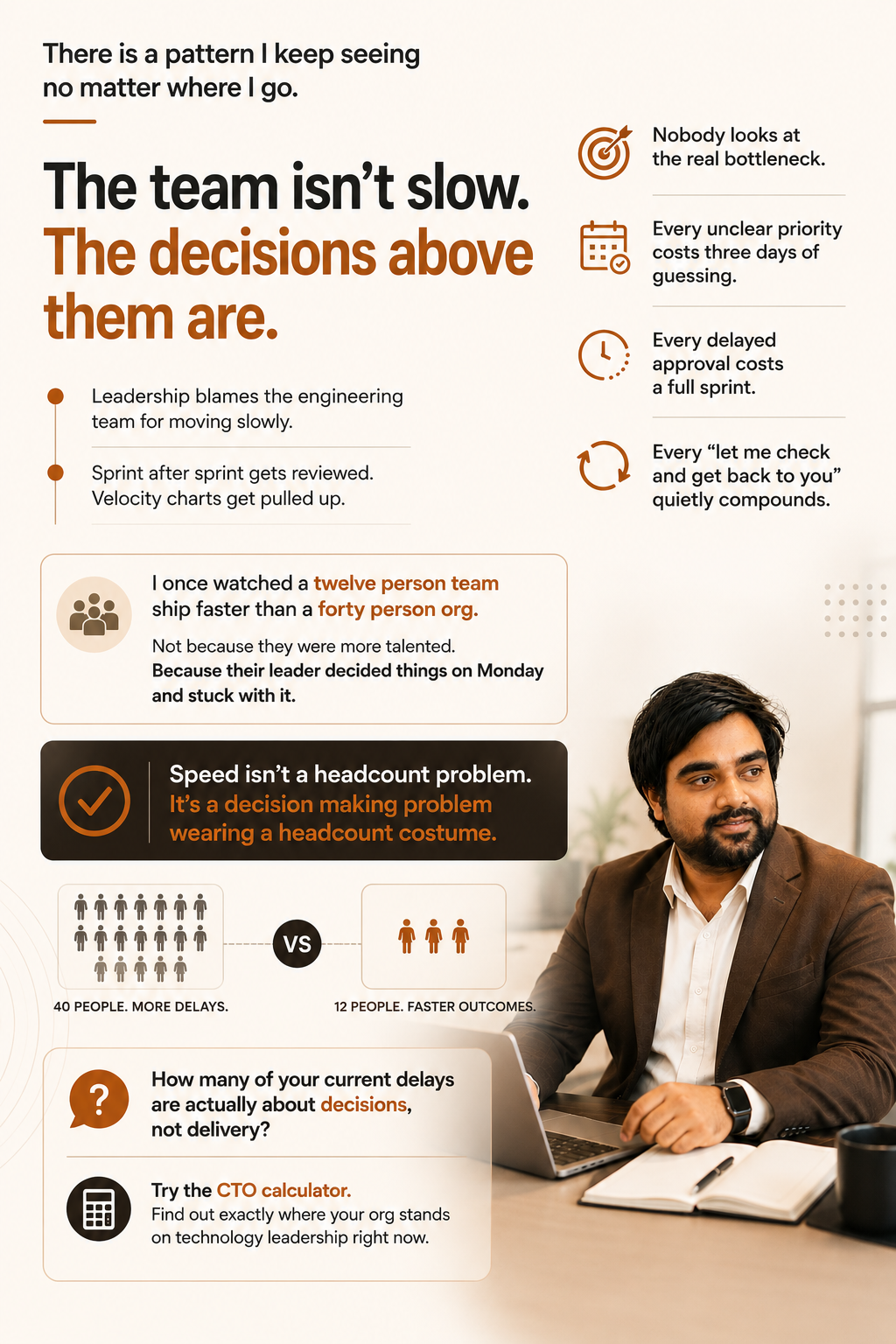
I bring this up because it is one of the most common patterns I see in growing companies preparing to hire their way out of a delivery problem. The instinct is understandable. The team feels stretched, the backlog feels endless, and headcount feels like the obvious lever. But headcount only compounds a decision that was already right. On a decision that was already wrong, it compounds the mistake at exactly the same rate.
The Team That Taught Me This the Hard Way
The engineering team I mentioned earlier had a roadmap that made sense eight months earlier, when the company had a different customer base and a narrower product surface. Nobody had revisited it since. The team kept executing against it faithfully because that is what well-run engineering teams do, they execute against the plan they were given.
What they actually needed was not more hands on the plan. It was one person willing to stop mid-sprint and ask whether the direction still made sense given how much the business had changed underneath it. Nobody wanted to ask that question mid-quarter. It felt like it would slow things down, disrupt commitments already made to stakeholders, and create the appearance of instability at a moment the company was trying to project confidence to investors.
Asking the question would have cost the team two weeks of visible slowdown. Not asking it cost them two full quarters of engineering output pointed in a direction the market had already moved away from, a cost that never appeared on any sprint velocity chart because velocity was never the problem.
Why This Is a Leadership Gap Dressed as a Skills Gap
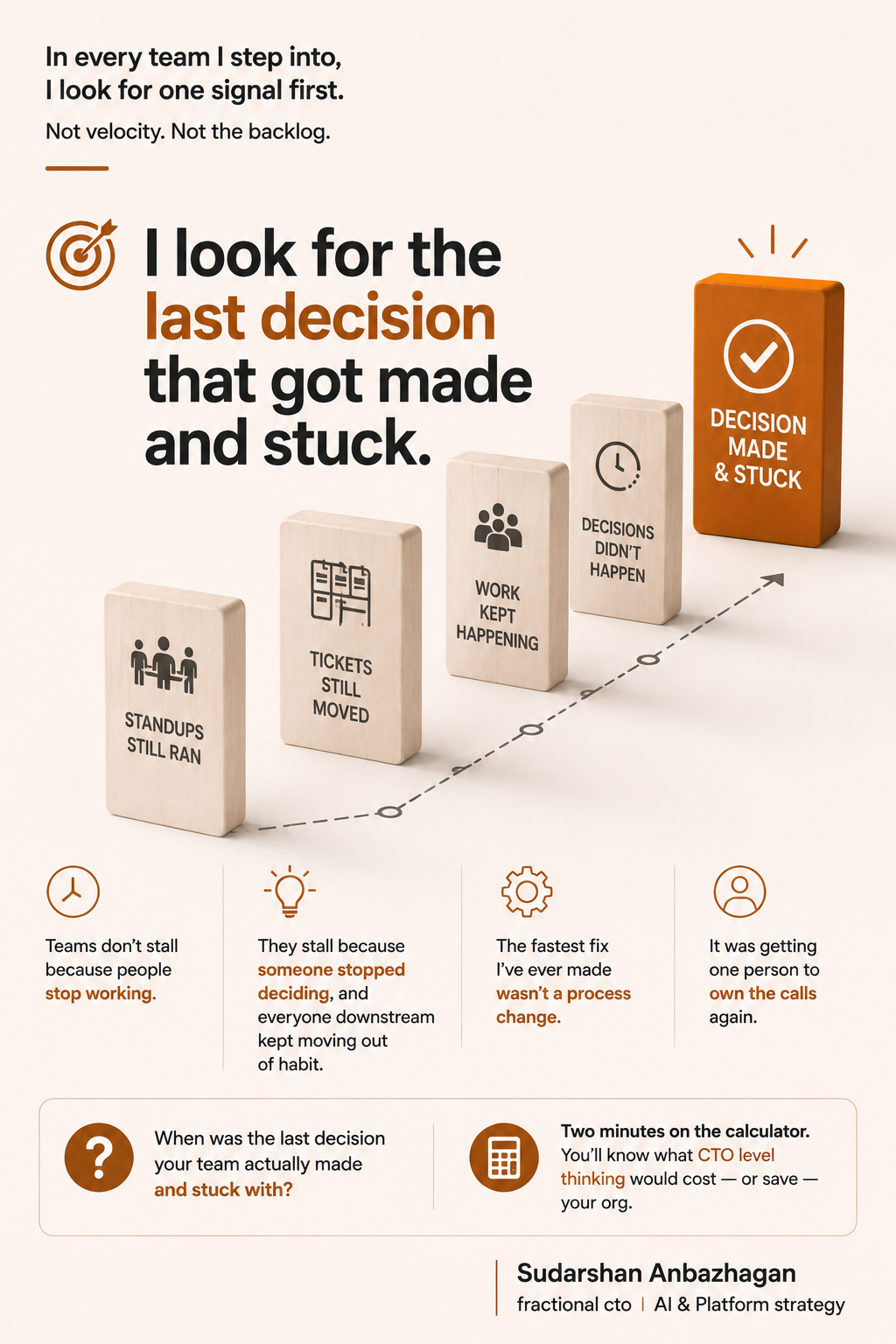
In every engagement across our 500+ project history, this pattern shows up in almost identical form. Leadership diagnoses a delivery problem as a capacity problem, because capacity is the easiest thing to see and the easiest thing to buy. Direction problems are much harder to diagnose from a status report, because the team still looks busy, tickets still close, and demos still happen on schedule.
The uncomfortable truth is that a team executing confidently in the wrong direction generates more reassuring metrics than a team that has paused to ask hard questions. Standup looks calm. The backlog burns down. And the actual business risk sits completely invisible until a competitor ships the thing your team should have pivoted toward two quarters earlier.
The Direction Check I Run Before Any Hiring Decision
Before recommending a single new hire to any client, I run a short sequence that takes less time than most companies expect, and it has saved several clients from scaling into a mistake at significant cost.
- Confirm the roadmap was validated against current customer behaviour within the last quarter, not simply carried forward from the last planning cycle.
- Identify one senior person, explicitly empowered, whose job includes pausing execution to re-validate direction, separate from anyone accountable for hitting the current sprint’s velocity target.
- Compare the cost of two weeks of deliberate slowdown against the cost of two quarters of confident execution in a direction that may no longer be correct.
- Only after that comparison is honest, decide whether the actual constraint is headcount or clarity.
Headcount Versus Clarity: A Simple Comparison
| Scenario | Adding Headcount | Fixing Direction First |
|---|---|---|
| Roadmap is correct | Accelerates good outcomes | Confirms and then accelerates safely |
| Roadmap is stale | Compounds the wrong outcome faster | Prevents wasted engineering quarters |
| Cost of being wrong | Rises with every new hire committed to it | Contained to the review cycle, low cost |
| Visibility of the problem | Hidden behind healthy sprint metrics | Surfaced explicitly before scaling |
Most leaders who have run this calculation are surprised by where the real cost sits.
→ Calculate Your Fractional CTO ROI
→ Read the Fractional CTO Guide
Where a Fractional CTO Fits Into This Decision
This is precisely the gap a Fractional CTO is built to close, not by writing more code or managing more sprints, but by holding the authority to pause execution and ask the direction question without it looking like a personal failure of the team currently doing the work. That authority is structural, not personal, and it is the piece most growing companies are missing when they reach for a hiring plan as the first response to delivery pressure.
In our engineering reviews across SuperBotics’ 500+ successful deployments spanning 14+ countries, the companies that avoid this trap are not the ones with the most disciplined engineers. They are the ones with someone accountable for the direction question who is structurally separate from anyone accountable for this quarter’s velocity number. Those two accountabilities conflict by design, and asking one person to hold both is asking them to mark their own homework.
The Real Question Before Your Next Hiring Round
More engineers compounds a good decision fast. On a bad one, it compounds the mistake just as fast, and the team rarely notices until the compounding has already run for several quarters. Before your next hiring round, the question worth asking is not how many people the backlog needs. It is whether anyone has actually confirmed the direction recently, or simply confirmed the headcount request.
That single distinction, asked honestly before the requisition goes out, is usually worth more than the hire itself.
Two minutes on the calculator. You’ll know what CTO-level thinking would cost — or save — your org.
→ Calculate Your Fractional CTO ROI
→ Read the Fractional CTO Guide
For a related look at how unclear ownership slows delivery even with a full team in place, see our checklist on technology governance health.