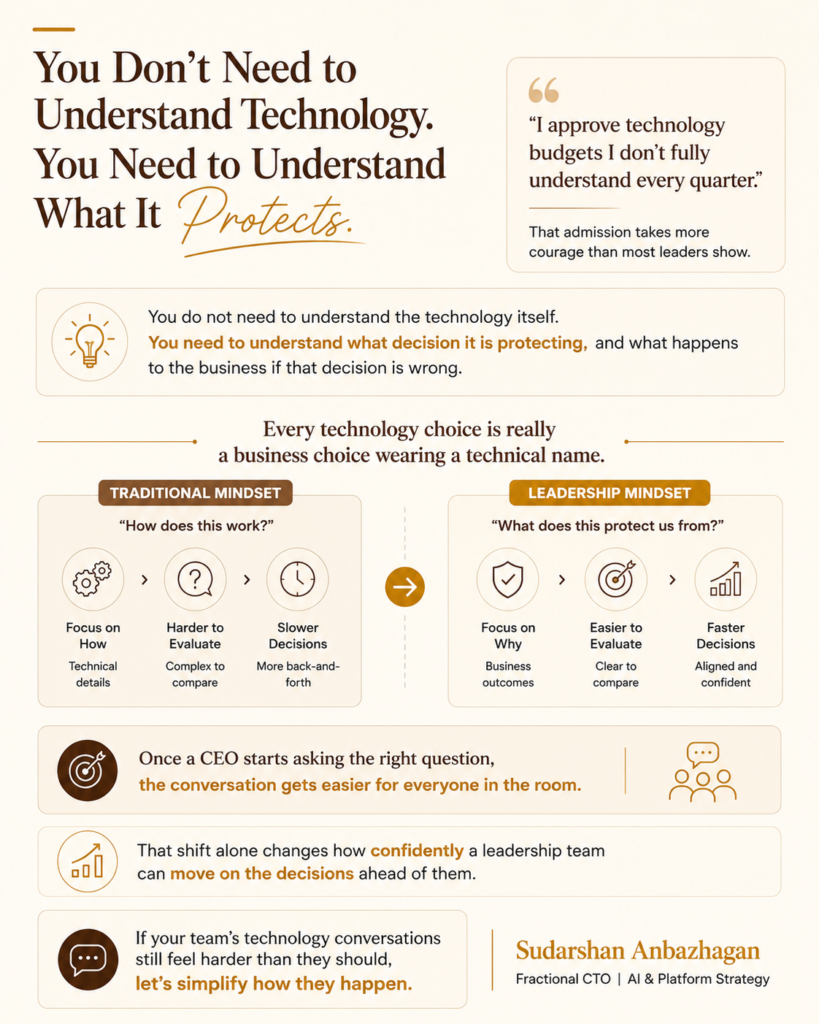

A CEO I worked with recently admitted something during our first strategy session that took more courage than most leaders show in that setting. He told me he approves technology budgets he does not fully understand every single quarter. That admission is far more common than boardrooms tend to acknowledge, and it points to a real gap in how technology decisions get evaluated at the executive level.
The good news, which surprises most non-technical CEOs when I explain it, is that they do not actually need to understand the technology itself in order to evaluate the decision well. What they need to understand is what decision the technology is protecting, and what happens to the business if that particular decision turns out to be wrong. Every technology choice is, underneath its technical vocabulary, a business choice wearing an unfamiliar name.
Reframing Technology Decisions as Business Decisions
Once a CEO starts asking what a given technology choice protects the business from, rather than how the underlying mechanism actually works, the entire conversation becomes easier for everyone in the room, including the technical team presenting the recommendation. This single reframe changes how confidently a leadership team can move on the decisions ahead of them, because it shifts the evaluation criteria from something the CEO cannot assess to something they are already equipped to assess.
Consider a decision about which cloud infrastructure provider to standardize on. The technical details of that decision, involving service level agreements, regional availability zones, and API compatibility, are genuinely difficult for a non-technical executive to evaluate on their own terms. But the business question underneath that technical decision is entirely accessible. What happens to the business if this provider has an outage during a critical sales period. What does switching providers cost us in eighteen months if this choice turns out to be wrong. Those are business questions with technical origins, and any experienced executive already knows how to reason through them.
The Vocabulary Trap
Part of what makes technology decisions feel inaccessible to non-technical leaders is simply vocabulary. Technical teams, often without intending to, present recommendations using language that assumes a level of familiarity the room does not actually have. This is rarely deliberate obfuscation. It is usually just the natural way technical specialists communicate with each other, applied without translation to an audience that needs a different framing entirely.
The fix here belongs partly to the technical team and partly to the executive asking the questions. A well-run technology conversation translates every recommendation into its underlying business consequence before it reaches a vote. A well-prepared CEO asks for that translation directly, rather than nodding along to a recommendation they have not actually evaluated on terms they understand.
Building the Habit of Asking What a Decision Protects
I encourage every non-technical executive I work with to adopt one standing question for every technology decision that reaches their desk. What does this protect us from, and what does it cost us if we are wrong. Asked consistently, this question does something valuable beyond just improving any single decision. It signals to the technical team that leadership expects every recommendation to come pre-translated into business terms, which changes how those recommendations get prepared in the first place.
Every technology choice is really a business choice wearing a technical name.
Over time, this shifts the entire culture of how technology decisions move through an organization. Technical teams stop presenting decisions as purely technical matters requiring specialist approval, and start presenting them as business tradeoffs that happen to have a technical implementation. That shift alone tends to surface disagreements earlier, when they are cheap to resolve, rather than later, when a decision has already been implemented and reversing it carries real cost.
What This Looks Like in Practice
In one engagement, a CEO’s team was debating whether to migrate a core system to a new platform, a decision framed entirely in technical terms around performance benchmarks and integration complexity. Once we reframed the conversation around what the migration protected the business from, namely a growing risk of downtime during the company’s busiest sales season, and what it cost if delayed another year, namely a compounding maintenance burden that was already consuming a disproportionate share of engineering time, the decision became straightforward. The technical debate had been genuinely difficult. The business tradeoff, once isolated, was not.
Why This Matters More as Companies Scale
The stakes of getting this reframe right increase as a company grows, because the volume of technology decisions reaching leadership grows with it, and each individual decision becomes harder to unwind once systems and teams have been built around it. A non-technical CEO who has not developed the habit of asking what a decision protects will find themselves approving an increasing number of choices purely on trust, which is precisely the pattern that eventually produces the kind of technical debt that surfaces as a crisis rather than a manageable, ongoing tradeoff.
If your team’s technology conversations still feel harder than they should, the fix is rarely a crash course in the underlying technology. It is usually a change in the question being asked. Once a leadership team gets comfortable asking what a decision protects rather than how it works, the conversations that used to require a translator start moving at the pace every other business decision already moves at.