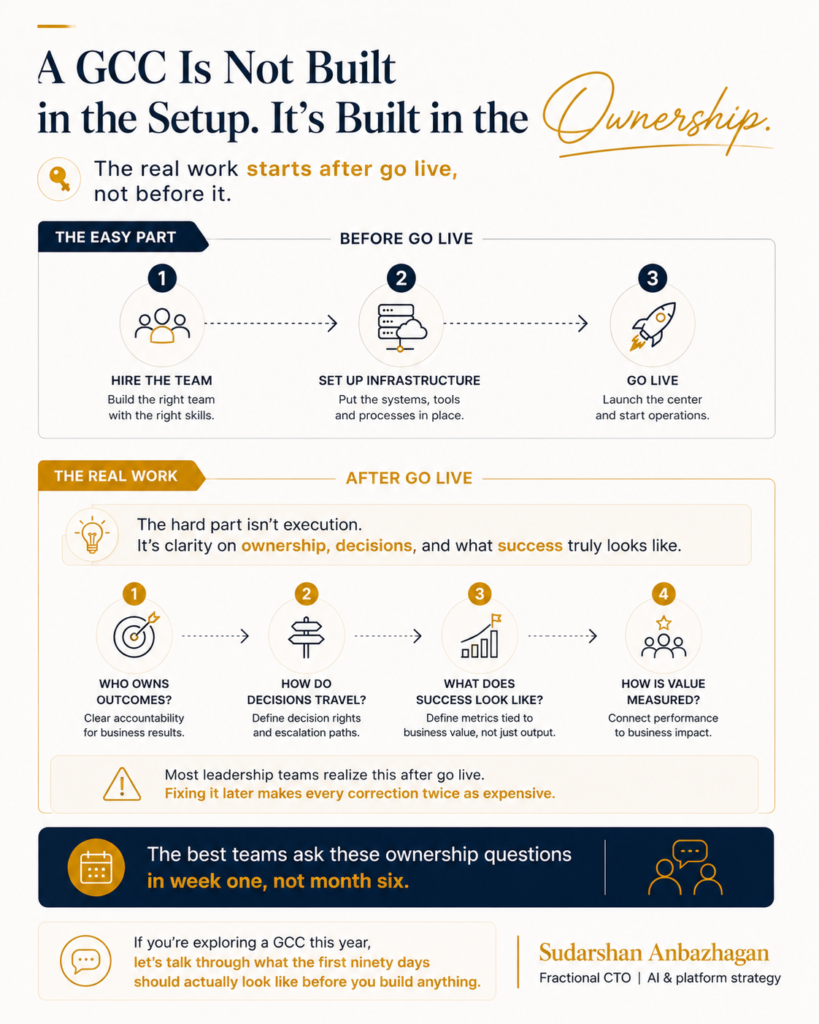

Every GCC setup I have been part of looked clean on paper before it looked real in practice. The plan reads well in a boardroom. Hire the team, stand up the infrastructure, go live on schedule, and report progress against a tidy set of milestones. Nobody objects to that version of the plan because nobody has lived through the version that actually unfolds once the center opens its doors.
What surprises leadership teams almost every time is that the real work of a GCC setup does not begin at go live. It begins after it. The infrastructure, the laptops, the office space, the onboarding schedule, all of that is the easy part and it gets treated with the seriousness it deserves because it is visible and it is measurable. What rarely gets the same attention is the set of questions that determine whether the center becomes something the business depends on, or something the business merely tolerates.
Why the First Ninety Days of GCC Setup Decide Everything That Follows
In my experience advising founders and CTOs across the US, UK, and Europe on GCC setup decisions, the first ninety days are where the center’s identity gets fixed, whether anyone intended it or not. Teams either establish who owns outcomes from day one, or they drift into a structure where the India team executes tasks that headquarters continues to think through on their behalf. Once that pattern sets in, it becomes remarkably difficult to reverse, because everyone on both sides has already adjusted their expectations around it.
The teams that get this right ask a very specific question before the first hire is even made. Who owns this outcome, not who owns this task. That distinction sounds subtle until you watch what happens in a leadership meeting six months later, when a technical question comes up and everyone in the room defers to whoever is dialed in from the India office, without anyone in that office having been given the authority to actually decide anything.
Ownership Before Infrastructure
Across the cross-geography engagements SuperBotics MultiTech has supported over the past several years, the sequence that works is almost always the same. Ownership gets defined before the org chart gets finalized. Decision rights get written down before the first sprint begins. Escalation paths get agreed before anyone actually needs to escalate anything. This ordering feels slower in week one. It saves months of confusion by week twelve.
The alternative, which I have also watched play out more times than I would like, is a center that hires fast, staffs up ahead of schedule, and looks impressive in a headcount report while nobody has actually agreed on who is accountable when a decision needs to be made quickly. That gap does not show up immediately. It shows up the first time something breaks and three people each assume someone else is handling it.
The Governance Question Every GCC Setup Plan Skips
Governance is the part of GCC setup that gets the least attention during planning and the most attention during the first real crisis. Most plans mention governance in a single slide, usually near the end of the deck, framed as something to figure out once the team is settled. That framing is backwards. Governance is not something you figure out once the team is settled. It is the thing that determines whether the team ever actually settles.
A center without a clear governance structure defaults to one of two failure modes. Either it waits for headquarters on every decision, which defeats the purpose of building a capability center in the first place, or it starts making calls it was never actually empowered to make, which creates friction that compounds every quarter it goes unaddressed. Both patterns are avoidable, and both are avoided the same way, by defining the governance model before the first person joins rather than after the first disagreement happens.
I have found that the clearest governance models answer three questions explicitly. What can the center decide without checking in. What requires a joint conversation before moving forward. What must always come back to headquarters regardless of how confident the center’s leadership feels about it. Writing these three categories down before launch removes an enormous amount of ambiguity that would otherwise get resolved informally, inconsistently, and often at the worst possible moment.
Measuring the Right Things From Day One
The second mistake I see repeatedly in GCC setup is a measurement problem disguised as a success story. Hours logged look strong. Tickets closed look strong. Utilization rates look strong. None of these numbers tell you whether the center is actually moving the business forward, and by the time leadership notices that gap, a full year of measurement habits has already calcified around the wrong signals.
Outcome metrics, the ones that connect the center’s daily work to results the business actually cares about, need to be agreed before operations begin, not invented retroactively at the first quarterly review when something already feels off. This is a harder conversation to have in week one than a staffing plan, because it forces leadership to articulate what success genuinely looks like rather than defaulting to activity as a proxy for progress.
The most expensive mistake in any GCC setup is not a slow hire or a missed deadline. It is a full year of measuring activity while assuming it reflects outcomes.
What Strong Outcome Metrics Actually Look Like
A useful outcome metric for a GCC setup connects directly to a business result that would matter to a customer or to the company’s revenue, not just to an internal process. For an engineering-focused center, that might mean tracking time from decision to shipped feature rather than tickets closed. For an operations-focused center, it might mean tracking how quickly a process exception gets resolved rather than how many exceptions get logged. The specific metric matters less than the discipline of choosing something that reflects value delivered rather than effort expended.
Building a GCC Setup That Becomes a Strategic Asset, Not Just a Cost Center
The centers that become genuine strategic assets by their second year share a common trait. They did not hire the fastest. They defined ownership, governance, and outcome measurement before the first person walked through the door. Structure built early creates speed later. Structure skipped early creates rework, and that rework always costs more the second time around because by then, habits and expectations have already formed on both sides.
This is not a theoretical concern. It shows up in how quickly decisions travel, in how much confidence headquarters has in the center’s judgment, and in whether the center is invited into strategic conversations or simply handed a backlog. If your GCC setup already feels like it is running but the outcomes have not caught up to the activity, the gap is rarely about the people involved. It is almost always about whether ownership was ever actually assigned in the first place.
Companies exploring a GCC setup for the first time often assume the hardest part will be finding the right talent in the market, and that concern is understandable given how competitive hiring has become across major technology hubs in India. But talent, in my experience, has never been the constraint. The constraint has consistently been whether leadership was willing to define, in writing, before operations began, what the center was actually being built to own. That single decision shapes everything that follows, and it is the one decision most plans skip entirely.
Thinking about GCC Setup? Visit sudarshananbazhagan.com to explore how Sudarshan can help.