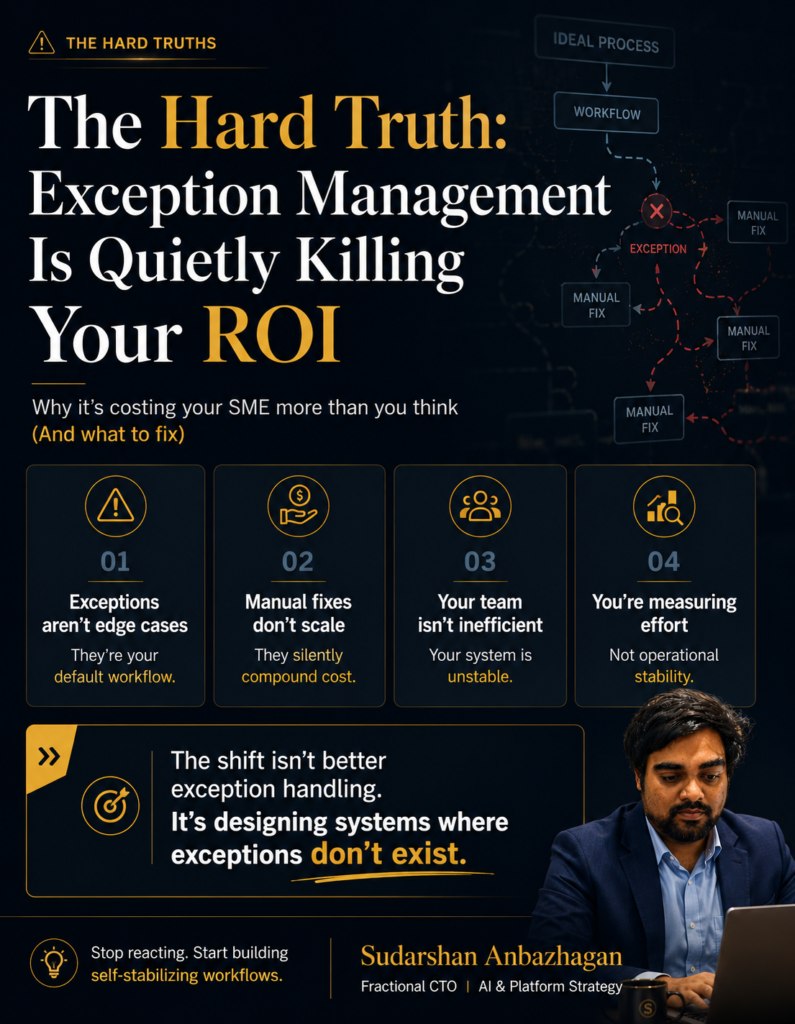

The Cost That Never Shows Up on the P&L
A CEO called me last year. Revenue was up. The team had expanded. New tools had been deployed across operations. Everything looked right on paper, he said, but margins kept shrinking and he could not identify why. I asked him one question: what percentage of his leadership team’s week was being spent on exceptions that had already occurred before? He went quiet for a long time. Then he said he had never measured that. That silence is exactly where the cost lives. Not in one visible line item on a budget report, but in hundreds of small, invisible costs that accumulate week after week across senior leaders, middle managers, and frontline teams. The hidden cost of process exception management in growing businesses is one of the most consistently underestimated threats to sustainable margin and long-term operational scalability. It does not announce itself. It compounds quietly until leadership can no longer explain why the numbers do not reflect the effort being invested.
After fifteen years of working with growing businesses across fourteen countries, the pattern I encounter most reliably is this: businesses that appear operationally healthy on the surface are often running on a foundation of exception management that is consuming far more senior capacity than anyone has calculated. The exceptions are closed quickly. The dashboards show resolution rates that look strong. But nobody is adding up the total cost of those exceptions across the entire organisation, including the escalation time, the decision delay, the context-switching, the re-work, and the downstream impact on customer commitments and data quality. When that full calculation is done, the number is almost always shocking to leadership. And it is almost always invisible on the P and L until it becomes a margin problem that nobody can explain with confidence.
Hard Truth One: Your Best People Are Your Most Expensive Exception Handlers
There is a deeply counterproductive dynamic at the heart of most exception-driven operations. The most senior, most experienced, most trusted people in the organisation are also the ones most regularly pulled into exception resolution. When an escalation hits, it travels up the chain until it reaches someone with the authority and the context to resolve it. That person is almost never a junior team member. It is almost always a senior operations leader, a department head, or in smaller businesses, the CEO or COO directly. Every time this happens, the cost is not just the time spent resolving that specific exception. It is the compounding cost of a senior leader operating in reactive mode rather than strategic mode, the decision delay created for everything else that required their attention, and the signal sent to the broader organisation that escalation is the accepted path to resolution. Multiply this across a week, a month, and a year, and the number becomes a meaningful explanation for why margins compress as organisations scale even when revenue continues to grow.
The fix for this is not to make senior leaders less available. It is to redesign the process so that the exceptions requiring senior escalation are fewer in number each month. That requires treating every recurring escalation as a design failure, not a capability failure. The question is not why the team did not handle this without escalation. The question is what in the current process design keeps producing exceptions that require senior intervention. When that question is asked consistently, with the same urgency usually reserved for individual exception resolution, the design conversation eventually produces a process that no longer depends on the most expensive people in the organisation to function at a basic level. That is what genuine operational efficiency looks like from a P and L perspective.
Hard Truth Two: Automation Makes This Worse Before It Gets Better
One of the most expensive mistakes I see growing businesses make is investing in powerful automation platforms on top of exception-driven processes without first redesigning the process itself. The intention is sound. The logic seems reasonable. If the team is spending hours managing manual exceptions, surely automating those workflows will reduce the burden and improve ROI. In practice, the result is almost always the opposite in the short term and often permanently. Technology scales what exists. If what exists is a process that depends on constant human intervention to manage recurring exceptions, technology does not eliminate that dependency. It makes it faster, more visible, and often more expensive. The exceptions that once took an hour to identify now surface in minutes. But they still require the same human judgement to resolve because the underlying process design that keeps producing them has not changed. The organisation has invested significantly in a platform that is now exposing its process problems more efficiently but not solving them.
The correct sequence, and it is non-negotiable in the engagements I lead, is to simplify and stabilise before automating. This means identifying the recurring exceptions first, mapping their root causes in the current process, redesigning the process to eliminate or reduce those root causes, and only then building automation on top of the stabilised design. This sequence takes longer in the planning phase. It requires more cross-functional conversation and more honest assessment of current state. But the organisations that follow it consistently achieve automation ROI that is measurable, sustainable, and visible on the P and L within two to three quarters of implementation. The organisations that skip it almost always return twelve months later with a faster version of the same problem and a significantly larger technology investment that has not yet delivered its intended return.
Hard Truth Three: Your Most Capable People Have No Incentive to Fix This
This is the hardest of the three truths to confront because it is the most structurally embedded. The team members who handle exceptions most brilliantly, who resolve escalations quickly and confidently, who keep the operation moving through every crisis, are often the reason the process never fundamentally improves. Their value is visible every single time something breaks. The organisation recognises them, relies on them, and rewards them for their responsiveness and capability in the moment. The value of preventing the same exceptions from appearing in the first place is invisible until prevention is already working. And prevention, by its nature, produces nothing visible. It produces absences. Fewer escalations this month. A shorter exception log. A team that is less frantic. These outcomes are real and significant, but they are extraordinarily difficult to attribute, celebrate, and reward in the way that a spectacular exception resolution can be attributed, celebrated, and rewarded in real time.
This is a leadership design problem. The incentive structure of most operations organisations actively discourages the work of process improvement because the current system rewards firefighting with visibility, recognition, and value. Changing that requires a deliberate leadership decision to make prevention as visible and as rewarded as resolution. This means tracking recurrence rates at the individual accountability level, not just overall. It means recognising and celebrating months where recurring exceptions decline, not just months where resolution speed increases. And it means protecting the time and authority required for team members to redesign the processes they work within every day. Without these structural changes, even the most motivated operations team will default to firefighting because the system they operate within leaves them no rational incentive to do anything else. Predictable operational ROI is not a people problem. It is a system design problem, and it starts with the incentive architecture that leadership builds and maintains.
What Changes When a Business Confronts These Truths Honestly
The organisations that do the work of addressing these three hard truths directly, consistently, and with the patience the work demands are the ones that build operations capable of scaling without proportional scaling of overhead, escalation cost, and senior leadership time. What the change looks like in practice is quiet and compounding rather than dramatic and immediate. In the first quarter, the exception log begins to get shorter as root causes are identified and process redesign begins to address them. In the second quarter, escalation frequency reduces noticeably and senior leaders begin to recover hours that were previously consumed by reactive exception handling. By the third quarter, the team has enough accumulated improvement that they can begin to take on more strategic work, not because the business has slowed down but because the operation has become genuinely more self-sufficient. That is what predictable operational ROI actually looks like, not a transformation deck and not a press release, but a quiet, compounding reduction in the problems that used to feel like the permanent cost of doing business.
The leaders I have seen build this most successfully share one common characteristic. They are willing to hold the uncomfortable conversation that these three hard truths require. They are willing to tell the organisation that resolution speed, while important, is not sufficient as a measure of operational health. They are willing to invest in the six-month process redesign work even when the short-term pressure to close exceptions quickly makes that investment feel irresponsible. And they are willing to change the incentive structure even when doing so creates short-term discomfort for the team members whose current value proposition depends on the exception-driven culture continuing as it is. That willingness is not common. But the leaders who hold it are the ones who eventually look back at an operation that has genuinely transformed, not through a single dramatic initiative, but through a sustained decision to ask better questions and hold the standard until the process had no choice but to improve.
If the pattern described in this article is visible in your organisation and you want a practical framework for beginning the work of addressing it, I would welcome the conversation. Connect with me on LinkedIn or read more at sudarshananbazhagan.com. The most expensive cost in your operation is most likely one you have not yet measured. Starting the measurement is the first step toward changing it.